🌸The Arrival of Spring
✍️Author’s Note
The Arrival of Spring is a reflection on renewal, memory, and the quiet persistence of life. Beginning with the first signs of spring on a balcony, the piece moves through poetry, painting, and personal recollection to consider how the season changes as we grow older. Spring appears here not only as a symbol of beginning, but also as a moment of recognition: of what returns, of what passes, and of what remains in memory. Beneath its gentleness lies a meditation on acceptance, transience, and the enduring grace of life’s recurring seasons.
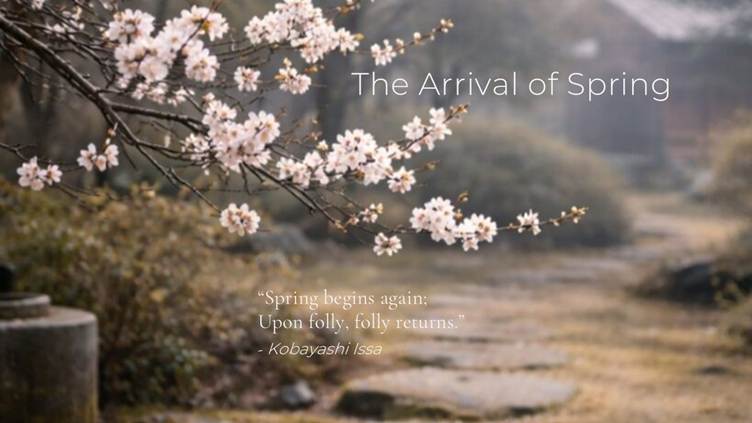
“Spring begins again;
Upon folly, folly returns.”
— Kobayashi Issa
Spring rarely arrives with ceremony. It announces itself quietly—sometimes as early as the end of January—when the first daffodils appear and the tulips begin their slow awakening from the winter soil. Nature never hurries, yet it never forgets its rhythm. And when it calls, it raises the gentle hope of another beginning.
This year the first signs appeared on my balcony, where daffodils and tulips began to stir beneath the pale winter light. Even the New Dawn roses, having endured the cold wind, seemed ready to return, as if nature itself were reminding us that persistence is woven into the fabric of life.
In spring, the world does not so much awaken as remember what it is. Light returns, warmth settles gradually into the soil, buds swell on the branches, and birds reclaim the air. Together these small changes form a quiet choreography, an ecological ballet shaped by the rhythm of the seasons.
For many, spring lives most vividly in poetry. It breathes through the lines of William Wordsworth, whose Lines Written in Early Spring and famous daffodils capture the season’s wonder with a simplicity that never loses its freshness. In painting too, spring has long been a symbol of renewal. Claude Monet, in Springtime, gave us light, blossoms, and human presence suspended in a moment of tender transience.
And yet spring is not only about beginnings.
As Alexander Pushkin once wrote, “Alas, my spring and summer passed now.” But Pushkin’s spring is not my spring. I have come to see the seasons differently—perhaps because I have become, in my own way, a man of all seasons.
Renewal no longer stirs longing in me so much as calm acceptance. I accept what life has offered, in both directions. Spring now resembles the tasting of wine: it draws out what is best, not only in the season, but in oneself, revealing a depth that only time can produce.
Perhaps the deeper truth is not that we blossom for our own joy, but that we blossom briefly, and that the joy remains in memory. What is fully lived leaves its trace.
When I think of spring, I also think of Charles Baudelaire:
“I shall see the springs, the summers, and the autumns slowly pass;
And when old Winter puts his blank face to the glass…”
There is in those lines both tenderness and inevitability. Paris, too, has always understood spring in its own way. The light returns along the Seine, cafés open their terraces, and the city seems to breathe again after winter’s grey restraint. Beauty becomes visible once more, and precisely because it is fleeting, it is all the more vivid.
The daffodils on the balcony rise each year without memory. We do not have that privilege.
When I think of spring, I also think of those gentle phantoms memory does not entirely release—traces of warmth, grace, and brightness that once passed through life and left their colour behind.
Spring, after all, is not only about beginnings. It is also about recognition: the quiet awareness that some seasons, and some presences, have left their colour behind.
And perhaps that is enough.
Spring rain—
Everything grows
more beautiful.
— Chiyo-ni
William J J Houtzager, Aka, WJJH, March, 2026
📌Blog Excerpt
Spring rarely arrives with ceremony. It announces itself quietly—sometimes as early as the end of January—when the first daffodils appear and the tulips begin their slow awakening from the winter soil. Nature never hurries, yet it never forgets its rhythm. And when it calls, it raises the gentle hope of another beginning.
 In what kind of world do we wish to live