Part III — Epilogue: Realistic Humanism in a Fractured World
✍️ Writer’s Note — Part III: Realistic Humanism
This final part is not a conclusion so much as a meditation. After eight decades I cannot claim to hold answers, only a perspective shaped by experience: less idealistic than in my youth, more cautious of power, yet still convinced that dignity is worth defending.
I call this stance realistic humanism: accepting that human rights are contested, selective, and fragile, but also that they remain the strongest language we have for resisting cruelty and preserving hope. To me, realism and humanism are not enemies but companions. Without realism, human rights drift into illusion; without humanism, they collapse into cynicism.
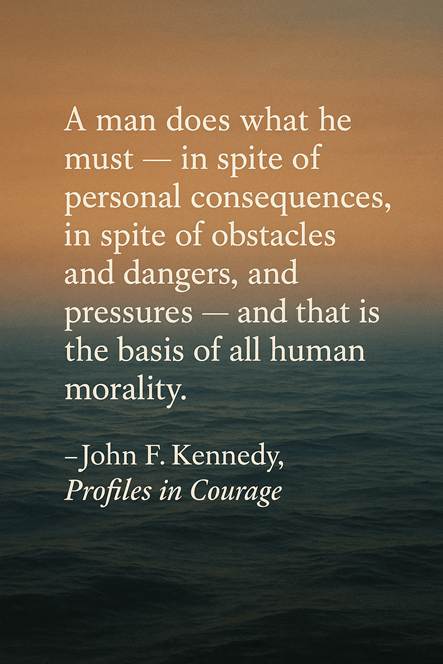
After eight decades of watching the world turn, I sometimes wonder whether I have become a cynical old man — one who sees the world as it is, not as I once wished it to be. Yet perhaps cynicism is not the right word. I would rather call it a more realistic humanism: less starry-eyed than when I first read John F. Kennedy’s Profiles in Courage or admired the idealism of the Peace Corps, but still holding to the belief that freedom and dignity are the highest of human aspirations.
This view is not built on visions of a perfect world achieved by ethical clarity or scientific truth. It grows instead from a humbler soil: the need to avoid returning to the darkest pages of history, the duty to face present problems honestly, and the responsibility to plant seeds for future generations whose shade we ourselves will never enjoy. We are links in a long chain; what we pass on — stories, values, institutions, even forests — helps determine the strength of that chain. That responsibility is weightier today, when our choices have consequences stretching far beyond our own time.
History has taught me that human rights, though noble in their wording, are never free from politics. They have always lived in the tension between inspiration and instrumentalization. The Universal Declaration of 1948 gave voice to humanity’s yearning to be free, yet during the Cold War rights were also wielded as weapons in the struggle for Western hegemony. What was proclaimed as universal often served as a selective tool to advance influence, power, and money.
I grew up learning to see two sides of every coin: ideals and consequences. From the Cuban Missile Crisis to the long delay of sanctions against Apartheid South Africa, from the quagmire of Vietnam to the invasion of Iraq, I witnessed how often rights were subordinated to interests. Iraq, in particular, marked a turning point: it discarded the principle of sovereignty established at the Congress of Vienna, leaving behind a tension that still fuels power struggles today. The conflict in Ukraine confirmed this logic: the dictates of security weighed heavier than the aspirations of principle, echoing Thucydides’ ancient warning that “the strong do what they can and the weak suffer what they must.”
The fall of the Berlin Wall remains one of the great events of my lifetime. There were opportunities to build a more inclusive world, but in our typical Western arrogance many were missed — and the consequences are still with us. I never believed Francis Fukuyama’s illusion of “The End of History.” Liberalism was not destined to triumph; history does not end, it cycles. What rises also falls. Rights, too, are caught in these cycles: used by states as instruments of legitimacy, yet remaining a beacon for those who resist.
In practice, human rights are not universal. They are applied with selectivity, shaped by power. For the crimes attributed to Vladimir Putin, the West swiftly agreed on a tribunal and rounds of sanctions. For Israel, despite grave accusations, hesitation prevails — because Israel belongs to “our” group. This double standard corrodes legitimacy more than any adversary can.
The institutions we built after 1945 — the United Nations, the ICC, the Bretton Woods system — have been invaluable, but they, too, are products of Western dominance. Today, in a multipolar world, their credibility demands reform. It is no surprise that many in Africa, South America, and Asia look with interest to the Chinese model, which emphasizes sovereignty, development, and non-interference. After five centuries of Western primacy, this reaction is natural.
If the river of rights is to keep flowing, we must pay attention to the scenery it runs through: an anarchic world where sovereignty and security weigh more heavily than principle, where hypocrisy clogs legitimacy, where sanctions often harm the innocent more than the guilty, and where double standards undermine the very norms we claim to defend.
What then does a realistic humanism ask of us?
- To defend a thin universal core of non-negotiable rights: life, freedom from torture and slavery, fair trial.
- To accept plural paths beyond this core, so long as they do not breach it.
- To apply principles consistently — even to our friends.
- To use coercive tools only with proportionality, clear objectives, and exit strategies.
- To respect sovereignty, but also remind governments of their duty to their people.
- To reform global institutions so that legitimacy matches today’s balance of power.
- To embrace dialogue not as concession but as necessity in a fractured order.
Human rights are neither a naïve universal nor a cynical charade. They are a contested common language. Their future depends not on preaching triumph but on practicing consistency, reform, and realism. Only then will the river of rights continue its journey — without washing away its own credibility.
“The arc of the moral universe is long, but it bends toward justice.”
— Martin Luther King Jr.
Final Coda: Many Rivers, One Sea
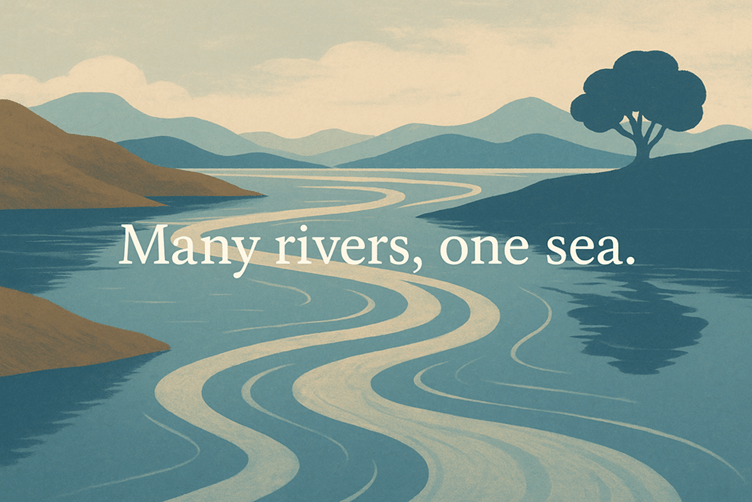
We often speak of the river of rights, as though there were only one course flowing through history. But in truth, there are many rivers. Each civilization has its own springs of dignity: the Western tradition of natural rights and liberty; the Confucian ethic of harmony and duty; the Islamic emphasis on justice and community; the African charter of rights and responsibilities; the Indigenous reverence for balance with the earth.
These rivers are not identical. Their waters run at different speeds, shaped by different landscapes, carrying different sediments. Sometimes they converge, sometimes they clash, sometimes they run parallel. Yet they share one destiny: to flow toward the same sea — the universal longing of human beings to live with dignity, free from fear and humiliation.
To recognize many rivers is not to weaken universality, but to strengthen it. It means understanding that the sea is fed by many sources, and that no one tradition owns the waters of humanity. Rights remain fragile currents, but they endure because they are renewed again and again by the contributions of many cultures.
If the metaphor holds, our task is clear: not to dam the rivers, nor to claim one as the only true course, but to keep them flowing, to allow their waters to meet, and to remember that it is in their confluence — not in their isolation — that humanity finds its horizon.
Many rivers, one sea.
🌐 Blog Description
The River of Rights: Epilogue — Realistic Humanism reflects on a lifetime of witnessing ideals and hypocrisies. It asks how rights can endure in a fractured, multipolar world, and argues for a realistic humanism: a thin universal core, consistent application, and the courage to reform.
 In what kind of world do we wish to live