Economic Sanctions: When the Ethical- and Human Costs Surpass the Benefits
✍️ Author’s Note
Economic sanctions are commonly presented as the humane alternative to military force: a means of exerting pressure without firing a shot. Yet their consequences rarely remain confined to governments, political leaders, or military institutions. They travel through currencies, hospitals, food supplies, employment and household incomes, reaching people who had no influence over the policies being punished.
This essay asks a simple but often neglected question: when sanctions fail to alter the conduct of those in power, who ultimately bears their cost? Sanctions may sometimes be justified and may impose genuine constraints, but economic damage should not automatically be mistaken for political success. Any policy pursued in the name of morality must also be judged by its human consequences.
—WJJH
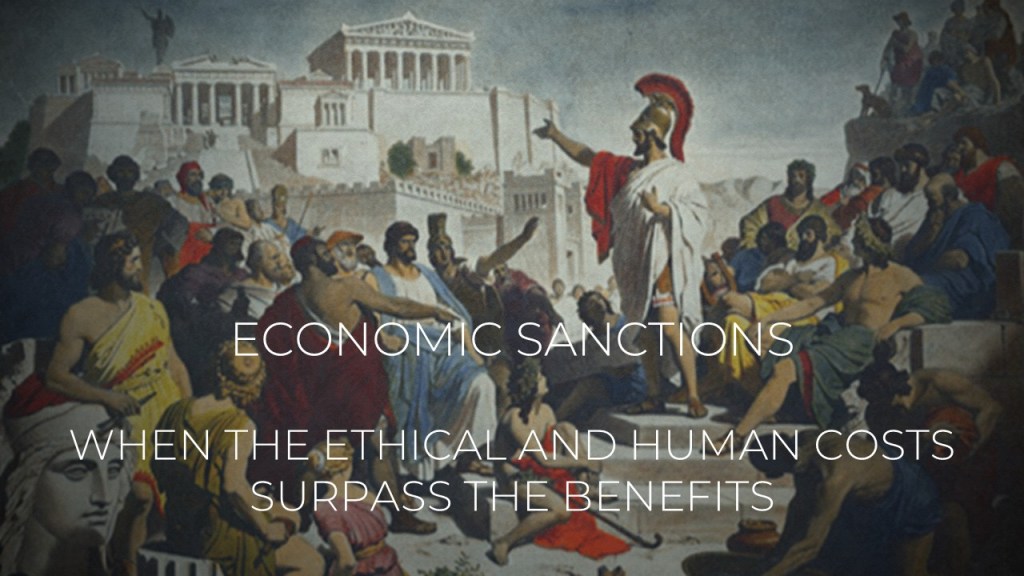
Philipp Foltz (c. 1805–1877)
“Sanctions are a blunt instrument.”
—Kofi Annan
For decades, and with increasing frequency since the end of the Cold War, the United States has employed economic sanctions as an instrument of foreign policy and as a moral justification for political objectives. What was once presented as an exceptional alternative to war has gradually become a routine response to international conflict, deeply embedded in the economic, political, and financial system.
The historical use of economic sanctions is not a novel concept in foreign policies. Thucydides and Plutarch document what is arguably the earliest recorded instance of economic sanctions in 432 BC—the “Megarian Decree,” embargoing trades between Megara and the Athenian empire. This Athenian retaliation for the Megarians’ treacherous behaviour may have contributed to prolonging and intensifying the Peloponnesian War (431-404 BC).
Contemporary sanctions, primarily employed by the U.S. and other developed nations, aim to pressure the leadership of transgressor nations into adhering to international law and ethical norms. As Carl von Clausewitz noted that war is the continuation of politics by other means, sanctions can be seen as the continuation of politics by economic means—an instrument perceived as more economical and preferable to military interventions.
However, sanctions have evolved into a form of political posturing, resonating well with a public influenced more by passion than reason. Despite their relatively low cost, sanctions, ranging from economic to diplomatic measures, may not provide universal answers to global issues, often proving counterproductive.
Sanctions, while attempting to crush economies and devalue currencies, inadvertently lead transgressor nations to adapt, engaging in illicit activities impacting essential supplies such as food, medicine, and sanitation, exacerbating hardships for their populations. The ethical and human costs of sanctions, particularly on vulnerable groups, like children, women, and other vulnerable groups, often outweigh their intended benefits.

Historically, sanctions have produced mixed and frequently disappointing results. Measures against Cuba, Iraq, Iran, North Korea, Russia, Syria and Venezuela have rarely secured their principal political objectives, while often imposing substantial costs upon ordinary citizens. In cases such as Rhodesia and apartheid South Africa, sanctions may have contributed to political change, but only alongside domestic resistance, diplomatic pressure, economic transformation and changing international circumstances.
However, when the intention is regime change, the logic of coercive sanctions does not hold, for the reason that the cost of relinquishing power will always exceed the benefit of sanction relief.
The U.S. has increasingly utilized sanctions as a foreign policy tool, especially since the Clinton era, aiming to promote American power and safeguard national interests. Recent sanctions against Russia, imposed by President Biden, have heightened geopolitical tensions, leading to economic repercussions on a global scale. However, the history of sanctions over the last six decades indicates a significant failure to instigate change due to growing interdependency between markets and countries.
Robert A. Pape’s influential study concluded that sanctions alone had succeeded in fewer than five per cent of the cases he examined. Although later scholars have disputed both his methodology and his narrow definition of success, the larger conclusion remains difficult to dismiss: sanctions rarely compel determined governments to surrender objectives they regard as essential to their security or political survival.
The pursuit of regime change through sanctions has often resulted in U.S. overreach, diminishing its influence and causing strains with European allies. The sanctions against Russia, in place since 2014, have not only been grossly ineffective in changing Russia’s behaviour but have also impacted global economies and led to closer ties between Russia and China, challenging the dominance of the U.S. led financial system. The sanctions highlight the divisions in the world, between industrialized nations supporting sanctions and neutral or non-aligned countries, including BRIC nations, resisting them.
The essential distinction is between economic damage and political achievement. Sanctions may reduce growth, restrict technology, weaken currencies and increase the cost of war without compelling a government to change its fundamental course. Economic pain is measurable; political success is much harder to demonstrate. When the objective, conditions for relief and route back to negotiation remain undefined, sanctions risk becoming permanent punishment rather than purposeful diplomacy.
In conclusion, the overuse of sanctions, coupled with a lack of relief, has diminished their effectiveness. Without restraint, diplomacy, compromise, and engagement, the world may witness an increase in military interventions and heightened political instability, underscoring the need for a nuanced approach to international relations.
January 2024
📌Blog Excerpt
On the US strategy of Economic Sanctions, as a foreign policy tool by the U.S., emphasizing its ineffective results and ethical implications. Despite being presented as a moral choice, sanctions often lead to adverse consequences for vulnerable populations and rarely achieve their objectives. The diminishing effectiveness and rising ethical and human costs necessitate a more nuanced approach to international relations.

