Chess Through the Ages: Strategy, Character and Civility
✍️ Author’s Note
Chess is often described as a game of strategy, but it is also a test of character. The board imposes rules, restraint, and silence; the player brings temperament, vanity, discipline, and grace.
This essay began as a more polemical reflection on the decline of manners in chess. On reconsideration, the argument seemed too simple. Chess has never belonged only to gentlemen, nor has its history been free of arrogance, bad temper, or poor conduct. What has changed is not necessarily human nature, but the scale and visibility of the game.
The internet has opened chess to millions, which is something to welcome. It has also made discourtesy easier to display. The old ideal nevertheless remains: that conflict can be intense without becoming uncivilised, and that defeat can be accepted without resentment or humiliation.
—WJJH
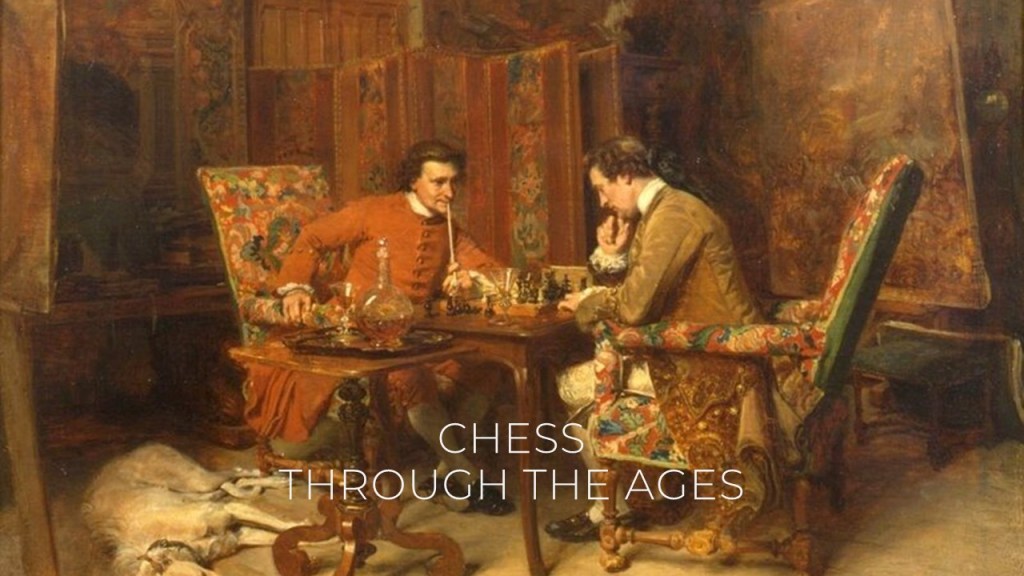
“Chess is the art of analysis.”
— Mikhail Botvinnik
Chess is an ancient game whose origins are generally traced to India nearly fifteen centuries ago. In A History of Chess: From Chaturanga to the Present Day, grandmaster Yuri Lvovich Averbakh describes its long journey from the Indian game of Chaturanga through Persia and the Arab world before it reached Europe.
Chaturanga, a Sanskrit name referring to the four divisions of an army, was more than a pastime. It reflected a world in which strategy, command, and preparation for conflict were essential concerns of rulers and military elites. From India, the game travelled to Sassanian Persia, where it became part of courtly life. Following the Arab conquest of Persia in the seventh century, it entered the Islamic world as Shatranj and developed a sophisticated culture of study, competition, and recognised masters.
Chess reached Europe during the Middle Ages, initially through royal courts, monasteries, and educated circles before gradually spreading more widely. In Russia, where it arrived under Byzantine and eastern influence, the Church at times condemned it alongside gambling and other supposed moral dangers. Its popularity nevertheless proved difficult to suppress. From Ivan the Terrible to Nicholas II, several Russian rulers were enthusiastic players.
This long association with courts, educated society, and military thought gave chess more than a reputation for intellectual difficulty. It also acquired an ideal of conduct. By the nineteenth century, chess had become not only a test of calculation and imagination but also, at least in principle, a performance of character.
The Etiquette of the Board
Chess has long been associated with honour, dignity, and restraint. The handshake before and after the game, the silence during play, the acceptance of defeat without complaint, and the analysis afterward all form part of its traditional code.
In that sense, chess resembles life. Victory reveals something about a person, but defeat often reveals more. The tension of the game creates a silent conversation between two opponents, an intellectual conflict conducted within agreed boundaries. Each player tries to overcome the other, yet both are expected to respect the rules and the person sitting across the board.
That is the ideal. It would be a mistake, however, to imagine that chess once enjoyed a golden age of flawless sportsmanship. It never did.
The game has always attracted powerful and difficult personalities. A few players—José Capablanca, Boris Spassky, Viswanathan Anand, and Levon Aronian among them—have appeared unusually gracious in victory and defeat. Many others have been more temperamental, combative, proud, or unable to accept disappointment quietly. Perhaps this is unsurprising. To reach the summit of chess requires an exceptional degree of ambition, confidence, discipline, and competitiveness—qualities that do not always produce a gentle disposition.
Bobby Fischer remains the most striking example. His brilliance was undeniable, but so were his arrogance, suspicion, and frequently discourteous behaviour. During the 1972 world championship match in Reykjavik, his demands and absences placed enormous strain on the organisers and on Spassky. Yet that same match helped create a worldwide chess boom during the Cold War.
Chess was therefore never a gentlemen’s game because only gentlemen played it. It was a gentlemen’s game because it held up an ideal of conduct to which some players rose and others did not.
From the Romantic Era to the Algorithm
Chess has passed through several recognisable eras. The Romantic school celebrated daring attacks, sacrifice, and imagination. The classical masters placed greater emphasis on position, structure, and long-term planning. Modern chess absorbed both traditions and subjected them to increasingly rigorous analysis.
The arrival of computers, and later artificial intelligence, transformed the game more profoundly than any previous development. Openings could be examined to extraordinary depth. Positions once considered mysterious could be evaluated in seconds. Players gained access to knowledge that earlier generations could only have accumulated through years of study.
This has unquestionably raised the technical level of chess. It has also changed its character.
Some believe that computer preparation has narrowed the game, making elite chess more theoretical and reducing the room for spontaneity. Others argue that technology has expanded human understanding and allowed players to reach levels that earlier masters could not have imagined.
Both views contain some truth. Modern players are stronger, better prepared, and more accurate. Yet there is also a danger that the game becomes an exercise in recalling what the machine has already discovered.
At the same time, online chess has opened the game to millions of people. Anyone with an internet connection can play at almost any hour against an opponent on the other side of the world. This democratisation is, on balance, something to welcome.
It has also made poor behaviour easier and more visible.
Anonymity removes many of the social restraints that once accompanied face-to-face play. An opponent may abandon a game without resigning, insult another player, accuse them of cheating, or behave in ways they would probably avoid across a physical board. Chess has not escaped the broader coarsening of public conversation.
But has the game itself become less civilised?
Perhaps not. Chess may not attract fewer gentlemen than it once did. What has changed is the scale on which the game is played and the visibility of those who do not live up to its traditions.
The courteous and the discourteous have always been present. The internet has merely placed them before a much larger audience.
The Mirror of the Board
Chess remains a mirror of society.
The board is unchanged. The pieces still move according to the same rules. The conflict still demands discipline, imagination, patience, and restraint. What changes is the person who sits down to play.
Some players bring generosity and composure. Others bring vanity, aggression, suspicion, or an inability to accept defeat. Most of us probably bring a mixture of both.
The internet has widened the mirror, but it has not changed what stands before it. It has made the gracious more visible, the graceless more audible, and the old ideal of civility more difficult to ignore.
That ideal still matters.
Chess teaches that conflict need not become chaos, that rivalry need not destroy respect, and that defeat can be accepted without humiliation. These lessons are not always followed, either on the board or beyond it.
But the fact that people fail to live up to an ideal does not make the ideal less valuable. It may make it more necessary.
The final paragraph now carries the polemic more quietly: it does not claim that civilisation has disappeared, but it does insist that standards remain worth defending.
Certainly. I would keep the supporting elements restrained, in keeping with the revised tone.
May 2021. Modified August 2026
📌Blog Excerpt
Chess has travelled across cultures and centuries, carrying with it an ideal of strategy, discipline, and civility. Yet the game has never been free of arrogance, bad temper, or graceless defeat. Has modern chess become less courteous, or has the internet merely made human behaviour more visible?


One thought