Reflections: The American Paradox
✍️Writer’s Note
America’s strength has always rested on a contradiction — liberty and domination intertwined.
This essay explores how a nation born of freedom continues to wrestle with empire, and why moral renewal begins with honesty.
— WJJH
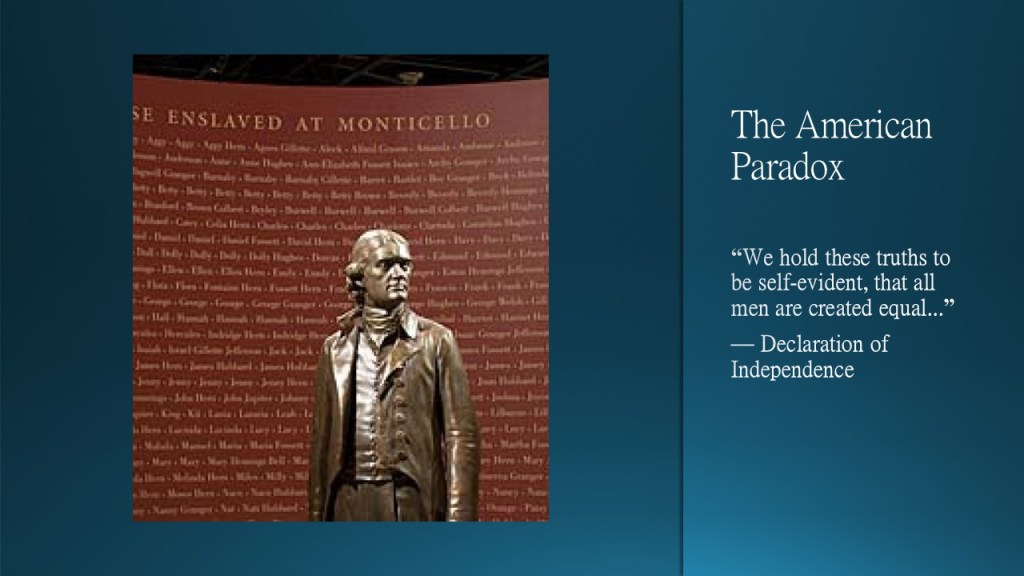
The American Paradox: Liberty and Slavery
From the nation’s inception, the American experiment has been marked by a striking paradox: the coexistence of Enlightenment ideals of liberty and equality with the brutal reality of slavery. Historian Edmund Morgan famously highlighted this contradiction, noting that some of the very figures who advocated freedom and human rights — including George Washington and Thomas Jefferson — were themselves slaveholders.
These leaders championed liberty, but their conception of freedom remained largely restricted to white men, while African Americans and others were excluded from those ideals. The rise of liberty from the seventeenth to the nineteenth century thus existed alongside the expansion of slavery, a system deeply embedded in America’s economic development.
Slavery was integral to the production of crops such as tobacco and cotton, which fuelled domestic prosperity and international trade. The Founding Fathers could proclaim the virtues of freedom while maintaining an oppressive system of forced labour partly because powerful economic interests depended upon it. This moral inconsistency became part of the American inheritance and continues to cast its shadow over the nation.
The Role of Civil Religion and Manifest Destiny
Despite the First Amendment’s prohibition on an established religion, the United States has long been a deeply religious society. The term civil religion has been used to describe a form of national faith built around American institutions, symbols, history, and ideals.
America, as a “creedal” society, is unified by principles embedded in foundational texts such as the Declaration of Independence and the Constitution. These documents — and the figures associated with them — acquired an almost sacred status, turning Washington and Jefferson into mythical Founding Fathers and the nation’s principles into something approaching articles of faith.
Abraham Lincoln reinforced this conception during the greatest crisis in American history. Confronted by civil war and slavery, he appealed to the nation’s founding ideals and to the possibility that America might yet fulfil them. The contradiction remained unmistakable: a country devoted to liberty was forced to confront the institution that most clearly denied it.
The doctrine of Manifest Destiny added another dimension to the American paradox. Together with the Monroe Doctrine of 1823, which opposed renewed European colonisation or interference in the Western Hemisphere, it contributed to a political culture that increasingly justified territorial expansion and a wider American role.
By the beginning of the twentieth century, Theodore Roosevelt had thrust the United States decisively onto the world stage as a significant actor in international power politics. He combined a belief in American national interests with a conviction that the United States possessed a broader civilising mission.
That outlook resembled contemporary European imperial thinking, famously expressed in Rudyard Kipling’s The White Man’s Burden. American involvement in Latin America, the Caribbean, and the Philippines frequently combined strategic and commercial interests with claims of benevolent purpose.
Woodrow Wilson later gave the American mission a different vocabulary when he spoke of making the world “safe for democracy.” Franklin D. Roosevelt appealed to another version of American purpose during the struggle against fascism in the Second World War. Different circumstances produced different policies, but the conviction that America carried responsibilities extending beyond its borders remained remarkably durable.
That belief persisted into the twenty-first century. George W. Bush’s intervention in Iraq was explicitly connected to the spread of democracy. Joe Biden, under very different circumstances, again framed international politics as a struggle in which the United States had a particular responsibility to defend democratic societies, including through its support for Ukraine.
The policies should not be treated as equivalent. Yet beneath them can be heard a recurring American conviction: that the United States has a particular responsibility to defend liberty beyond its own borders. At its best, that conviction has encouraged generosity and international leadership. At its worst, it has encouraged hubris.
Persistent Contradictions in Modern Society
The paradox extends beyond the history of slavery and empire.
The continued use of capital punishment and the absence of effective gun control remain striking examples of tension between American ideals and American realities. A nation that places great emphasis on individual liberty and the sanctity of life continues to struggle with gun violence and retains the death penalty in many jurisdictions.
The American paradox therefore raises a broader question: how does a society committed to freedom reconcile itself with practices that appear to contradict its professed values?
The difficulty is hardly unique to America. All nations live to some degree with the distance between principle and practice. But countries that claim a wider moral mission assume a correspondingly greater burden to examine that distance honestly.
The challenge is therefore not that America has contradictions. Every society does. It is whether the United States can acknowledge its own with sufficient humility to prevent national confidence from becoming national hubris.
Missed Post-Cold War Opportunities and Strategic Failures
During the 1980s, Mikhail Gorbachev profoundly changed both the Soviet Union and the international order through glasnost and perestroika. His reforms opened Soviet society, reduced Cold War tensions, and helped create the circumstances in which Eastern Europe regained its freedom.
The collapse of the Soviet system offered the United States and Europe an extraordinary opportunity to reconsider the security architecture that had divided the continent for almost half a century.
The antagonistic roots of American-Soviet relations reached back to the doctrine of containment articulated by George F. Kennan in 1946 and 1947. Kennan argued for patient but firm resistance to Soviet expansion, primarily through political, economic, and strategic means. He later became increasingly critical of the militarised form that containment assumed and of the permanent structures created by the Cold War.
Kennan also recognised the difficulty of dismantling a military-industrial establishment once it had become deeply embedded in political and economic life. Even the disappearance of the Soviet adversary, he suggested, would not automatically bring demilitarisation.
The years between 1989 and 1991 nevertheless demonstrated that cooperation was possible. George H.W. Bush and Gorbachev managed the end of the Cold War with considerable restraint, while the Strategic Arms Reduction Treaty marked an important step towards reducing the nuclear confrontation.
Gorbachev — a decent man in a political culture where decency could easily be mistaken for weakness — played an indispensable role in allowing the peaceful liberation of Eastern Europe and the dissolution of the Soviet empire.
Events soon overtook him. After the failed Soviet coup of 1991, Boris Yeltsin became the first president of the Russian Federation.
The Yeltsin years were marked by political upheaval, economic disruption, the accumulation of enormous wealth by a small group of insiders, and widespread public disillusionment. The collapse of the Soviet Union also created psychological wounds that should not be underestimated. Millions of Russians experienced not liberation but national humiliation and loss.
None of this made Russia’s subsequent authoritarian development inevitable, nor did it deprive Russian leaders of responsibility for their own choices. But the political environment in which those choices were made also reflected decisions taken in Washington and European capitals.
The West made genuine attempts to integrate Russia into international institutions and the global economy, but it never succeeded in creating an enduring security relationship in which Russia felt itself an accepted participant rather than a defeated peripheral power.
At the same time, the newly liberated states of Central and Eastern Europe had their own histories, fears, and agency. Their desire to join NATO cannot simply be reduced to American expansionism. Decades of Soviet domination gave countries such as Poland, Hungary, and the Czech Republic understandable reasons to seek Western security guarantees.
The dilemma was therefore real: how could Europe reassure those states without recreating a permanent confrontation with Russia?
The first post-Cold War enlargement of NATO became effective in 1999, when Poland, Hungary, and the Czech Republic joined the Alliance. It provided security to countries that actively sought membership, but it also altered the strategic relationship with Moscow.
The opportunity for a more inclusive European security arrangement gradually narrowed.
Meanwhile, the European Union embarked on its own ambitious enlargement after Maastricht. Expansion helped consolidate democracy and prosperity across much of Central and Eastern Europe. Yet enlargement also came at a price: widening often took precedence over deepening.
Zbigniew Brzezinski recognised that an enlarged Europe could simultaneously extend Western influence while making the emergence of a politically unified Europe capable of independent strategic action more difficult.
A different approach might have been a more explicit two-speed Europe, allowing a core group to proceed towards deeper political, fiscal, and defence integration while newer members joined other parts of the European project more gradually.
Instead, Europe enlarged without completing its political architecture.
The consequences remain visible. Differences over judicial independence, media freedom, migration, foreign policy, and the meaning of European sovereignty continue to complicate integration. Europe also remains heavily dependent upon the United States for its defence and for significant elements of its foreign policy.
After Gorbachev and Yeltsin, Vladimir Putin emerged initially as a pragmatic leader but developed an increasingly authoritarian system. His government progressively restricted domestic political freedom, while Russia adopted a more confrontational foreign policy.
Western policy contributed to the environment in which Russian resentment developed, but Russia made choices of its own.
The United States also made consequential choices.
The George W. Bush administration’s wars in Afghanistan and particularly Iraq damaged confidence in American judgment and weakened international institutions. At the NATO summit in Bucharest in 2008, the declaration that Ukraine and Georgia “will become members of NATO” crossed what Moscow had repeatedly described as a critical security threshold.
Russia’s subsequent actions in Georgia and later Ukraine were Russian decisions and remain Russia’s responsibility. But strategy requires more than assigning responsibility after events have occurred. It requires asking whether foreseeable reactions were adequately considered beforehand.
George F. Kennan had already warned in 1997 that NATO enlargement risked strengthening nationalist and anti-Western tendencies in Russia and recreating the atmosphere of the Cold War.
His warning did not mean that Russian aggression was inevitable, nor that Moscow possessed a veto over the sovereignty of its neighbours. It did mean that the security of one part of Europe could not indefinitely be considered in isolation from perceptions of insecurity elsewhere.
The failure of the post-Cold War period was therefore not the responsibility of one capital alone. Washington mistook its unipolar moment for something more permanent; Moscow increasingly answered weakness with authoritarianism and later force; Europe enlarged without acquiring the political cohesion necessary to become a strategic power in its own right.
A rare historical opportunity was gradually lost.
Present-Day Divides: The Costs of Primacy and Military Overreach
The doctrine of American primacy draws upon a long tradition of thinking about power, deterrence, and international order. Its modern defenders argue that overwhelming American power discourages challenges and thereby contributes to global stability.
There is substance to that argument. American power helped create and defend an international system from which many countries benefited.
But primacy also carries costs.
From Vietnam to Iraq and Afghanistan, military commitments have periodically exposed a widening gap between the ambitions of American foreign policy and the willingness or ability of American society to sustain them.
Ukraine represents a different kind of conflict: Russia initiated the war, while the United States and its allies have supported Ukraine without directly entering the war against Russia. Yet even here the broader question remains: how far can international commitments expand before strategy requires clearer distinctions between the desirable and the essential?
Since the social upheavals surrounding Vietnam, the United States has simultaneously confronted widening inequality, deteriorating infrastructure, political polarisation, and distrust in public institutions. Foreign commitments did not create all of these problems, but neither can their financial and political costs be regarded as irrelevant.
The United States faces serious structural challenges in education, immigration, infrastructure, gun violence, incarceration, healthcare, and the social safety net. These coexist with a large and rising national debt and enormous continuing defence commitments.
The disconnect between the aspirations of American leadership and the lived experience of many citizens has consequently widened. Parts of the population feel economically insecure, politically unheard, or culturally displaced.
Populism feeds upon that disconnection.
For some Americans, “America First” is not primarily a theory of international relations. It is an expression of the belief that resources and political attention have been directed elsewhere while problems at home have accumulated.
History offers many examples of great powers discovering that external commitments and domestic strength cannot indefinitely be separated. America is unlikely to be an exception.
The question is therefore not whether the United States should abandon international leadership. Withdrawal would create problems of its own.
The more important question is whether American leadership can be sustained without weakening the domestic foundations on which that leadership ultimately depends.
The assumption that U.S. primacy is both indefinitely desirable and indefinitely achievable has become increasingly difficult to maintain in a world where economic, technological, military, and political power is more widely dispersed.
Leadership will consequently have to rely increasingly upon persuasion.
Former Secretary of State James Baker put the point well when he observed that effective American leadership depends upon understanding the objectives, arguments, and necessary trade-offs of prospective partners.
That is not weakness. It is diplomacy.
Conclusion: Rethinking Global Leadership
The American paradox is therefore not merely historical.
A country founded upon extraordinary ideals remains confronted by the distance between those ideals and the exercise of power — at home and abroad.
The United States faces a world very different from the unipolar moment that followed the Cold War. China has emerged as a peer economic and increasingly technological competitor. Russia, though economically much smaller, remains a major military and nuclear power. Regional states possess greater autonomy, and countries across Asia, Africa, Latin America, and the Middle East are increasingly unwilling to organise their foreign policies around Western preferences alone.
This diffusion of power need not be welcomed or condemned. It must first be understood.
Framing international politics primarily as a struggle between democracy and autocracy risks reducing a complicated world to a moral binary. Values matter. So do interests, geography, history, culture, and power.
Russia’s invasion of Ukraine and the wars and instability of the Middle East have demonstrated both the necessity and the limits of military power. Afghanistan, Iraq, and Libya similarly remind us that removing a regime is easier than constructing the political order that follows it.
Realism need not mean abandoning principle. Nor should respect for different histories become an excuse for repression or aggression.
It means recognising that a sustainable foreign policy must balance moral aspiration with prudence.
The United States itself has long lived with spheres of influence even while formally rejecting the concept. The Monroe Doctrine is perhaps the most obvious historical example. Other great powers inevitably view their immediate strategic environments through similar lenses, whether Washington approves of them or not.
Recognising such realities does not require accepting every claim made in their name.
It requires understanding the world as it exists before attempting to change it.
The unipolar moment has passed. American leadership therefore needs a different vocabulary: less hegemony, more partnership; less missionary certainty, more diplomacy; less assumption of obedience, more persuasion.
Perhaps primus inter pares — first among equals — provides a useful starting point.
The United States would remain an extraordinarily powerful country, probably the single most influential member of the international system. But leadership would increasingly mean accepting shared responsibility, building coalitions, respecting international law, and recognising that other nations possess legitimate interests and perspectives of their own.
Such a change would demand political maturity both inside and outside the United States, and there is little guarantee that such maturity presently exists.
Yet the alternatives are not attractive.
Humanity faces problems that no great power can solve alone: climate change, pandemics, artificial intelligence, nuclear proliferation, resource scarcity, and technological disruption. These challenges do not respect ideological or national boundaries.
International institutions will therefore have to adapt as power changes. The United Nations, created in 1945, inevitably reflects the distribution of power at the end of the Second World War. Its Security Council veto simultaneously recognises geopolitical reality and frequently paralyses collective action.
Reform will be exceptionally difficult, because those possessing power rarely volunteer to surrender it.
Nevertheless, an international order that claims universality cannot indefinitely appear to serve primarily the interests of the states that originally designed it.
America’s greatest contribution to such an order may therefore not lie in preserving unquestioned primacy.
It may lie in something more difficult: demonstrating that great power can coexist with restraint.
The United States has repeatedly proclaimed liberty, equality, democracy, and human dignity as universal values. Its influence will ultimately depend less upon proclaiming those values than upon the degree to which its own conduct reflects them.
The American paradox cannot be eliminated.
But it can be recognised.
And recognition is where humility begins.
November 2024
📌 Blog Excerpt
The American Paradox illustrates the tension between ideals of liberty and the historical reality of slavery and imperialism, from founding figures to contemporary foreign policy. The U.S. struggles with moral inconsistencies, questioning its global leadership amidst societal division, military overreach, and pressing domestic issues that require urgent resolution and a shift towards cooperative international relations.


Good summary og US history and where se are today. Future looks uncertain and hard to predict.
LikeLiked by 1 person
Much appreciated for your kind comment. When growing up I was blessed with a excellent history teacher who taught us to look at the connection and the past can teach of much about understanding today and the future. Time will tell, but I am not optimistic about the former and future guy, as he already showed who he is.
LikeLike