Rabindranath Tagore — The Wider Human World
✍️ Author’s Note
An Indian friend first introduced me to Rabindranath Tagore through Gitanjali. On New Year’s Day 2006 she gave me Mira Bai and her padas, and later another very different Indian voice, Sri Nisargadatta Maharaj, through I Am That, a book her father had treasured as well.
At the time, these were thoughtful gifts from a good friend, and they held great meaning, as they still do. I was interested, certainly, but I now realise that I was not yet fully open to everything they might contain. That came later. Some books seem to wait quietly until experience has made us ready to see more in them.
They are a little like paintings to which we return. The painting itself has not changed, but our perception of it has. With distance, colours, relationships, shadows and details become visible that were always there, but which we were not yet able to see. Understanding matures because we have changed — through time, experience, loss, reading and memory.
Tagore stayed with me.
Not because I became a student of Indian philosophy, nor because I suddenly understood a civilisation far removed from my own. Quite the opposite. He reminded me how little we understand when we look at another culture only through the windows of our own.
Perhaps that is where this reflection should begin.
—WJJH
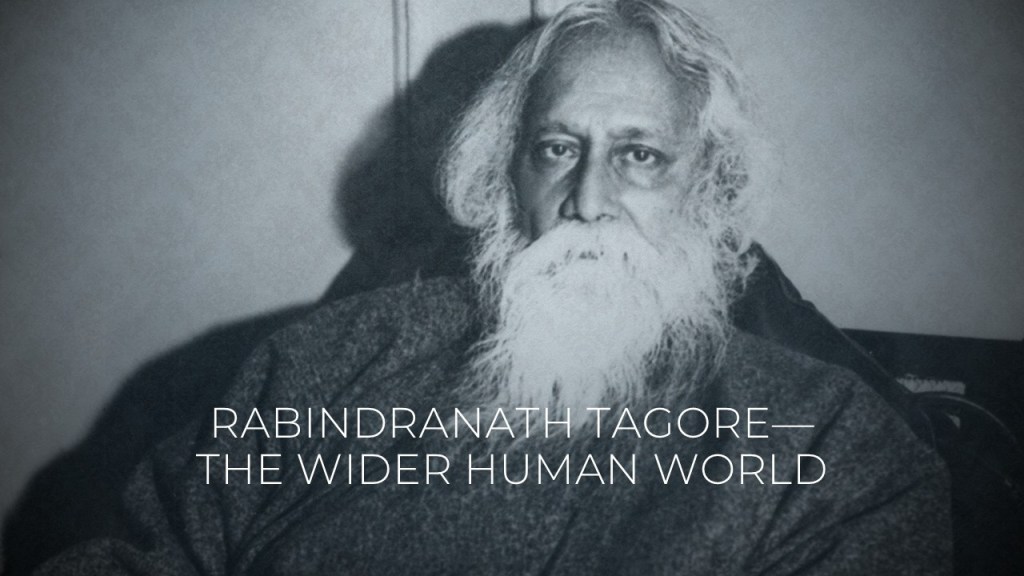
A Door Opens
Growing up in Europe, history had an understandable geography. Greece and Rome stood somewhere near the beginning; Christianity, the Renaissance, the Enlightenment and the modern European state followed. Other civilisations appeared, certainly, but often at the edges of the narrative — encountered through trade, war, empire or exploration.
The older I became, the less satisfactory that map seemed.
Will and Ariel Durant helped enlarge it. So did books about China, Persia, Islam and India. Civilisation, after all, has never belonged to a single continent, religion or people. Ideas travelled long before we invented the terminology of globalisation.
Tagore belonged naturally to that widening landscape.
Born in Bengal in 1861, he became poet, novelist, composer, painter, educator and philosopher. In 1913, Gitanjali helped make him the first non-European recipient of the Nobel Prize in Literature. But biography and prizes tell us surprisingly little about why someone continues to matter.
What interests me more is the world he tried to imagine.
It was a world in which one could belong somewhere without believing that one’s own place represented the summit of civilisation. One could love one’s country without worshipping the nation. One could inherit a tradition without becoming its prisoner. And one could encounter another civilisation without either imitating it or dismissing it.
Those distinctions have not become less important with time.
Loving a Country Without Worshipping It
Tagore loved India. That makes his criticism of nationalism more interesting, not less.
He lived under British colonial rule and was hardly indifferent to the humiliation and injustice that accompanied it. Yet he distrusted the transformation of patriotism into an ideology in which the nation became an end in itself.
In his lectures on nationalism, he distinguished human society from what he saw as the increasingly mechanical organisation of political and economic power. He feared that when the nation became an object of worship, human beings could begin to surrender moral responsibility to an abstraction.
His criticism was therefore not a rejection of belonging. It was a warning about what belonging can become.
We need communities. We inherit languages, memories, landscapes and traditions. They help make us who we are. Tagore did not ask people to become rootless citizens of nowhere.
But roots are not walls.
A country can be loved without declaring others inferior. A civilisation can be valued without claiming ownership of civilisation itself. And loyalty to one’s own community need not require indifference to those outside it.
Tagore distrusted the moment when the collective began to demand precisely that.
His concern was ultimately human rather than geopolitical: what happens to the individual conscience when an organisation claims a higher moral authority simply because it calls itself the nation?
The question remains inconveniently alive.
The School Beneath the Trees
Tagore did more than write about these ideas. At Santiniketan he tried to give them physical form.
He founded a school there in 1901, partly in conscious reaction against an educational system he regarded as mechanical, confined and detached from life. Classes were held beneath the trees. Music, painting, drama and craft stood beside more conventional subjects. Learning was meant to engage the senses and imagination as well as the intellect.
Education, in Tagore’s view, was not simply the accumulation of knowledge but the cultivation of a human being.
The open-air classroom was not merely picturesque. It expressed a philosophy: education should not separate the child from nature, creativity or the surrounding community. Tagore distrusted systems that produced examination results while narrowing curiosity.
From this school grew Visva-Bharati, formally founded in 1921. Its ambition reached beyond educational reform. Tagore wanted to create a place where cultures could meet without one having to surrender to another. Indian traditions, other Asian traditions and Western thought were to encounter one another through study, conversation and intellectual exchange.
Santiniketan was more than a school. It was Tagore’s vision of the world translated into practice: a place where education, nature, art and the meeting of cultures were meant to coexist rather than remain separate ideals.
Here his philosophy became practical.
It is easy to advocate mutual understanding in the abstract. Tagore tried to build an institution in which it might actually occur.
His experiment extended beyond Santiniketan. At nearby Sriniketan he supported rural reconstruction and forms of education intended to help village communities develop their own capacities rather than simply receive solutions imposed from above.
This makes Santiniketan more than an attractive episode in Tagore’s biography. It reveals a consistent idea running through his work: education should enlarge human possibility rather than standardise it; cultures should encounter rather than exclude one another; and knowledge should remain connected to life.
In 2023, Santiniketan was inscribed on UNESCO’s World Heritage List. More than a century after Tagore founded his school beneath the trees, the place is recognised not merely for its buildings or landscape, but for the ideas embodied there: humanism, education, internationalism and the meeting of cultures. Whatever changes institutions undergo over time, that recognition confirms the lasting cultural significance of Tagore’s experiment.
Perhaps genuine education always carries a certain risk. We may begin by teaching someone what we know and end by helping them discover a world larger than our own.
East and West
There is a temptation when writing about Tagore to turn him into the wise man from the East, brought forward to correct the materialism of the West.
That does him little justice.
Tagore was too curious for such a division. He admired elements of European thought while criticising others. He drew deeply from Indian traditions without treating everything Indian as sacred simply because it was Indian.
He was interested in encounter, not in cultural surrender.
Tagore did not ask India to become Western, nor did he imagine that India should protect itself by retreating into an idealised past. He believed cultures could meet, challenge one another and enlarge one another without becoming identical.
Civilisations, like individuals, rarely improve by spending all their time admiring themselves in the mirror. We often discover something about ourselves only when confronted by people who have inherited different assumptions.
For Tagore, that encounter was not a threat to identity but one of the ways identity could deepen.
There is a difference between losing oneself and discovering that the self was larger than one supposed.
The Poet Returns
After Santiniketan, nationalism, civilisation and the meeting of East and West, it is tempting to leave Tagore among the large ideas.
But I first met him through poetry.
That matters, because Gitanjali contains the quieter side of the same vision. The poems speak of love, mortality, surrender, nature, the divine and the mystery of existence. They are spiritual without demanding doctrinal agreement, and intimate without becoming narrow.
Perhaps that is why they endure.
We know life is finite, yet beauty still affects us. A lotus opens and closes. A rose fades. The scent of perfume disappears almost as soon as we notice it. Permanence is promised to none of it, and still we stop, look, remember and are moved.
Why?
There may be no final answer. Perhaps that is part of the point. We continue to ask questions that resist completion: what gives beauty its hold over us, what remains when a moment has passed, why love matters when loss is inevitable, and what meaning can be found in a life we know will end.
Tagore does not resolve these questions.
He gives them room.
And perhaps that is what some poetry does at its best: it does not close the door with an answer, but leaves it open long enough for us to keep looking.
Perhaps impermanence is not merely what threatens meaning. Perhaps it is also what gives meaning its intensity. A rose that never faded might no longer move us in quite the same way.
I did not fully understand that when the book first came into my hands. Some books seem to wait quietly until experience has made us ready to see more in them.
Gitanjali was one of those books.
📌Publishing Note:
Originally published in December 2024. Revised and substantially expanded in September 2026.
📌Blog Excerpt
A personal rediscovery of Rabindranath Tagore — from Gitanjali and Santiniketan to nationalism, civilisation, education, impermanence, and the wider human world.

