Books That Left Their Mark
List three books that have had an impact on you. Why?
✍️Author’s Note
This reflection is part of an ongoing series of personal musings sparked by morning prompts and lifelong questions. As always, these thoughts are not final truths but fragments of a larger conversation—one between self, society, and the written word. I welcome your own book recommendations or stories of how a book left its mark on you. Let’s keep the dialogue alive.
This morning’s prompt posed an interesting question: Name three books that had an impact on you. Three is, of course, an arbitrary limit—many books have shaped my thoughts and interests. “Impacted” might not be the right word, but these books certainly left a lasting impression
During my school years, I often turned to my father’s richly stocked Russian library for inspiration. It became a treasured source of intellectual discovery. Among my favourite authors were Gogol, Pushkin, Turgenev, and Chekhov. I still remember Turgenev’s remark: “I agree with no one’s opinions; I have some of my own.”
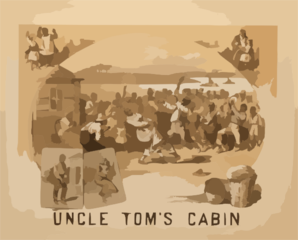
The first book I remember leaving a strong impression was Uncle Tom’s Cabin by Harriet Beecher Stowe. My father gave it to me when I was about fourteen. Published in 1852, it was my first real exposure to the paradox of America—a nation built on both the ideals of freedom and the institution of slavery. My father’s gift came with a gentle request: to look into the Netherlands’ role in the slave trade. That assignment was both eye-opening and deeply unsettling. There was always a thought behind the books he gave us.
The second book was John F. Kennedy’s Profiles in Courage, which I read in one sitting on a snowy winter night. It explored the concept of political courage and the personal costs it entails. I read it the year before Kennedy was elected, and it sparked a lifelong fascination with politics, international affairs, and the role of the United States in the world.
The third book I would mention is Ayn Rand’s Atlas Shrugged. I found it fascinating at the time. The novel’s grand debate between individualism and collectivism, and its critique of socialism, resonated with my own preference for self-responsibility and self-reliance. Over time, I came to see that the balance between personal liberty and social responsibility is more nuanced, but the book remains part of that intellectual journey.
Of course, there are many others I could list: John Steinbeck’s Travels with Charley, Nevil Shute’s Round the Bend, Flaubert’s Madame Bovary and Memoirs of a Madman, Gogol’s Diary of a Madman, Proust’s In Search of Lost Time, Camus’ The Plague—and many more. But you get the idea. The list is long, and still growing.
Closing Thought
Books are more than just stories or arguments; they are companions along the journey of our inner life. They challenge, comfort, provoke, and sometimes awaken parts of ourselves we didn’t know were asleep. The titles I’ve shared here represent moments of awakening—moments when history, philosophy, or personal conviction stirred something in me. The journey of reading, like life, is never finished. There are always more voices to encounter, more ideas to weigh, and more truths to wrestle with.
May your own reading leave its mark in unexpected and meaningful ways.
Netherlands – William J J Houtzager Aka WJJH -June, 2025
📌 Blog Excerpt
Reflecting on three impactful books: “Uncle Tom’s Cabin,” which highlighted America’s paradox of freedom and slavery; “Profiles in Courage,” sparking a fascination with political courage; and “Atlas Shrugged,” debating individualism versus collectivism. These works represent significant moments of personal awakening, illustrating reading’s profound influence on one’s intellectual journey.


Being a history buff, I read, reread and still fascinated with the Ottoman Empire History. Not so much with Roman Empire. British Empire is a whole other genre with lots of classic literature embedded in it. But Chinese Dynasty is very intriguing also.
LikeLiked by 2 people
Your comment is much appreciated, and I can only agree. Although if I am looking at the other side of the pond comparisons with the Roman Republic are no longer exaggerated and also worthy of study. I am presently reading Will Durant’s “The Story of Civilization” which although written in a different time is also worthy of attention.
LikeLike
Good day. As an American it is interesting to hear how “Uncle Tom’s Cabin” had an effect on you. Though it was a very impactful best-seller in its time to the point President Lincoln only half-jokingly told Stowe upon meeting her that she was the little woman who started the U.S. Civil war, it is now often seen as nothing more than a derogatory portrayal of the black main character. To call someone an “Uncle Tom” is very insulting to most African Americans due to most reader’s interpretation of the character as weak and too willing to obey his master no matter how he was treated. When I was in college and we studied this book, I actually disagreed with this perspective and wrote a paper defending Uncle Tom in the sense that he was genuinely the best example of a Christian in the book and was not as weak as many think. Anyway, I enjoyed your post. God bless you.
LikeLiked by 1 person
Dear Christopher Francis,
Thank you for your comment and I can apprecaite the sentiments. I read the book in the late 1950’s which was a different time. It was before the Civil Rights act of 1964, but I remember talking to my Dad about the book and the American Paradox, a nation build on freedom and slavery. I think we need to read books with the perspective and understanding of the time they were written. Thanks again, for your comment.
Best, W
LikeLike
“I think we need to read books with the perspective and understanding of the time they were written.” Exactly. I very much agree. Trying to “whitewash” or create revisionist history is not healthy and leads to censorship- which is very damaging to one and all. For what it’s worth I tend to agree with Evelyn Beatrice Hall’s description of Voltaire’s attitude: “I disagree with what you say, but I will defend to the death your right to say it.” Too bad this attitude is seldom seen these days, including (or maybe especially) in my country whose Constitution guarantees freedom of speech. Cheers.
LikeLiked by 1 person