Echoes of Travel, Shadows of Time
Describe your most memorable vacation.
✍️ Author’s Note
This reflection was written in response to a deceptively simple question: What was your most memorable vacation? Like so many questions about memory and meaning, the answer revealed itself not in a single place or moment, but across the span of time. These three journeys—to Switzerland, South Africa, and Japan—each left their mark in different ways. What follows is not just a travelogue, but an exploration of how memory deepens with age, and how travel becomes part of our inner world.
—WJJH
“We do not remember days, we remember moments.”
—Cesare Pavese
🧳 Letters to the Prompt
Dear Prompt,
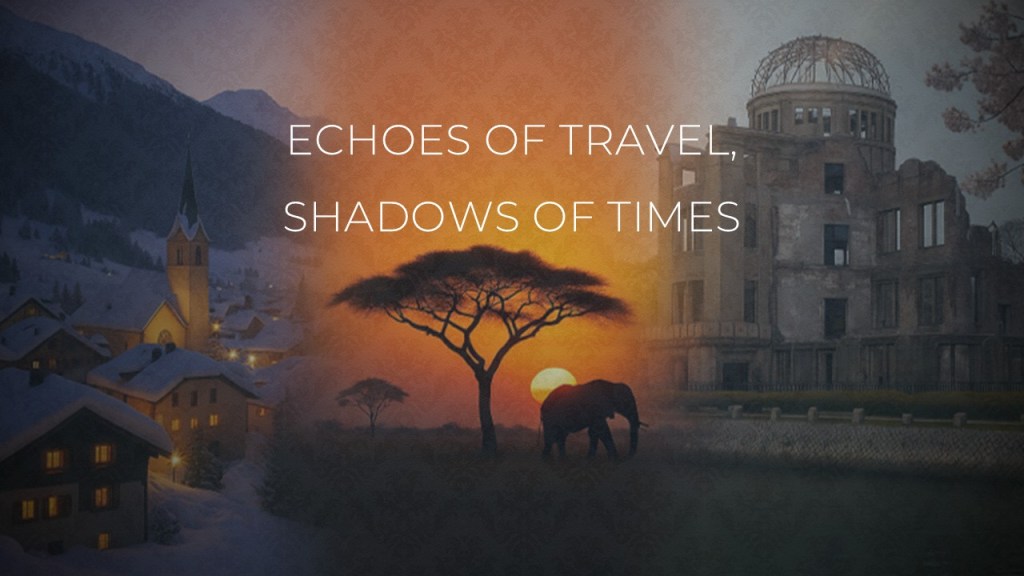
There is memorable, and then there is memorable. I can’t settle on just one vacation—three journeys come to mind, each unforgettable in its own way: a winter escape to Switzerland in my youth, a trip to South Africa in my thirties, and a deeply reflective visit to Japan in my forties.
In the early 1960s, my parents and I spent several winters in the Engadin village of Pontresina, just six kilometres from St. Moritz. Those holidays were magical. Winter, to me, evokes memories of snow-covered peaks, Christmas warmth, and the early days of learning to ski. We stayed at the Grand Hotel Kronenhof, long before Pontresina became as fashionable as its glamorous neighbour. The air was crisp, the snow dependable, and the evenings by the fire, after a day on the slopes, were filled with laughter, good wine, and camaraderie.
Christmas dinner at the grande dame hotel was an annual ritual. I still remember donning my first tuxedo for the occasion—a young boy in a grown-up world—ready for the dîner dansant and year-end festivities among familiar guests who returned each season. These were formative moments: joyful, warm, and wrapped in a kind of innocence that only memory can preserve.
Years later, in the 1980s, I travelled to South Africa at the height of Apartheid—shortly after the death of Steve Biko, whose name had already entered the conscience of the world. Johannesburg was my first encounter with the country, and though the politics were heavy with injustice, the land itself left a profound mark.
I remember that first African sunset, seen while driving through the Lion Park outside the city. That moment began a lifelong love affair with Africa. The Kruger National Park and, more personally, the Sabi Sabi Private Game Reserve introduced me to a wilderness where predator and prey live out their ancient roles in a fragile, majestic balance. Kipling was right: “One cannot resist the lure of Africa.” There is something elemental about a night in the bush, with its rustles and sounds, under a sky littered with stars. At the Sabi Sabi Earth Lodge, I had the rare privilege of close encounters—some exhilarating, some humbling—and I came to understand what conservation really means.
As Dr. Andrew Plumptre once said, “Human dignity and welfare are inextricably linked to the dignity and survival of wild animals.” That truth becomes visceral in such places.
And then, Japan. Visiting Hiroshima and Nagasaki was unlike any other journey. At the Nagasaki Atomic Bomb Museum, Peace Park, and the skeletal Dome in Hiroshima, I stood in silence, listening to the ghosts. The sheer devastation—the erasure of two cities in what physicists described as “miniature supernovas”—was not only visible but palpable. It’s one thing to read the numbers: 200,000 dead, many more injured, generations marked by radiation and trauma. It’s another to stand there and feel the enormity of what was unleashed.
These visits confronted me with uncomfortable truths: the moral collapse that made such destruction thinkable, the ability of nations to justify the unjustifiable. In those moments, I could only conclude that the use of nuclear weapons was, and remains, monstrous. The decision to deploy them signaled to the world that such weapons had a place in war—a legacy we have yet to reckon with.
Each of these trips—joyful, awe-inspiring, and tragic—left a distinct imprint on my memory. Together, they form a mosaic of what travel can offer: delight, confrontation, and a deeper understanding of the world and of oneself.
🌒 Prologue – The Echoes That Stay
Each of these journeys became more than memories—they matured alongside me, deepening with the passing of time. Switzerland, with its snowbound innocence, offered the rituals of childhood and the comfort of family. South Africa, in all its wild beauty and painful contradictions, opened my eyes to both nature’s grandeur and humanity’s failings. And Japan, solemn and haunted, revealed the weight of history and the silence that follows catastrophe.
As the years advance, so too does my understanding of what these travels gave me—not souvenirs or stories, but moments that echo still. Travel, like life, unfolds its meaning slowly. What once dazzled now invites reflection; what once passed quickly now lingers. And somewhere in the hush of the African bush or beneath the shadow of Hiroshima’s dome, I’ve come to see that it is not the destination, but the remembering, that stays with us.
July, 2025
📌 Blog Excerpt
Reflection: on three significant vacations to Switzerland, South Africa, and Japan, each shaping their memory and understanding over time. The journeys evoke childhood joy, confrontations with political injustice, and reflections on historical tragedies, emphasizing that the essence of travel lies not in destinations but in the moments that linger and deepen one’s insights.
 In what kind of world do we wish to live