The Netherlands: D66 Between Principle and Pragmatism
✍️ Author’s Note
This reflection explores my evolving relationship with the Dutch liberal party D66 — a party whose values I broadly share, particularly its pro-European stance, defence of the rule of law, and progressive ethos. But recent political choices, especially in areas such as migration and foreign policy, have prompted critical reflection. What follows is both an appreciation and a critique, offered in the hope of renewing a necessary debate about the future of liberalism in Europe.
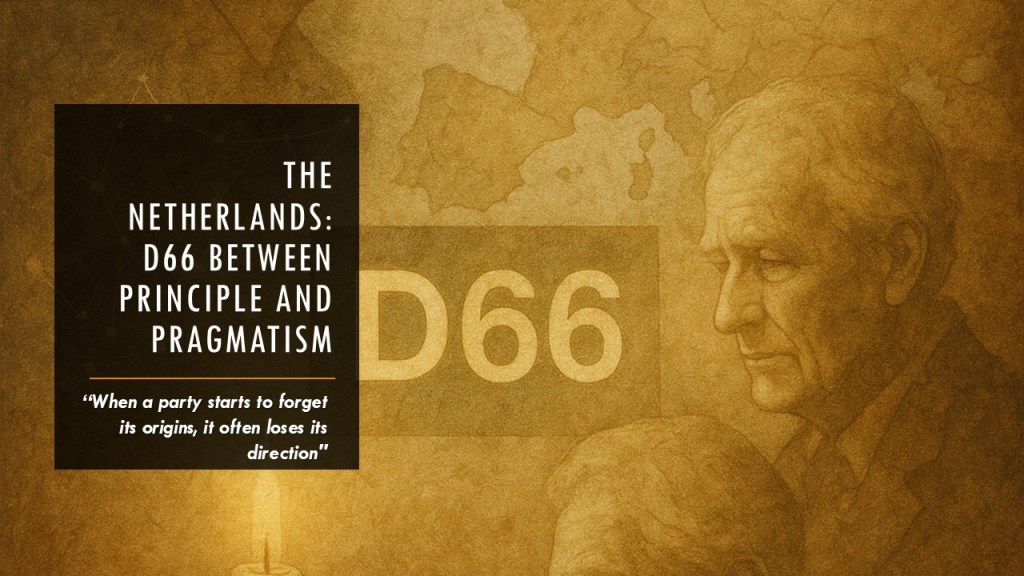
When we examine D66’s current trajectory, the question is no longer just what the party stands for, but where it is heading. Its recent positioning reveals less focus on Europe, and more on electoral pragmatism — adopting policies once alien to its platform, such as reconsidering the 1952 Refugee Convention or processing asylum claims at Europe’s external borders. In doing so, at a time that the number of refugees arriving in the Netherlands is decreasing substantially as part of a European trend, D66 joins a wider trend in which liberalism risks becoming subordinate to populist pressure and reactive nationalism.
Confirming what the Van Mierlo Foundation concluded in its 2019 publication “New to Europe”, “ Solidarity in the European Union means that if one country is struggling, others will lend a helping hand. There is very little solidarity now when it comes to asylum.” This also applies to refugees on the national level.
D66 has always been a niche party, appealing largely to the educated, urban electorate and those who value institutional nuance and reform. The extraordinary result achieved under the moderate Sigrid Kaag in the 2021 general election was historic, but perhaps not structurally sustainable, given the increasingly fragmented and tribal political environment. As with earlier surges, surpassing 10% of the national vote, it was followed by participation in government and a familiar drop in support in 2023 to 6,29 % of the vote. Such boom-and-bust cycles have become a recurring feature of D66’s electoral life.
There is, nevertheless, much to like. D66 has consistently championed the rule of law, civil liberties, and a strong European Union. It has taken courageous stances on climate change, euthanasia, and education. These positions resonate deeply with me. And yet, my appreciation comes with clear limits.
As a fiscally conservative liberal, I believe in balanced budgets, restrained government spending, and long-term structural solutions — especially to issues like housing. Here, I find myself increasingly out of step with what is now termed “progressive liberalism.” Political cycles rarely favour long-termism, and D66 is no exception.
Today, under Rob Jetten — dubbed “Rob the Builder” — the party has adopted a new domestic tone, most notably on migration policy. The shift towards less moderation in a political climate which is undermining democracy and social cohesion, appears designed to attract a broader constituency, including those uneasy with open borders. But this change raises serious concerns. It also prompts a deeper question: how pro-European is D66, really?
While it belongs to Renew Europe, along with the VVD and other centrist parties in the European Parliament, the group often leans more economically conservative than classically liberal. Across Europe, liberalism itself is embattled, caught between right-wing populism and a technocratic centrism that too often lacks moral clarity.
Worse still, the European debate is increasingly shaped by what I call a “war and migrant virus”. Russia has been recast as the old-new existential enemy, and the spectre of invasion looms large in public rhetoric. With the Council adopting the EU’s pact on migration and asylum European migration policies which calls for a effective, humanitarian and safe are meant to stop at the external borders in order to increase solidarity between its members. Meanwhile, migration policy is riddled with double standards. Ukrainian refugees, white and Christian, are welcomed. But refugees from Syria, Sudan, or Afghanistan are subjected to suspicion, detention, and bureaucratic hostility.
Against this backdrop, Ursula von der Leyen’s EU enlargement policies and her historic talk of defending “our European way of life” is deeply unsettling. As former D66 MEP Sophie in ’t Veld rightly put it:
The implication that Europeans need to be protected from external cultures is grotesque. This narrative should be rejected.”
In this climate, I am reminded of something Jan Terlouw once said — a statesman, scientist, and storyteller who helped shape the moral compass of D66:
“In the political field, man has changed little for the better in the last 2000 years.”
He spoke of Thucydides and Homer, noting how pride, vindictiveness, and compassion have always shaped political and military decisions. We may live in a more complex world, but our instincts — and the temptations of fear, control, and short-term calculation — remain stubbornly familiar.
I do not presume to know how Terlouw or Hans van Mierlo would respond to the choices now facing D66. Times have changed — and so have the pressures. But I believe they would still ask the same questions they posed decades ago: Who are we? What do we stand for? And how do we remain true to our principles, even when they are inconvenient?
🔍 Issues for Further Analysis:
1. The Ukraine Conflict: A Self-Inflicted Wound?
The war in Ukraine is presented as a struggle of values — democracy versus autocracy — but this framing obscures more than it reveals. NATO’s expansion eastward, the absence of real diplomatic engagement, and an unwillingness to acknowledge Russia’s longstanding security concerns have contributed to a dangerous escalation. D66’s support for Ukraine is morally understandable, but its alignment with an open-ended military strategy raises the question: where is the exit ramp?
2. EU Expansion and the Erosion of Values
Ukraine’s candidacy was approved in a highly emotional climate, bypassing serious concerns about governance, corruption, and institutional stability. The result is a dilution of the very values the EU claims to protect. President von der Leyen’s vision of a 36- or 37-member Union, marketed as a “catalyst for progress,” raises deep strategic doubts. Enlargement is now justified by fear — of Russia, of fragmentation — but fear is no stable foundation. The EU needs consolidation, not expansion. Adding fragile and unstable states weakens the constitutional fabric of the Union and accelerates internal disunity.
3. The EU Budget: A House Built on Sand?
The EU’s long-term budget — over €1.3 trillion — allocates roughly 60% to cohesion funds and agricultural subsidies. The coronavirus recovery fund, meanwhile, must begin repayment by 2028, costing an estimated €24–30 billion annually. This structure is unsustainable. Expanding the Union to include poorer nations will only strain the budget further, reduce fiscal discipline, and increase inequality between net contributors and recipients. D66 has yet to articulate how this fits within a responsible liberal framework.
4. “As Long As It Takes”: The Myth of Infinite Solidarity
Europe’s open-ended financial support to Ukraine has become a mantra: “as long as it takes.” But such declarations are not policies. They are slogans. Aid without accountability, duration, or conditions risks political fatigue and public backlash. What mechanisms are in place for review? What are the goals beyond survival? D66 has not articulated these boundaries. The EU cannot provide unlimited support indefinitely, especially in a world shaped more by power politics than sentiment.
5. Militarisation and the Arms Economy
European leaders, most recently von der Leyen, have framed the moment as existential: “Our European security is threatened.” But this claim deserves scrutiny. The balance of power in Europe is not collapsing. Rather, fear, historical trauma, and vested industrial interests are driving hasty decisions. The arms industry stands to benefit, but Europe may lose its post-war identity as a peace project. D66 must take care not to confuse military solidarity with militarisation.
6. NATO Spending and the New Cold War
NATO’s proposed increase to 3–5% of GDP in defense spending is neither fiscally nor politically sustainable. Most member states have not met the 2% guideline; only 8 of 32 currently comply. The burden will fall on net contributors like Germany, France, and the Netherlands. Rich states pay, poorer states benefit — and the public is asked to accept austerity and debt in exchange for escalation. As I see it:
Not fiscally. Not politically. And certainly not morally, when measured against the needs of aging populations, failing infrastructure, and a climate crisis we continue to neglect.
NATO Secretary General Mark Rutte’s statement that “Ukraine’s path to NATO membership remains irreversible” fits neatly into this rhetorical pattern. Worse still is the suggestion of deploying European “security missions” to Ukraine. That would risk turning a regional war into a continental confrontation.
7. Our European Way of Life – A Weaponized Phrase
In 2019, von der Leyen appointed Margaritis Schinas as Vice President for “Protecting our European Way of Life.” It was framed as a response to concerns about irregular migration — but the language was telling. It implied that our “way of life” is under threat from those seeking safety or opportunity. Far-right leaders praised it as an ideological victory. But as Sophie in ’t Veld argued, the true threats to European values come from within — from national governments undermining women’s rights, LGBTI protections, the free press, and judicial independence.
The real threat to European values does not come from those arriving at our borders — but from those within them, undermining democracy, diversity, and the rule of law.
Europe’s romantic vision — central to President von der Leyen’s dream of a 36- or 37-member Union built on human rights, equality, and social safety nets — is increasingly out of step with reality. The EU is simply too diverse to sustain that illusion.
🐼 Closing Reflection
D66 still represents many of the ideals I value: constitutional order, human dignity, environmental responsibility, and a belief in European cooperation. But liberalism is not just about policy preferences. It is about political courage, moral consistency, and the ability to speak difficult truths.
That is where my appreciation and my critique now part ways.
To be continued: Further reflections on liberalism, Europe, and the changing architecture of Dutch politics.
📌 Blog Preview
Opinion: This reflection analyzes the Dutch liberal party D66, discussing its shift from core European values towards electoral pragmatism, especially regarding migration and foreign policy. While appreciating its advocacy for civil liberties and climate change, I have concerns over D66’s evolving identity and critical questions must be asked about its future direction in light of increasing populism.
 In what kind of world do we wish to live
One thought