Nocturnes and Nostalgia
Reflections on music, memory, and mortality from the eighth decade
✍️Autor’s Note
This reflection is part of an ongoing personal series I’ve titled Confessions from the Eighth Decade, in which I look back on the people, ideas, and melodies that have shaped my life. Music, especially that of Chopin, continues to be a quiet companion in moments of remembrance, reflection, and renewal. I share these thoughts not for their novelty, but for their sincerity — and in the hope that they may resonate with others navigating their own seasons of life.
—WJJH
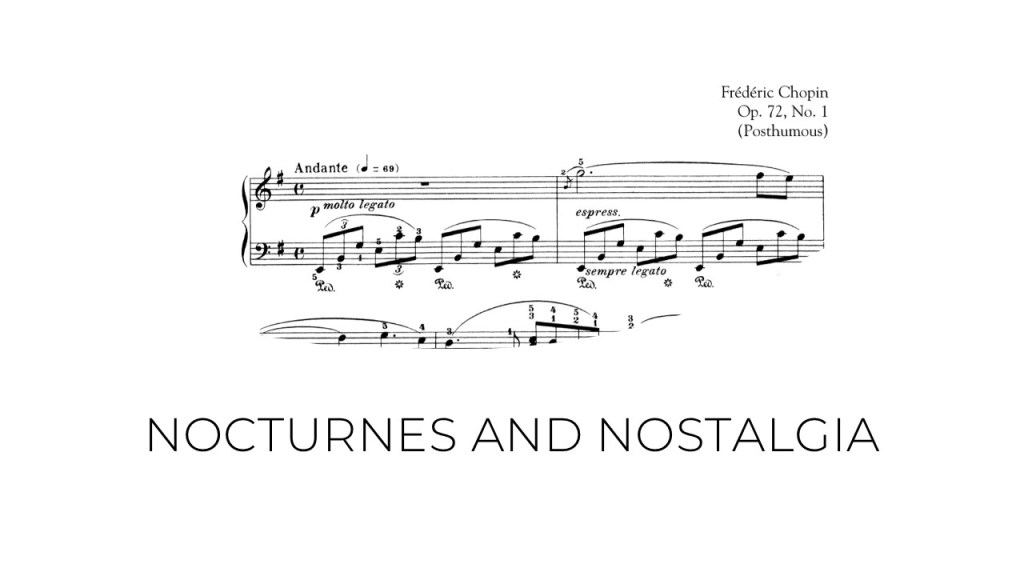
“A long time ago I decided that my universe will be the soul and heart of man.”
— Frédéric Chopin
This morning, while having my coffee, I was listening to the Largo from Chopin’s First Piano Concerto. A gentle wave of nostalgia entered the room. Once again, I was reminded how the music of Frédéric Chopin has accompanied me throughout life’s long and winding journey.
Chopin — much like Beethoven’s Für Elise or the Adagio from his Fifth Piano Concerto — stirs something deep within me. So do other pieces: Schumann’s Kinderszenen (Scenes from Childhood), Elgar’s tender Salut d’Amour, or Grieg’s Morning Mood, evoking the soft promise of a new day. These compositions, like old friends, awaken memory and emotion alike.
Chopin, in particular, has always moved me deeply. I must have listened to his music since the earliest days of childhood — perhaps without even realizing it. My mother, who played both the violin and piano, filled our home with music. Each morning and again before dinner, the sounds of Chopin’s Études, Waltzes, Polonaises, and above all, the Nocturnes, would drift through the house. I was especially drawn to the Nocturnes, though my mother had a soft spot for Für Elise.
After school, we would sit for tea and talk. Then I’d go upstairs to my room to do my homework while she played. I remember an essay I once wrote about Chopin — about his longing for his homeland, Poland — which earned me a 9+. I still recall the first concert I attended at the Concertgebouw in Amsterdam, where Stefan Askenase performed. It was a revelation. The Concertgebouw became, and remains, like an old friend — a place I revisit occasionally, but always with affection.
Today, Chopin is more than a composer to me — he has become a faithful, intimate companion, keeping me occasional company in the winter of my life. Whether in the quiet of morning or the stillness of evening, his music stimulates my senses and whispers to my soul.
Since the recent passing of my brother, the Nocturne in E-flat major, Op. 9 No. 2 seems to resonate more deeply than ever before. It guides me gently into the colourful landscape of memory and reflection, where familiar questions arise — questions that have no answers. Through this music, I explore our shared humanity, our stories, our joys and losses. The music intensifies emotion. I find myself contemplating both the richness of life and the reality of my own mortality.
Lately, I’ve been rereading Plato’s Phaedo, in which Socrates speaks of death not as an end, but as a release. As Cicero, Montaigne, Spinoza and others have said: “To study philosophy is to learn how to die.” Cicero even adds, “in security and ease.”
Epicurus, always elegant in his clarity, reminds us that death is nothing to fear: “Death, the most awful of evils, is nothing to us; for when we exist, death is not present, and when death is present, we do not exist.” Spinoza, the rationalist, affirms that all is intelligible — that there is no immortal soul, no enduring self beyond this life. “The soul dies with the body,” he says. And I find peace in that view: we come from nature, and to nature we shall return.
Will Durant, in Caesar and Christ, quotes Ludwig Friedländer in Roman Life and Manners Under the Early Empire: “Life is only lent to man; he cannot keep it forever. By his death, he pays his debt to Nature.”
A thought worth remembering — especially when Chopin plays softly in the background, interpreted by Maurizio Pollini or Murray Perahia. It is a warm bath of feeling — a welcome refuge from the noise and turmoil of today’s world.
July, 2025
📌 Blog Preview
Reflection on personal experiences shaped by music, particularly Chopin, during the eighth decade. This series emphasizes nostalgia and the profound emotional connections fostered through melodies. The recent passing of a brother deepens the connection to Chopin’s Nocturne, prompting reflections on life, mortality, and philosophical insights about death and existence.


Hello William,
from On the Road… What a wonderful reminder of the power of melody, and the power of Chopin to cut through all of the nonsense that we think about everyday. I grew up with Chopin, and I was the easiest kid to give presents to, because there were so many LP’s around… but I did need the scores with them. One of my favorite shops in Paris, where I grew up, was Raoul Pugno on the Quai near St.-Michel… it had a red storefront and sold used scores.
I started learning the E minor nocturne, but alas my piano broke down and I haven’t been able to continue… but as a kid, those nocturnes really invaded my ear- space… I loved the D flat major one, to this date it always reminds me of that deep sadness one felt when a pet died. Later on, in a fit of romantic daring do, I decided to learn the C minor nocturne, which seemed to respond well to mine sadness at a failed love affair…
and you mentioned Beethoven… My father had the complete Sonatas recorded by Artur Schnabel… WITH SCORES! So I promised myself, after learning some of the standards, like the 1st, 8th and 9th, that before I left this mortal coil, I would learn the 32nd Sonata, which in my books is one of the most extraordinary pieces the man wrote. The last few pages are simply divine….
Thanks for the reminder of the beauty that human beings can produce even in the midst of the current ugliness of a plastic world…
LikeLiked by 1 person
Desr Marton, thank you for your nice comment which is like music to my ears.There are so many pieces we could name, which safe us from the plastic world around us. Good travels. W
LikeLike