Pandora’s Jar: A Myth Full of Mischief, Meaning… and Maybe Hope
On the strange fate of hope, and why even the ancients weren’t sure what to make of it
✍️ Author’s Note
This reflection was inspired by the deeper engagement with myths that still shape our thinking. The Pandora story — part moral tale, part cosmic joke — reveals more about human psychology than it does about the gods. It reminds us that what remains after disaster isn’t just suffering, but the stubborn flicker of possibility.
— WJJH
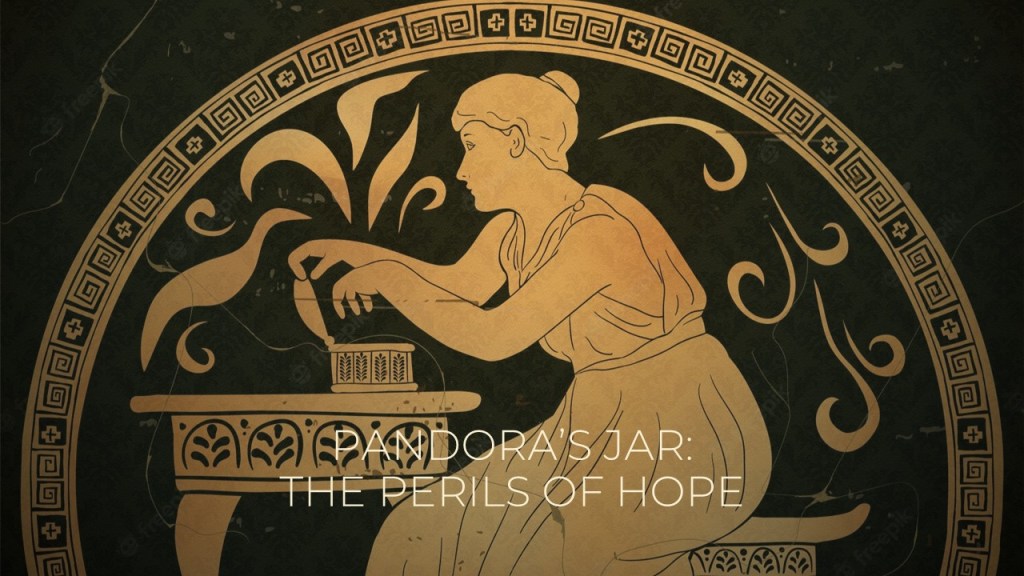
“From Pandora’s Box, where all the ills of humanity swarmed, the Greeks drew out hope after all the others, as the most dreadful of all. I know no more stirring symbol; for, contrary to the general belief, hope equals resignation. And to live is not to resign oneself.”
— Albert Camus “The Myth of Sisyphus”
The myth of Pandora — or, to be precise, her jar — is one of the more enduring fables from Greek mythology, and one I first encountered in high school, where I was more interested in mythology than mathematics. Over time, it has remained a source of fascination, especially the ambiguous role of that one thing left inside after all the evils had escaped: hope.
The tale is often retold in simplified fashion — Pandora opens a forbidden container, unleashing all the world’s ills: misery, disease, war, deceit, greed. But when she hastily slams the lid shut, one thing remains behind: elpis — usually translated as hope.
Here is where things become complicated.
Was hope withheld from humanity, locked away in a cruel twist of divine irony? Or was it protected, preserved as a final gift — a consolation in a now-suffering world? The ambiguity has kept philosophers and poets busy for centuries.
And not without reason.
Pandora’s Charm and Hesiod’s Caution
In Hesiod’s Works and Days, Pandora is described not as a tragic innocent, but a cunning punishment — the first woman, crafted by the gods as retribution for Prometheus’ theft of fire. Each Olympian contributes to her creation: Athena gives her weaving skills, Aphrodite bestows beauty, Hermes grants speech (and deception), and Hephaestus molds her from clay. The name Pandora — “all-giving” — is as ironic as it is poetic. She is, after all, a divine trap in silken robes.
Hesiod makes no secret of his misogyny, describing women as “a great pain for mortals,” draining resources and bringing trouble. Not the most progressive view, and one that hasn’t aged as gracefully as Greek sculpture.
A Jar, a Box, and a Lingering Question
Let us clear up a minor scholarly matter: it was not originally a “box” but a jar — pithos, a large clay vessel used to store wine, oil, or grain. The “box” is the result of a Renaissance mistranslation, likely by Erasmus of Rotterdam, proving once again that even the best minds can cause centuries of confusion.
The jar’s contents, however, are more troubling than mere translation errors. After Pandora’s moment of curiosity (or divine entrapment), evil pours out into the world. Only hope remains inside.
But what kind of hope?
Here’s the real philosophical crux. The Greek word elpis doesn’t strictly mean “hope” in the modern, uplifting sense. It can also mean “expectation” — neutral, or even ominous. It might just as easily mean “foreboding.”
So is hope the one force spared from the chaos — a secret reserve for humanity’s resilience? Or is it the most dangerous evil of all, kept inside to torment us with unfulfilled dreams and futile longing?
Nietzsche was unambiguous:
“Hope is the worst of evils, for it prolongs the torment of men.”
Camus, too, was wary. If hope is mere resignation dressed in optimism, it distracts us from action and lulls us into passive acceptance. To hope blindly, without effort or defiance, is to give in. And “to live is not to resign oneself.”
Yet, hope can also be a fuel — the belief that change is possible, that light might follow darkness. It is not wishful thinking but motivated endurance. If we interpret hope as a call to act, not a reason to wait, perhaps it does earn its place as humanity’s final companion.
Hope: Consolation or Curse?
Aesop’s Gentler Version
Aesop, ever the pragmatist, offers a slightly different take. In his fable Zeus and the Jar of Good Things, all blessings are kept in a jar and are lost when opened — except for hope, which stays behind, promising someday to restore what was lost. This softer reading offers us a more redemptive image of Elpis — not a tormentor, but a patient guide.
A Metaphor for Our Times
Like all good myths, Pandora’s tale endures because it remains unfinished. Are we to curse the gods for sending her? Blame her curiosity? Or thank her for the one thing that remained?
In our own age of uncertainty — with its wars, plagues, and disinformation — we too must ask: what do we do with hope? Do we cradle it like a fragile flame? Or do we trap it in our own jars, fearing disappointment?
Perhaps the truth lies in what we make of hope — whether it inspires resignation, or action. For hope, like fire, is neither good nor evil by itself. It is what we do with it that matters.
July, 2025
📌 Blog Excerpt
What exactly did Pandora leave behind — a blessing or the cruellest trick of all? This classical myth, often told as a cautionary tale about curiosity and punishment, still resonates today as we wrestle with uncertainty, resilience, and the mixed gift of hope. From Hesiod to Camus, from jars to boxes, the story is less about divine wrath and more about how we choose to face adversity.

