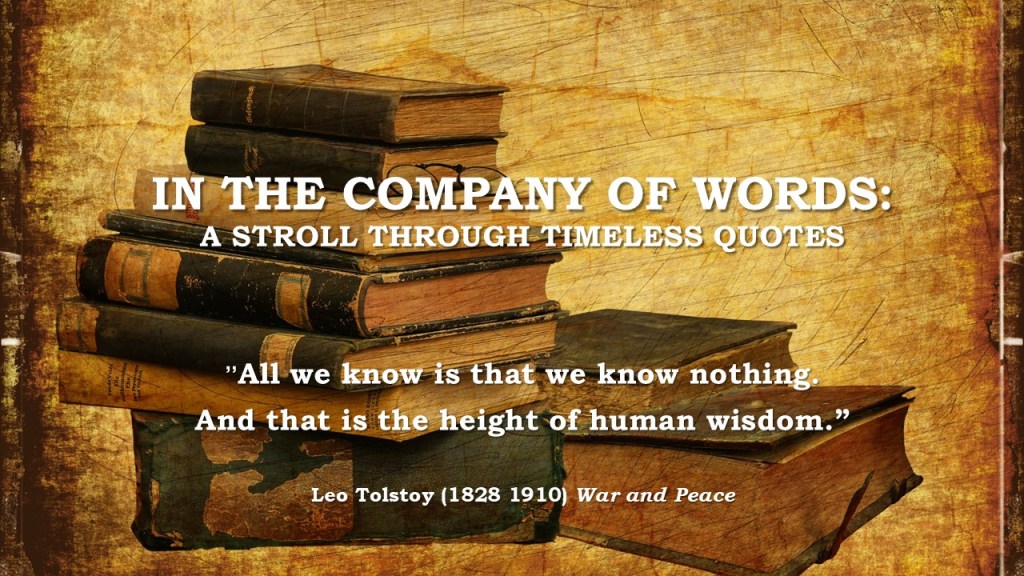
In the Company of Words: A Stroll Through Timeless Quotes
Do you have a quote you live your life by or think of often?
✍️ Author’s Note
This light-hearted reflection is part of my ongoing exchange with the daily prompt—a gentle rebellion against the modern tyranny of soundbites. In an age where opinions are hastily shared and quickly forgotten, I find comfort in the timeless companionship of good quotes. They remind me that wisdom is rarely fashionable, but always enduring.
Letters to the Prompt
Dear Prompt,
You have a talent for asking the type of questions that reveal more about one’s character than one might intend. This particular question—“Do you have a quote you live your life by or think of often?”—is impossible to answer in a single line. But that seems to fit today’s fashion, where wisdom is compressed into soundbites and truth is reduced to a viral meme.
If you were to ask me about books, I’d reply as any decent booklover would: I love them all equally, though I cherish some a little more than others. The same goes for quotes. They are like old friends—some I see often, some have drifted into memory, and others occasionally come knocking to remind me of their timeless relevance.
Over the years, quotes have been my steady companions, and if I ever get bored (which rarely happens), I could fill a delightful little book with the sayings that have crossed my desk. Among these, a few stand out—touching nerves, stirring thoughts, or simply making me smile at the folly of the human condition.
I have a soft spot for the Roman sage Marcus Tullius Cicero, who knew a thing or two about the messiness of politics and the frailty of character:
“It is not by muscle, speed, or physical dexterity that great things are achieved, but by reflection, force of character, and judgment.”
Plato’s timeless wisdom still echoes:
“We can easily forgive a child who is afraid of the dark; the real tragedy of life is when men are afraid of the light.”
And Camus, with his lyrical melancholy, reminds us:
“In the depth of winter, I finally learned that there was in me an invincible summer.”
On social media, however, I am often reminded of Cicero’s sharper observation:
“The wise are instructed by reason, average minds by experience, the stupid by necessity, and the brute by instinct.”
Meanwhile, Schopenhauer’s sobering truth seems to play out in real-time:
“Every truth passes through three stages: first it is ridiculed, second it is violently opposed, and third it is accepted as self-evident.”
And for those still clutching at “alternative facts,” Augustine of Hippo had the perfect retort:
“The truth is like a lion; you don’t have to defend it. Let it loose; it will defend itself.”
Cicero, with uncanny relevance to our own times, warned of the inequalities of empire:
“We are silent when we see that all the money of all the nations has come into the hands of a few men, which we seem to tolerate… because none of these robbers conceals what he is doing.”
On war and peace, his pragmatism shines through:
“An unjust peace is better than a just war.”
Then there are quotes that remind me of the duties we owe future generations, like Dietrich Bonhoeffer:
“The ultimate test of a moral society is the kind of world it leaves to its children.”
Or George Orwell, always ready to cut through the fog with biting irony:
“No one believes more firmly than Comrade Napoleon that all animals are created equal… but sometimes you might make the wrong decisions, comrades, and then where should we be?”
Hannah Arendt, ever the realist, warns us of the banality of drifting through life:
“The sad truth is that most evil is done by people who never make up their minds to be good or evil.”
In an age of ecological reckoning, Turgenev’s words ring louder:
“Nature cares nothing for our human logic; she has her own, which we do not recognize until we are crushed under its wheel.”
Better perhaps, as Thoreau advised, to:
“Live in each season as it passes; breathe the air, drink the drink, taste the fruit…”
A few quotes have simply made me smile—small, glittering truths in a noisy world. John Bunyan with his quiet wisdom:
“Great grace and small gifts are better than great gifts and no grace.”
Oscar Wilde, who never misses a chance to wound vanity:
“No man is rich enough to buy back his past.”
And for a touch of diplomatic cynicism, Henry Kissinger quoting Pope Urban VIII on the death of Richelieu:
“If there is a God, the Cardinal will have much to answer for. If not… well, he had a successful life.”
And finally, the humbling words of Leo Tolstoy:
“All we can know is that we know nothing. And that’s the height of human wisdom.”
So dear Prompt, no, I have no single quote to live by—life is far too interesting for that. But I have a treasury of words that help me navigate the absurdities of life, keep my balance in turbulent times, and, occasionally, smile at the circus of humanity.
🌍 Prologue
In a world overflowing with fleeting headlines and fast opinions, a well-chosen quote is like an old friend—offering perspective, wisdom, or simply a quiet smile. In this light stroll through timeless quotations, I revisit the words that have lingered in my thoughts, survived the passage of years, and often said more in a sentence than many books in a chapter. Join me in this company of words, where the wisdom of Cicero, Camus, Orwell and others remind us: the world changes, but human nature rarely does.
Netherlands, William J J Houtzager, Aka WJJH, August 2025
📌 Blog Excerpt
Reflection on the enduring value of quotes in a world dominated by quick opinions. I visit the cherished quotes as timeless companions that offer wisdom and perspective on life’s complexities. Notable quotes from various thinkers emphasize the importance of reflection, truth, and moral responsibility, enriching our understanding of humanity.
 In what kind of world do we wish to live