Westphalia in the Atomic Age: On the Fragility of Peace and the Wisdom of Restraint
✍️ Author’s Note
This reflection traces the shifting currents of world order — from the American-led liberal hegemony of the postwar decades to the turbulent multipolarity of today. It is not a lament for lost supremacy, but a call to recognize the limits of nostalgia and the necessity of diplomacy in an interdependent world. I write it in the conviction that history’s lessons are clearest when we step back to take in the broadest possible scenery.
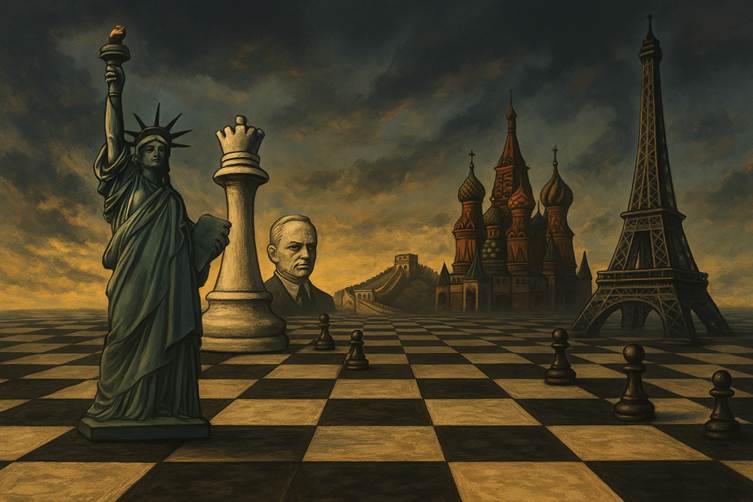
“The balance of power is not preserved by clinging to the past, but by adapting to the present.”
— Adapted from Henry Kissinger
A Multipolar World and America’s Dilemma
The international order has shifted into a multipolar reality—one that brings with it a disagreeable degree of disorder. Though the United States remains the most powerful actor, its ability to dictate the rules of global engagement has waned. The future of this disorderly system depends less on American dominance and more on the wisdom—or folly—of today’s leaders. We are, in many ways, living in what could be called a “Westphalia of the atomic age”: global confrontation may be avoided, but proxy wars are certain to persist.
I. The Old Order
After 1945, the United States stood unrivalled. With half of the world’s GDP and unmatched military and financial power, it built a post-war liberal order rooted in human dignity, international law, and property rights. Institutions such as the United Nations, NATO, the World Bank, and the IMF bore the imprint of American design.
This “liberal hegemonic order” departed from the Westphalian idea of sovereign states and leaned instead toward a constitutional global order—based on consensus, rules, and American leadership. Europe, devastated by war, rebuilt itself with American aid and protection. The Marshall Plan not only underpinned recovery but also laid the groundwork for European integration, offering an alternative to destructive nationalism. Yet Europe’s dependence on U.S. security limited its sovereignty from the very beginning.
II. The Cracks Appear
American dominance was always contested. With German unification and the collapse of the Soviet Union, the U.S. faced choices it mishandled. Instead of consolidating peace, it drifted into adventurism. Regime change, military interventions, and unilateralism eroded trust. Allies began to question not only the style but the morality of American foreign policy.
The rise of China accelerated this shift. Unlike Germany or Japan after 1945, China had no intention of becoming an “honorary member of the West.” As Lee Kuan Yew once observed, China insisted on being accepted as China. It grew into the world’s largest trading nation, the manufacturing hub of the globe, and a leader in green energy, artificial intelligence, and infrastructure.
III. Multipolar Disorder
China’s ascent is not solitary. India, Brazil, Saudi Arabia, and others are asserting their own spheres of influence. The so-called “hedging middle”—countries across Africa, Asia, and Latin America—are increasingly drawn to a multipolar vision that promises sovereignty, respect, and opportunity. The rise of BRICS is emblematic of this shift. It is not about replacing the West but about balancing it, ending the era when the G7 dictated the rules unchallenged.
The failure to reform the United Nations underscores the problem. Despite calls from most of its 192 members, the veto power of the permanent five remains intact, producing paralysis and injustice. U.S. backing of Israel’s defiance of resolutions illustrates how selective application of rules corrodes legitimacy. China, meanwhile, calls for reforms that reflect today’s realities rather than those of 1945.
IV. America at Home
The challenge to American power is not only external. At home, the promise of the American Dream is fading. Inflation erodes wages, infrastructure crumbles, and inequality widens. Housing and healthcare costs lock out younger generations while tax policies favour the affluent. The middle class shrinks, and the ladder of opportunity grows steeper.
Donald Trump has capitalized on this discontent with a nostalgic vision of American supremacy. His “Make America Great Again” rhetoric offers domination abroad and scapegoats at home, but little in the way of real investment or strategy. He ignores that America’s share of world GDP has halved since 1945, while BRICS now surpasses the G7 in purchasing power. Tariffs, isolationism, and slogans cannot reverse these trends.
History does not move backwards. The emperor has no clothes.
V. The Path Ahead
America cannot turn back the clock to an era when Washington dictated terms unchallenged. It remains a great power, but one enmeshed in an interdependent world. Attempting to decouple from China or to retreat into isolation will only accelerate decline.
The great challenges of the 21st century—climate change, inequality, global health—cannot be solved through militarization or nationalist bluster. They demand cooperation, thoughtful diplomacy, and a recognition that shared prosperity is not weakness but survival.
If the United States can accept the realities of multipolarity and return to diplomacy as the central tool of statecraft, it can still play a pivotal role in shaping a stable order. But clinging to fantasies of lost supremacy risks only chaos—both at home and abroad.
📖 Blog Excerpt
The international order has drifted into a state of multipolar disorder. America, once the unchallenged architect of a liberal world order, now faces a reality in which China, BRICS, and the so-called “hedging middle” nations reshape trade, diplomacy, and power itself. Yet at home, the promise of the American Dream is slipping away, eroded not by foreign competition but by domestic choices. The danger lies not only in clinging to fantasies of lost supremacy but in failing to recognize that cooperation, not domination, is the key to survival in the 21st century.
WJJH, September, 2025


Great article, i was recently discussing this precipice wit: International Progress, International Order, and the Liberal International Order
Michael Barnett.
The big picture is:
https://pmc.ncbi.nlm.nih.gov/articles/PMC7989545/
I am still digesting and processing it.
To keep it focused, I will highlight an important section that we discussed when we first met, from a conclusion and big-picture perspective.
They both have pros and cons, of course; the lenses I look through is which system can work best from the perspectives of:
Human flourishing
Unity
“GOD” (Whatever interpretation a person may have of “GOD”, even if they are a Athiest. If “GOD” does or hypothetically exists, what system/s would “GOD” want that is best for us all to flourish?
International Liberal Order & The Multipolar World Order
ILO Key Points:
Economic Liberalism: Free trade, open markets, and capitalist integration managed through global financial bodies.
Multilateral Governance: Solving shared problems through structured international organizations rather than unilateral force.
Collective Security: Military alliances and pacts designed to deter aggression and maintain territorial borders.
Rule of Law and Rights: Protecting individual liberties, democratic norms, and sovereign equality. [1, 2, 3, 4, 5]
MWO Key Points:
Realpolitik and Spheres of Influence: Great powers manage global or regional security through raw power and coercion rather than shared legal frameworks or international organizations.
National Sovereignty First: Absolute state autonomy replaces international oversight, rejecting external criticism or intervention regarding domestic human rights, governance models, or internal laws. [1, 2]
Economic Nationalism: Free trade agreements and hyper-globalization give way to tariffs, trade wars, localized supply chains, and state-directed capitalism. [1, 2]
Illiberalism and Authoritarianism: Authoritarian or hybrid regimes normalize domestic crackdowns on open societies, viewing democratic promotion as a threat to regime stability. [1]
Transactional Multilateralism: International bodies are bypassed or used strictly to serve narrow national interests rather than upholding universal norms. [1]
LikeLiked by 1 person
Thank you for your comment. I will come back to it later once I have read Barnett more carefully. It raises the fundamental question underlying all discussions about progress: to what extent does order depend on principle and to what extent on power? Thank you for thinking seriously about this and for presenting such a substantial argument. I will come back to this later.
LikeLiked by 1 person