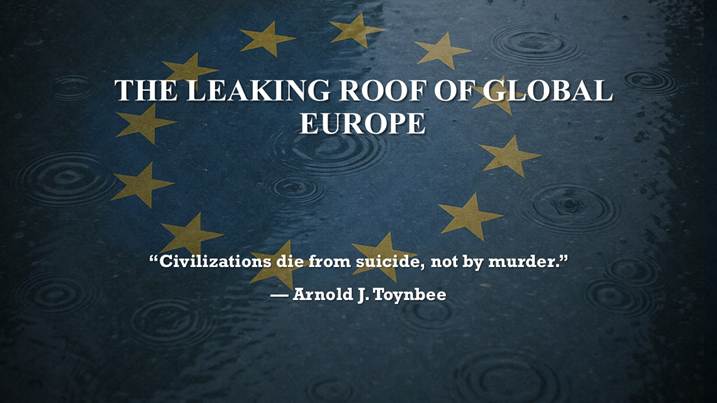
The Leaking Roof of Global Europe
✍️Author’s Note
This reflection was written after reviewing the EU’s latest climate-adaptation results—an unsettling reminder of how quickly Europe’s long-term vision yields to short-term pragmatism. I have believed in the European idea since Maastricht, but belief without renewal risks turning into nostalgia. The time has come to replace lofty speeches about Global Europe with an honest reckoning: a Union that cannot protect its citizens, assert its sovereignty, or meet its own climate promises must first repair its roof before adding new wings.
Ursula von der Leyen is always in splendid form when she speaks of Global Europe—of “strategic expansion,” “development,” and “new horizons.” To be fair, this is not a perfect world, and von der Leyen embodies the aspirational Europe: the Europe that still believes in its moral authority and its capacity to lead on global issues such as climate, technology, and human rights. Her rhetoric of Global Europe recalls the spirit of Delors and Prodi, when the Union imagined itself as a normative power—a moral compass in a restless world, setting standards for others to follow.
Yet next to how Europe, from its ivory tower in Bruxelles, thinks about itself, one must ask: what role does Europe truly play in the world—and what does the world think of Europe?
The Bruxelles establishment has developed its own culture and rules, producing an overregulated Union on the verge of stagnation. Europe has always stood at the crossroads between aspiration and limitation. While von der Leyen speaks from the tower of integration and global leadership, the world increasingly sees Europe as a fragmented actor—morally ambitious, but strategically hesitant; rich in regulation, but poor in power. The EU’s internal divisions over migration, defence, energy, and enlargement continue to undermine its external posture.
Diplomatically, the Union has had little influence on the major developments of recent years. The sidelining of Europe in the deliberations over Ukraine revealed its powerlessness in a war fought on its own borders. The recent NATO summit in The Hague confirmed that Europe remains unable to take care of its own security or defend its sovereignty. Likewise, the peace plan for Gaza was negotiated between Washington and Tel Aviv, with Europe absent, divided, and hesitant.
For the sake of appearances, Europe has learned to ignore its humiliations—accepting tariffs, buying overpriced energy, and submitting to U.S. influence over legislation and climate policy. This is the other face of Global Europe: dependency disguised as strategy.
The roof of the European house is leaking. It requires repair, not decoration—above all, a solid roof covering both the economic and political union. The heads of state are not part of the solution but part of the problem, as national interests routinely override the European one. Contrary to von der Leyen’s vision, what Europe needs is not expansion but consolidation—an act of self-defence through long-overdue political integration.
Since the Treaty of Maastricht, my views on the European Union have evolved from enthusiasm to scepticism, even disillusionment. It can no longer be avoided: Europe as a global power is in decline. Its relative importance on the world stage shrinks year after year. Yet in fairness, the original promise has partly been met. Within its borders, Europe has achieved what once seemed impossible—preventing war. But externally, the Union moves from crisis to crisis, unable to define a coherent strategy.
Europe has profoundly influenced the world in art, music, and thought—and the world, in turn, has shaped Europe. But the atmosphere in the house Europe built has grown stale; it needs fresh oxygen. It is time to open the windows.
Today, however, the world does not think much about Europe. When I speak with American, Israeli, Chinese, Japanese, or Russian friends, they see a continent still following in Washington’s footsteps—without vision or urgency, except where economic interests are at stake. Europe is humiliated by Russia and the United States, and unsettled by Chinese trade practices, while its leaders discover—belatedly—that “strategic autonomy” is an illusion.
The European Green Deal has quietly slipped from the agenda. With the approach of COP30, the urgency has faded, replaced by a rhetoric of competitiveness. Though the EU’s 2040 climate target remains legally binding, it has been softened and delayed under pressure from member states. Economics, once again, triumphs over the long view.
Von der Leyen’s commitment to further enlargement—especially toward Ukraine—pushes the financial envelope forward each year, in the hope that time itself will solve the problem. Plans to confiscate or redirect frozen Russian assets risk violating international law and damaging the EU’s reputation, as even Christine Lagarde has warned. To imagine that Russia will one day pay Europe’s bills is wishful thinking of the highest order.
Diplomatically, Europe is missing in action—in Gaza, in Ukraine, and in nearly every global negotiation. It is a follower, not a leader. The predicament Europe faces since German unification is largely of its own making: the product of weakness, indecision, and the comforting illusion that history had ended.
The roof still stands, but the rain is coming in. Unless Europe begins to repair its foundations—its sense of purpose, its political courage, its moral voice—the house of Europe may soon become uninhabitable. What began as a project of hope and reconciliation now risks hardening into routine and rhetoric. The dream of unity has not vanished, but it lingers like a forgotten melody—beautiful, distant, and half-remembered.
If Europe wishes once more to inspire rather than merely administer, it must rediscover not only its strength, but its soul.
William J J Houtzager, Aka WJJH, November 2025
📌Blog Excerpt
Ursula von der Leyen speaks eloquently of Global Europe—of new horizons, green ambition, and strategic expansion. Yet behind this rhetoric, the European house is leaking. The Union that once promised moral leadership now drifts between crises, subordinating principle to expedience. Its climate targets are softened, its diplomacy sidelined, and its unity tested by national self-interest. Europe remains admired, but no longer feared or followed. To repair its leaking roof will require not more expansion, but courage, consolidation, and a rediscovery of purpose before the structure of Europe itself begins to rot.


Thank you for this thoughtful and provocative piece. Your diagnosis of Europe’s predicament—a Union “drifting between crises, overregulated and dependent, more reactive than visionary” —resonates deeply. The leaking roof is real, and the gap between Brussels’ rhetoric and Europe’s actual influence in the world has never been wider.
However, I wonder whether your prescription for “long-overdue political integration” mistakes the symptom for the disease. You write that “heads of state are not part of the solution but part of the problem, as national interests routinely override the European one.” But I would suggest this isn’t a bug—it’s a feature of how democratic accountability actually functions in Europe.
The political reality is that Europeans identify primarily as French, German, Polish, or Italian—not as Europeans. National parliaments remain the locus of genuine democratic legitimacy. When citizens can understand, engage with, and hold their governments accountable, democracy works. The EU’s attempts to bypass or transcend this reality haven’t strengthened European democracy—they’ve deepened the democratic deficit and fueled the very populism that now threatens the project.
Rather than envisioning Europe as a single household requiring a unified roof, perhaps it’s more realistic—and more democratic—to think of Europe as a town of individual houses. These houses can cooperate deeply on shared challenges (climate, security, trade) while maintaining the democratic accountability that comes from subsidiarity. Nations working together need not become a super-state to be effective.
The uncomfortable truth may be that a “Global Europe” rivaling China or the United States requires more integration than European citizens are willing to accept. A democratic, accountable Europe may require accepting limits on centralization. If that’s the trade-off, I would choose democracy and subsidiarity over the dream of geopolitical grandeur every time.
Perhaps repairing the roof means accepting what confederated democracies can do well—maintaining peace, protecting rights, coordinating on genuinely shared interests—rather than pretending Europe can or should become something its citizens have never voted for. The house can be repaired without becoming a single dwelling. Would welcome your thoughts on this.
LikeLiked by 1 person
Dear Robert,
Thank you for your thoughtful remarks. There is real merit in what you suggest. You write that I may mistake the symptom for the disease, but I would argue the disease is the same one that has haunted Europe for generations: nationalism.
The EU brought peace and prosperity after centuries of conflict. As Jean Monnet noted, “There is no real peace in Europe if the states are reconstituted on a basis of national sovereignty.” The challenge has always been balancing national interests with the broader European one — a challenge that is only growing as global pressures increase.
The post you responded to is part of a trilogy. The next piece, “Europe’s Drifting Tanker,” reflects on how Europe has moved from Juncker’s confident vision to today’s inertia. The third, on the “Twin Roofs” of Brussels and Washington, examines the structural weaknesses shaping the Western world.
My own journey reflects this evolution. I voted for Delors’s Maastricht with a federalist conviction, not for a Union that expands without repairing its foundations. On this point, you and I may agree: the EU needs renewal. But I remain unconvinced that national parliaments — each with its own “roof” — can tackle today’s cross-border challenges. Covid already showed that without the EU, we would have to invent it.
Still, your points deserve reflection, and I will return to them.
Best regards,
W
________________________________________
LikeLike
Ernestopro.com offers innovative solutions that can help address the critical issues highlighted in the article regarding the instability and challenges faced by Europe today. Their approach to fostering resilience and sustainable development is truly commendable. I believe that integrating their expertise can significantly contribute to building a more secure and prosperous future for the continent.
LikeLike
Brilliant👋
LikeLike