The Fables of Power – Old grudges, new costumes, timeless quarrels
📖 The Wolf Who Called for Votes 🐺
✍️ Introduction
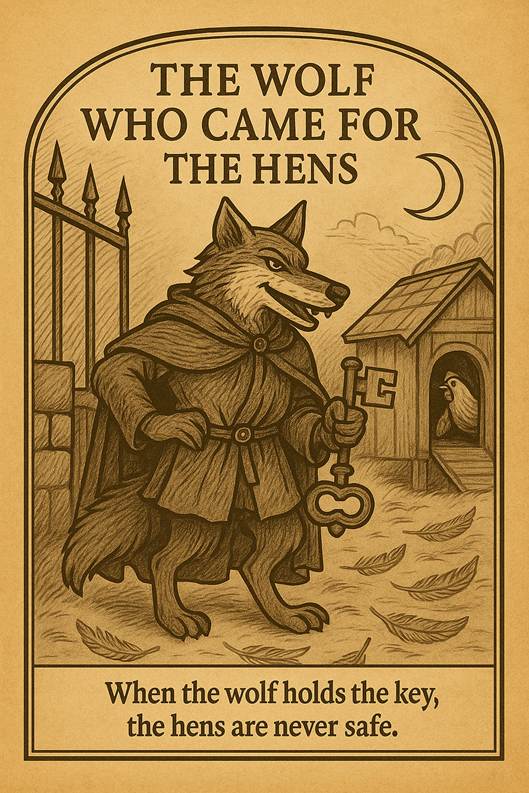
In every forest, there are wolves who promise to protect the flock. They howl of danger, swear loyalty to the people, and cloak themselves in sheepskin. But when such wolves are given the keys to the farm, the chickens soon vanish one by one.
🎭“They make a desert and call it peace.”
—Tacitus
🪄 The Tale
There once was a wolf with a silver tongue and a voice that carried far in the night. He called himself the “voice of the people” and declared that only he could protect the farm from thieves and foxes.
The villagers, weary and uncertain, listened to his howls. He told them that the hens were ungrateful, that the lambs were lazy, that the old shepherd had betrayed them. Most of all, he promised to bring back the “good old days” — when a great wall stood around the forest, keeping every danger out and every creature in its place.
With every speech, his growl grew louder, until the people mistook it for strength. At last, they gave him the keys to the farm. The wolf bowed solemnly, draped himself in a shepherd’s cloak, and promised to guard the gate.
But under the moonlight, feathers drifted. By dawn, the henhouse was empty, and the sheep huddled in fear. The wolf licked his chops, declaring still that he was the true protector of the people.
And though the villagers grumbled, many still believed him — for it is easier to fear the shadows he pointed to than to see the teeth behind his smile.
⚖️ Moral of the Tale
He who howls of lost golden days may yet lead the flock into darker nights.
🎭 Closing Line
The stage of the world is never empty. The next fable is already being written…
🛡️ Next Fable Preview
The Black Knight of Muscovy
Cloaked in darkness, this knight rides with poisoned words and bags of gold, whispering to witches and warlocks in far-off lands. He promises power, but his friendship is always paid for in chains.
📌 Blog Excerpt
A wolf with a silver tongue howled of danger, promised a wall to bring back the “good old days,” and draped himself in a shepherd’s cloak. But once given the keys to the farm, the henhouse emptied, the sheep trembled, and still he cried: “Only I can protect you.”
 In what kind of world do we wish to live
As I woke up this morning and my first thought was about how did we get from hominids to this “advanced” state… And here I get this parable in the mail.
We discovered tools, of course, and that made us more viable as a species. And we had a sense of tribe, a common goal and a common enemy, if you will, the environment that demanded mastering. And so we had a form of common natural law. Because we accepted certain behaviors, and because we rejected others. But we also got and get confused. Our contact with nature is lost. The advent of reading, generally, meant knowledge transfer, but also transfer of nonsense. And less and less immediate experience in favor of learned experience. So, we have to judge, what is real, what is false and what is fake.
Our striving for survival has made us very vulnerable to phantoms. And they are legion these days… I just re-read the allegory of the Cave… ““Most people are not just comfortable in their ignorance, but hostile to anyone who points it out.”
Have a great day.
LikeLiked by 1 person
In our journey from darkness to the light some of us are able to discover a level of understanding and may find wisdom🤔! Its a long road.
LikeLike
I reread your reply early this morning “The contact with nature is lost.” All I can say is that nature puts us all on trial, and we would be well advised to follow its rhythm, because it is existential. Nature gives us perspective, shows us a mirror, and demands honesty — if only we cared to look. It is most regrettable that we so often see the world not as it is, but as we would like it to be. November has a way of softening the world. The mornings are quieter, the light is more forgiving, and it’s as if the season itself has grown reflective. This alone is reason enough for reflection, but then November is a reflective month, and nature has a way of showing us things, which I will come back to later.
LikeLike