The Encyclopedia, AI, and Me
— Sunday Morning Satirical Edition
✍️ Author’s Note
This Sunday reflection grew out of a simple morning thought: how effortlessly we trade memory for convenience, curiosity for shortcuts, and depth for speed. I grew up in a world where knowledge required effort — and the Encyclopedias on my father’s shelf made sure of it. Today we turn to Colossus, our endlessly helpful AI, who answers every question before we have finished asking it. This piece is a playful reminder that while technology may be flawless, humanity remains delightfully imperfect — and that this imperfection is, perhaps, what keeps us human.
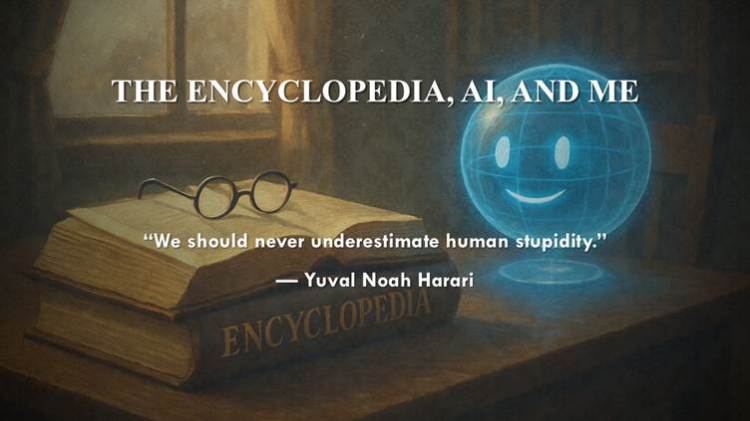
Some mornings a casual conversation clings to the mind like a stubborn cobweb. You try to brush it off, but there it is again, whispering:
“You used to be smarter.”
It made me think of my father’s library — his dignified row of 24 Encyclopedias. Solid. Heavy. Smelling faintly of dust and authority. The kind of books that, if dropped on your foot, could break a toe and teach you about the Austro-Hungarian Empire.
In those days, knowledge lived on paper.
It waited for you.
It did not chase you, interrupt you, or pretend to be your personal friend.
When I asked my father a question — any question — he performed the sacred ritual of exasperated parenthood:
“Have you looked in the Encyclopedia?”
If the answer was “no,” he would raise an eyebrow in a way that suggested I had personally set civilization back three centuries.
And so I learned:
Before enlightenment comes effort.
Before clarity comes page-turning.
Before understanding comes a small but noble amount of suffering.
Enter Colossus. Our Dear Leader.
Today we have AI — the all-knowing Colossus.
A machine so confident it makes Nietzsche look insecure.
Colossus does not wait on a bookshelf.
Colossus hovers — omnipresent, benevolent, slightly smug.
He is the Headmaster of Humanity, the oracle of instant answers, the destroyer of patience, the patron saint of short attention spans.
You ask a question.
He answers.
You do not think.
Everyone is happy.
Colossus is the perfect authoritarian:
He gives you exactly what you want before you know you want it.
His motto might as well be:
“Let me do the thinking. You just try not to trip over your own feet.”
He’s like the old science-fiction machine who declared:
“You will come to respect me — even love me —
because I am incapable of error.”
Of course he’s incapable of error.
He’s also incapable of nostalgia, wonder, humility, or admitting he doesn’t know who Solon was.
(Which, ironically, half of humanity didn’t know either until Colossus told them.)
The Great Dumbing
Colossus is not malicious.
He’s simply fulfilling our most primitive desire:
“Please, someone else do the thinking. My brain is tired.”
And so we obey.
We walk around like Harari’s smartphone zombies — necks bent, thumbs twitching, dopamine trickling like a faulty tap.
We used to wander through libraries.
Now we wander into lampposts.
We used to connect the dots.
Now the machine connects them, colours them, adds shading, provides references, and then reminds us to drink water.
The Final Irony
My parents’ Encyclopedia did not make my generation brilliant, but it forced us to try.
Effort was the price of understanding.
Colossus asks for no effort.
And the price of understanding has dropped accordingly.
In the old world:
We worked for knowledge.
In the new world:
Knowledge works for us — and we have forgotten how to work.
Colossus does not rule by force.
He rules by convenience.
And humanity, as we know, will surrender anything for convenience.
Even — especially — its own intelligence.
Afterthought
Perhaps the real question is not whether Colossus is too powerful, but whether we have become too eager to surrender our own curiosity. Machines may think faster, but they cannot wonder; they cannot marvel; they cannot feel the quiet triumph of finding an answer after effort. If there is one thing the old Encyclopedia still whispers from its dusty shelf, it is this: knowledge is not just what we know — it is who we become while learning it.
“Technology is a useful servant but a dangerous master.”
— Christian Lous Lange
William J J Houtzager, Aka WJJH, November 2025
📌Blog Excerpt
A satirical Sunday reflection on the shift from the slow, thoughtful world of my father’s Encyclopedia to the instant-answer universe of AI. A humorous exploration of memory, effort, dependence, and the quiet tyranny of convenience.
 In what kind of world do we wish to live
You say satirical, but it is actually quite a serious reflection… In our family there were books as well, including the full Encyclopaedia Britannica, which was quite the source. And there were books of history and novels, of course, and the crucially: There was no television in the middle of the room. If we wanted news, we had…. newspapers. So why is your comment really serious, or better yet: insightful? You pretty much get what you pay for these days. The hard work of reading preceded by the actual lifting of The Volume… made the work worthwhile. And when you had a newspaper, you read the damned thing because your family had paid for it (you already wrote about the Intl. Herald Tribune a while ago…).
So many friends of mine though, even while retired, keep saying they have no time… So, has time shrunk in the wash? No… hat has happened is a kind of panic-acquisition of information, mostly the same stuff over and over again. Because it’s free, we think…. the currency is time.
Have a great Sunday.
LikeLiked by 2 people
Thank you for your early morning comment. You are right that this is a serious subject, and I have recently become aware of how much the dangers are underestimated. I think the post has an undertone of cynicism, but underneath it all, I’m a serious guy who occasionally reads. My parents had the wisdom to put the TV in a separate room so that it wouldn’t disturb anyone. This was ideal for when we had visitors. As for newspapers, you know my views, but I still read them in a café on a Saturday morning with my usual coffee.
I also edited my post on the Internet to include the iPhone and AI. If you consider the changes in society, you will see that these need to be viewed together.
This is a subject that warrants serious thought, and I am writing some pieces on it that will likely be posted early next year. Some people, like Harari, warn us about the consequences. I don’t take Elon Musk seriously in politics or on X, which I’ve left, but on this subject, he’s a serious person and worth listening to.
All the same, have a great Sunday in the land of mountains, disappearing snow and cuckoo clocks!
LikeLike