Europe’s Eastern Ambitions and Dutch Realities
A Short Reflection on Strategy, Costs, and the Drift of D66
✍️ Author’s Note
This reflection revisits Europe’s eastern ambitions and their quiet domestic consequences, written at a moment when Dutch coalition negotiations have entered a new phase. It does not question Europe’s moral language, but the strategic and fiscal realism beneath it. As European commitments expand, the space for honest political choice at home is narrowing—often without being acknowledged.
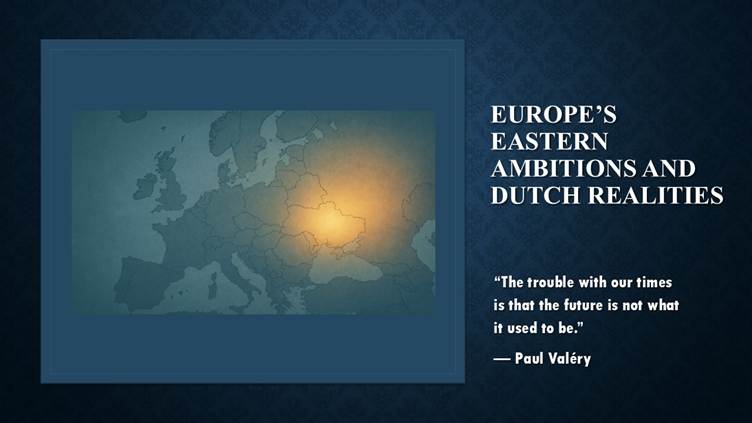
There are moments when the polite European narrative reveals its cracks.
The war in Ukraine is one of those moments.
Behind the moral language—democracy, sovereignty, the rule of law—lies a far more uncomfortable truth: Europe itself helped create the strategic dilemma it now condemns. For two decades, the European Union spoke in warm, expansive sentences about “partners,” “integration,” and “shared futures,” while gradually drawing Ukraine deeper into its economic and political orbit.
None of this occurred in a vacuum.
Russia watched the West move ever closer to its historical frontier. That Moscow would react—violently, foolishly, and tragically—should not have been surprising. What is surprising is Europe’s insistence on being surprised.
Merkel and Sarkozy understood this in 2008 when they blocked Ukraine’s NATO membership. They were right—not because they admired Russia, but because they understood history, geography, and the brutal logic of power. Their successors, buoyed by moral certainty, forgot that restraint.
The European Union now advances into what Brzezinski once called the Eurasian Balkans: a volatile belt where great-power interests collide. Ukraine is only the beginning. If Europe anchors itself in Kyiv, what follows? Moldova? Georgia? The Caucasus? How far east does Europe’s moral mission travel along the Silk Road before it collides with Russian and Chinese realities?
This is not a question Europe is prepared to answer—financially, politically, or strategically. Yet we continue to act as if moral enthusiasm can substitute for strategic dependence.
The Dutch Dimension — D66, Fiscal Reality, and the Normalisation of the Extreme Right
This brings me back to the Dutch dimension—quiet on the surface, but decisive underneath.
Every grand European gesture eventually arrives in The Hague not as a moral principle, but as a budget line, a legislative crisis, or a coalition compromise. Today’s agreement between D66 and CDA, and the opening of a new negotiation phase in which VVD is implicitly aligned, makes this unmistakably clear.
The emerging framework suggests a coalition of at least three parties, with additional parliamentary support required—particularly for financial commitments, defence spending, and long-term structural reforms. Given the increasingly constrained fiscal environment, the preference for early structural financial agreements reflects not confidence, but caution.
The policy priorities now placed on the table are familiar:
- An energetic approach to asylum and migration: stricter asylum rules, the return of the “spreading law,” proposals to “modernise” or effectively bypass elements of the Refugee Convention, and temporary three-year residence permits.
- Phasing out the mortgage interest deduction.
- Tackling the housing shortage and spatial planning through large-scale, state-backed construction projects, combined with removing the nitrogen lock via far-reaching agricultural reform and nature restoration.
- Defence and security choices firmly aligned with NATO commitments.
- Creating space for economic growth, improving the investment and business climate, and addressing energy security and climate policy simultaneously.
Each of these choices carries enormous structural costs. Yet they are presented, as has become fashionable, as if they can be absorbed without painful trade-offs or long-term consequences for public finances.
As someone who has always considered himself a fiscally conservative liberal, I cannot overlook what is missing: the sober realism that characterised the early Rutte years. Rutte’s greatest contribution was not vision or charisma, but budgetary discipline—the recognition that debt is merely a promise made by adults and paid for by their children.
That clarity has faded.
What we see now is a new political logic:
the more the centre compromises with populism, the more populism becomes the centre of gravity.
The current negotiating agenda reflects this drift. Measures that once belonged exclusively to the radical right are now reframed as “pragmatic,” “necessary,” or “what society demands.” This is how the extreme right becomes normalised without ever needing to govern: bit by bit, the centre adopts its language, instincts, and ultimately its policies.
D66 at the Crossroads
This is where my reluctance about D66 deepens.
The party once stood for principled internationalism, the rule of law, and the belief that evidence—not emotion—should guide policy. Today, those principles remain in tone, but not always in consequence:
- It speaks eloquently of Europe, while avoiding a clear accounting of Europe’s financial ambitions.
- It defends human rights, yet accepts compromises that legitimise increasingly hardline asylum policies.
- It champions innovation, while endorsing construction and investment plans with insufficient fiscal grounding.
- It preaches long-term thinking, while supporting measures that mortgage the future for political survival in the present.
D66 wants to be European in ideals, progressive in tone, and fiscally responsible in image—while operating in a political arena where these positions increasingly contradict one another.
And so the Netherlands enters a new political phase: coalitions built on unease, budgets built on optimism, and compromises built on the quiet hope that tomorrow will take care of itself.
It never does.
The Larger European Question
The deeper irony is that Europe’s geopolitical ambitions are accelerating the very domestic forces that threaten liberal politics. The more pressure placed on budgets, migration systems, and social cohesion, the more voters drift toward parties that promise simplicity and assign blame.
If the centre cannot offer coherence, the extremes will offer clarity.
This is the paradox at the heart of Europe’s eastern ambitions. We speak of defending democracy abroad while quietly undermining it at home. We profess respect for international law, yet the European Commission now proposes legally dubious financial constructions—such as using €90 billion in frozen Russian assets at Euroclear to underwrite loans for Ukraine, effectively amounting to confiscation, raising questions about Eurobonds, and risking European financial stability.
We extend our moral reach eastward while borrowing against our future.
We speak of solidarity while shifting the costs to the next generation.
We engage in geopolitics without confronting its domestic consequences.
The war in Ukraine is reshaping Europe’s frontier. More quietly—but no less profoundly—it is reshaping Europe’s democracies, and none more so than our own.
As someone who values stability, realism, and coherence, I cannot escape a growing unease:
if Europe continues to pursue expansive ambitions abroad while ignoring its limits at home, it risks destabilising both.
William J J Houtzager, Aka WJJH, December 2025
📌 Blog Excerpt
Europe speaks of defending democracy at its eastern frontier, yet increasingly struggles to preserve it at home. The war in Ukraine has exposed a paradox at the heart of European politics: moral ambition abroad paired with evasiveness about its domestic costs. In the Netherlands, this tension surfaces not in grand speeches, but in coalition agreements, budgetary optimism, and the gradual normalisation of policies once considered extreme.
As D66, VVD, and CDA move toward a new governing framework, the familiar language of pragmatism masks a deeper drift. Strategic commitments are made first; fiscal consequences are deferred. Human rights are affirmed in principle, while quietly diluted in practice. What emerges is not a political breakthrough, but a consolidation of unease—where Europe’s expanding role accelerates the very pressures that weaken liberal democracy from within.

