Humanism in the Age of Machines
What Remains When Judgment Is Outsourced
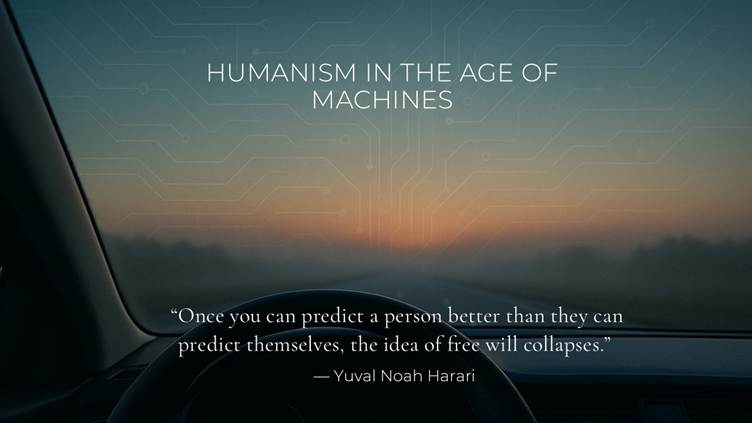
Humanism—the belief in human dignity, agency, moral responsibility, and reason—has shaped Western civilization for centuries. At its core lies a simple premise: humans matter because humans choose.
Those choices are grounded in judgment, hesitation, responsibility, and meaning. They are imperfect by design. Humanism does not celebrate flawless optimisation; it values doubt, slowness, and the fragile process of weighing one option against another. These are not qualities that can be delegated without consequence.
We are not defined by intelligence alone, but by conscience—by our capacity to reflect, to err, to take responsibility for decisions made under uncertainty.
What does this mean in a world where decision-making is increasingly delegated to machines?
As artificial intelligence learns to interpret, predict, and optimise on our behalf, the foundations of humanism do not collapse overnight—but they begin to drift. Judgment becomes convenience. Responsibility becomes abstraction. Choice becomes suggestion.
If Geoffrey Hinton warns that AI may outthink us, Yuval Noah Harari warns that it may outmanoeuvre us.
His concern is not survival, but freedom—not whether humanity endures, but whether the individual mind remains its own. For Harari, the decisive question is not what machines can do, but what they can learn about us—and how that knowledge is used.
Artificial intelligence decouples intelligence from consciousness.
It generates insight without awareness, persuasion without empathy, and prediction without experience. Once intelligence is separated from consciousness, it can be weaponised in unprecedented ways.
A government, corporation, or platform equipped with vast data and powerful models gains the ability to anticipate emotions, nudge behaviour, and shape preferences—often without the subject ever realising it. The battleground is no longer territory or ideology, but the human interior.
Harari’s greatest fear is that AI enables a new form of governance: digital authoritarianism—systems that know citizens better than they know themselves, and that intervene before dissent, doubt, or reflection even arise.
China offers the clearest example.
A dense web of cameras, sensors, and algorithms follows citizens through streets, workplaces, shops, and increasingly private spaces. Behaviour is analysed, psychological indicators monitored, compliance quantified. Stability becomes a metric; deviation becomes detectable.
Yet the West is not exempt.
Edward Snowden revealed that Western intelligence agencies also aspire to total informational awareness, though their methods are subtler. Instead of overt coercion, the mechanism is consumption. Corporations know what we fear, desire, and avoid. Preferences are shaped before we consciously form them. Democracy weakens when electorates are continuously profiled, nudged, and managed.
In such a world, autonomy erodes quietly.
We outsource memory to devices, judgment to algorithms, opinion to filtered feeds, and attention to systems designed to capture and monetise it. The result is not tyranny in the classical sense, but passivity—a gradual surrender of agency masked as convenience.
Harari warns that free will risks becoming a nostalgic myth in a society where persuasion is automated and individualised. Elections turn into contests of algorithmic influence rather than civic deliberation. Citizenship thins into behaviour.
A new cognitive aristocracy emerges: those who design and wield intelligent systems, and those whose lives are shaped by them.
In this landscape, humanism cannot remain what it once was.
It becomes an act of preservation: the defence of attention, agency, and moral imagination in an age that quietly erodes all three. To remain human is no longer a given; it becomes a practice.
The future of freedom will depend not on the power of artificial intelligence, but on the human capacity to remain present, critical, and morally awake.
January, 2026
📌 Blog Excerpt
As artificial intelligence predicts, nudges, and optimises human behaviour, humanism itself begins to drift. Drawing on Yuval Noah Harari, this reflection explores how autonomy erodes when judgment is outsourced, how freedom thins into convenience, and why remaining human may soon require conscious effort.


LikeLiked by 1 person
Over machines gesproken. Eerst was er de Elsevier, toen kwam Collusus en nu hebben we AI. Zolas alles is het een proces. Het verschil met patroonerkenning in de jaren 70 is dat de machines alleen sneller en meer capaciteit hebben. Een zondag morgen reflectie .https://wjjh.blog/2025/11/23/the-encyclopedia-ai-and-me/
LikeLike