Epilogue — The Quiet Hour Before Tomorrow
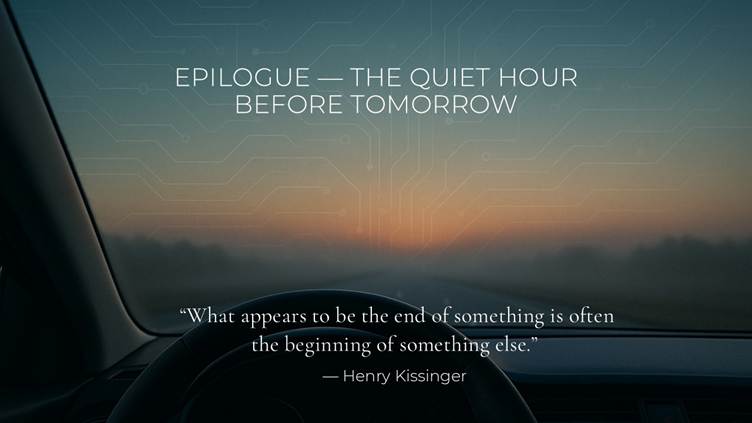
There is a moment each day—often before the news has had time to intrude—when the world is still honest. The light is soft, the mind unhurried, and the noise of human ambition has not yet begun its daily ascent. In such hours, one can look toward the future without fear, without illusion, and without the restless demands of the present.
One conclusion emerges with clarity: artificial intelligence, for all its power and uncertainty, is not an intruder from another world. It is a mirror. We built it from our curiosity, our ambition, our impatience, and our desire to know more than we can understand. It reflects both our genius and our frailties. And now it stands before us, asking questions we once reserved for philosophy alone.
Hinton reminds us that our creation may outrun us.
Harari reminds us that our freedom may slip quietly away.
Musk asks what remains of meaning once machines can do everything better.
And Kissinger, in the final years of his long life, warned that we are leaving the Enlightenment behind—not by force, but by choice.
We are entering an age in which outcomes matter more than reasons, prediction more than understanding, efficiency more than truth. What fades is not only a method of thinking, but a spirit—one that once valued effort, discovery, hesitation, and doubt.
A friend recently wrote to me that technology increasingly removes mystery and wonder from life—the uncertainty that once made travel, exploration, and even error part of the romance of living. He described a journey through Italy in which every decision was guided by an algorithm, leaving little to chance.
I understood him immediately. I remember my own early travels through Italy from Switzerland, guided only by a Michelin map and curiosity. Every turn felt like an act of discovery. Today, the unknown has become an inconvenience; surprise, an inefficiency.
And yet it is precisely the unknown—the uncertain, the unplanned—that nourishes the human spirit. When everything is predicted, optimised, and pre-selected, boredom grows. Not the peaceful boredom of rest, but the existential boredom of a life without challenge or discovery. In a world where labour is increasingly automated and universal basic income becomes a necessity, this boredom may well become a social fault line. Divisions will not form only between rich and poor, but between those who find meaning and those who lose it.
Machines may carry the burden of calculation, prediction, and memory.
But wisdom—if it is to exist at all—remains a human responsibility.
The danger is not that machines become too intelligent, but that we become too willing to surrender our own. The future will be shaped not by the brilliance of our inventions, but by the clarity with which we confront ourselves.
Tomorrow will come, as it always does, with its algorithms, its miracles, and its mysteries.
Whether we enter it as passengers or participants remains, for the moment, a human choice.
William J J Houtzager, January 2026
📌 Blog Excerpt
Artificial intelligence is not an intruder from another world, but a mirror of our ambitions and frailties. In this closing reflection, we consider what is lost when mystery becomes inefficiency, when prediction replaces discovery, and why wisdom, doubt, and meaning remain irreducibly human responsibilities.
 In what kind of world do we wish to live
Hello William, finally a little window of time in the hustle and bustle of activities… Your multipositional observations of AI and the modern world are very important. There is no single way to approach this new challenge to our human community. Because it is more than just a challenge…. like all tools, it is also n aid in certain tasks, a way of burrowing further and farther… Unfortunately, we cannot know whereto.
Recently, on some site, I mentioned a few times a word that you use… And I think it is because it is rarely used. Has nothing to do with intellect: wisdom. Sure, we can cultivate intellect in many ways. This morning, which taking care of all the little chores of my professional life, I am listening to the Grosse Fuge by Beethoven. As I stop, it rings in my head somewhere, it’s complexity making the brain feel as happy as an iron pumper lifting weights. Wisdom though, as you rightly suggest, comes in the silence before the fleas and wasps of the daily news cycle intrude on our thought patterns…
Finally a note… Who would have ever thought that Henry Kissinger would agree with Theodor Adorno…. the Enlightenment is finished. It left us with many thoughts about democracy, but also with the maybe erroneous notion that democracy is the end-all, not a stage…
Well… Thank you for these thoughtful texts. Back to the salt mines here… 🙂
LikeLike
Dear Marton,
Greetings to the salt mines, and your observations are highly appreciated.
I think the real risk lies not in AI itself, but in a passive approach to using it — treating it as a source of answers rather than a thinking partner. AI has amazing capabilities, but the danger is that people will stop asking their own questions if they rely on it. Those who use it in the way I used the encyclopedia — as a resource to interrogate, cross-reference and challenge — will likely sharpen rather than dull their thinking.
There has always been anxiety about new tools making people “dumb”, as I believe AI is doing. This anxiety is, of course, very old. People have said it about writing itself (Socrates worried it would ruin memory), the printing press, calculators and search engines. Sometimes these fears had some truth to them, but the bigger picture was always more nuanced.
I will some back on this soon.
Best,
W
LikeLike