The Continuous Flow of History
✍️Author’s Note
This short reflection began with one of those deceptively simple morning questions: do I think more about the future or the past? The longer I sat with it, the less convincing the distinction became. The future does not arrive untouched, and the past is never entirely behind us. This piece is a brief meditation on history as continuity: not as nostalgia, but as a way of understanding the present with greater depth, proportion, and realism.
Do you spend more time thinking about the future or the past? Why?
LETTERS TO THE PROMPT
The prompt, with its familiar habit of asking intrusive questions early in the morning, offered one that was more interesting than most: do I spend more time thinking about the future or the past, and why? On the surface, it seemed a simple choice. Yet the more I let the question breathe, the less separate the two appeared.
It is a mistake to assume that the past is dead and only the future counts. Without some understanding of how human beings have behaved across the centuries, how are we to interpret the present moment — the rise of China and the Global South, the uncertainties of the Atlantic world, the wars in Ukraine and the Middle East, or the shifting balance of power in the international order? We do not understand Pax Americana without remembering Pax Romana, nor the temper of our own age without looking through the eyes of thinkers such as Voltaire and Nietzsche.
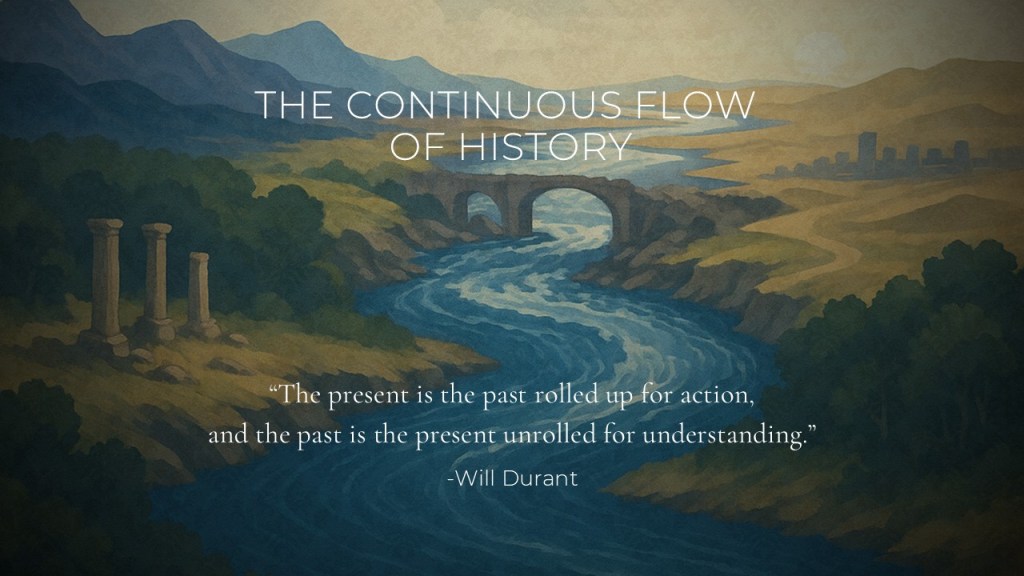
It made me think of Will and Ariel Durant, who understood history not as something finished, but as something that continues to live in the present. They often saw political history as a turbulent torrent of wars, revolutions, and ambition, while the deeper life of humanity continued on its banks. As Will Durant wrote, “the present is the past rolled up for action, and the past is the present unrolled for understanding.”
For Durant, the central questions of life concerned the nature of man and the search to reduce suffering while enlarging the possibilities of a meaningful life. History therefore mattered because it was, in his words, “philosophy teaching by examples.” It was not speculation, but reality observed across centuries: how human beings have actually behaved, built, ruled, believed, destroyed, and begun again.
That remains, to me, one of the clearest ways of expressing why the past still matters. I do not dwell on it out of nostalgia, but because it helps explain the present. Memory — personal as well as historical — gives shape to judgment. What we call the future does not arrive untouched; it emerges from what humanity has already lived, learned, forgotten, and repeated.
Civilisation moves through continuity and disruption, decline and renewal. Societies falter, powers pass, and yet something remains: ideas, values, habits of thought, fragments of wisdom, taken up again by those who come later.
Perhaps that is why I find it difficult to choose between past and future. The past is never wholly behind us, and the future never arrives empty-handed. History remains our most reliable guide to human character, to the temper of the present, and to what may still lie ahead.
William J J Houtzager, May, 2026
📌Excerpt
The past is never wholly behind us, and the future never arrives empty-handed. What we call the future emerges from what humanity has already lived, learned, forgotten, and repeated. History remains our most reliable guide to human character, to the temper of the present, and to what may still lie ahead.

