The Mirror and the Compass
Europe, power, and the search for direction in a less ordered world
✍️Writer’s Note
This reflection began with a personal memory of Davos in another age, when the world, though dangerous, still seemed structured and intelligible. What concerns me today is not simply that power politics has returned — it never truly left — but that the language of restraint, proportion, and strategic clarity has weakened at the very moment it is most needed. The mirror now facing Europe reflects more than external disorder. It reflects Europe’s own incompleteness, its habits of dependence, and its uncertainty about what it is willing to defend. In that sense, this is not only a geopolitical reflection, but also a meditation on direction, responsibility, and the cost of freedom in a harsher age.
— WJJH
Prologue — A World Less Certain
There was a time, in the early years of the World Economic Forum, when I moved more comfortably in that environment. It was the early 1980s. Davos was lighter then: playful, social, optimistic. The company was pleasant, the wine tasted good, and although the Cold War was dangerous, its logic was clear. Nuclear deterrence was harsh, but intelligible. The world was tense, yet structured.
What has changed is not access or wealth, but the nature of danger itself. The frameworks that once helped to stabilise the strategic balance are steadily eroding. Arms-control treaties disappear almost unnoticed. Nuclear risks are discussed as though they can be compartmentalised, managed, or absorbed. At the same time, artificial intelligence is beginning to compress decision times and has already entered the theatre of war, adding new uncertainties to systems already under strain.
The world has not become more rational. It has become faster, more fragmented, less predictable, and less capable of self-correction. What once felt like a structured rivalry now resembles a landscape of overlapping risks, fading restraint, and growing strategic confusion.
This is why gatherings such as Davos and Munich no longer inspire confidence in the way they once did. They still bring together influence, language, and power, but no longer the same sense of orientation. The conversations remain polished, the declarations familiar, yet beneath them lies a more unsettling reality: a world moving forward without clear direction, and a Europe still uncertain how to navigate it.
I. The End of the Reliable Hegemon
For decades, Europe lived within the Atlantic system. The United States was not only its military protector, but also the central pillar of the order within which Europe functioned. The relationship was unequal, but broadly predictable.
That era is passing.
The United States has not ceased to be powerful, but it has become less reliable as a stabilising force. Its language has changed, and with it the character of the relationship. Where earlier administrations more often spoke the language of institutions, partnership, and shared rules, recent American rhetoric places greater emphasis on sovereignty, borders, national interest, and civilisational struggle.
In such a climate, Europe is valued less as a partner in a common political project than as an instrument in a harder contest for leverage. Tariffs, financial pressure, supply chains, and alliance politics become tools not only against adversaries, but also against allies. The hegemon does not disappear; it simply ceases to reassure.
This transformation did not begin yesterday. The Iraq war, the selective application of international law, and the widening divergence in strategic priorities already pointed to a deeper shift. What we are witnessing now is not a sudden rupture, but the gradual unravelling of an older Atlantic certainty.
The result is a relationship increasingly marked by mistrust. The United States remains indispensable in many respects, but no longer fully credible as the guardian of the order it once claimed to lead.
II. Europe’s Deeper Weakness
Yet Europe’s dilemma is not only external. Its deeper weakness lies within.
For years, European leaders have spoken of strategic autonomy, technological sovereignty, and political agency. Yet the structures of dependence have remained largely intact: security still anchored in Washington, critical technologies shaped elsewhere, and political unity fragile and incomplete.
This weakness long predates the war in Ukraine. It belongs to the wider post-Cold War settlement, shaped by Western confidence and too little regard for history, power, and insecurity. Russia bears full responsibility for its aggression and for the damage it has inflicted on Ukraine, on Europe, and on itself. But Europe, too, failed to think seriously enough about the world in which those choices would be made.
The post-Cold War order rested on assumptions that now appear increasingly fragile: that enlargement could proceed without lasting geopolitical consequences; that power would gradually yield to law; and that the American guarantee would remain firm even as the strategic environment changed.
Some European leaders recognised the dangers earlier than others. But Europe as a whole did not change course. It continued to expand its ambitions without securing the military, political, and economic foundations required to sustain them.
That remains the deeper problem. Europe speaks the language of sovereignty, but hesitates before its burdens. It proclaims principles, yet applies them unevenly when confronted with hard questions of power, alliance, money, and consequence.
Nationalism, meanwhile, remains Europe’s old sickness, while enlargement is increasingly treated less as a disciplined legal and political process than as a geopolitical instrument. In such circumstances, consolidation may be wiser than further expansion — not as retreat, but as self-preservation.
The European Union still resembles a large tanker: solid, procedural, and built for stability. In calmer waters this was a strength. In rougher seas it turns slowly.
Its difficulty, however, is not only slowness, but political incompleteness. Europe has economic weight, legal form, and administrative capacity, yet it still struggles to speak with one strategic voice. In a more forgiving age, that could still be mistaken for strength. In a harsher world, it reveals itself increasingly as weakness.
That, perhaps, is Europe’s deeper weakness: not simply that it depends on others, but that it has not yet fully accepted the cost of acting for itself.
III. The Mirror of the Wider World
From Brussels or Washington, the present moment may feel like a dramatic rupture in the Western order. Beyond the Atlantic world, the view is often different.
In capitals such as Brasília, Delhi, Jakarta, or Pretoria, these developments are seen less as a global crisis than as a redistribution of power within the West itself. Much of the existing international order was shaped without their meaningful participation, and its rules have often been applied selectively.
For many states, the system never fully reflected their experience. What the West now perceives as instability may therefore appear elsewhere less as an unexpected breakdown than as a long-anticipated adjustment. The cracks in the Western alliance are not necessarily mourned; they are read instead as signs that the old order no longer commands the same authority.
This does not mean that a fairer order is emerging. It means only that confidence in the old one has weakened. Many states now hedge, diversify, and balance, not because they trust a new centre, but because they no longer trust the old one to endure.
IV. The European Fork in the Road
Europe now stands at a strategic crossroads.
Two instincts have become increasingly visible. One seeks to preserve the Atlantic relationship for as long as possible, emphasising the depth of historical ties and the strategic realities that still bind Europe to American power. The other points in a different direction: toward a Europe more capable of defending its own interests and shaping its own course in a more fragmented world.
These are not merely different policy preferences. They reflect two different understandings of Europe’s future. One still treats dependence as tolerable, however uncomfortable. The other has concluded that dependence itself has become a source of vulnerability, and that autonomy can no longer be postponed.
That is now the deeper divide: not simply between Atlanticism and autonomy, but between a Europe that continues to adapt itself to circumstances shaped elsewhere and a Europe willing to bear the costs of acting more fully for itself.
This does not mean severing the Atlantic relationship, nor does it require the illusion that all European states will move with equal speed or equal resolve. But it does require a clearer sense of strategic proportion. A Union of twenty-seven members cannot indefinitely expand its ambitions without consolidating its political will, institutional discipline, and material foundations.
In that light, enlargement should be approached not as a reflex of geopolitical urgency, but as a question of long-term coherence. Expansion without sufficient consolidation risks importing fragility rather than extending stability.
Europe has not yet chosen. It still speaks in both registers at once, and in that hesitation lies much of its present weakness.
V. The Need for a New Compass
The present crisis is not only geopolitical. It is also moral and strategic.
For decades, the Atlantic relationship allowed Europe to postpone difficult decisions. Dependence could be described as partnership, and continuity could be mistaken for stability. That ambiguity remained sustainable for as long as the wider order retained a measure of coherence. It is less sustainable now.
The world is moving into a different era, marked by multipolarity, technological acceleration, strategic rivalry, and weakening restraint. The brief historical moment in which the United States functioned not only as a great power, but also as the central stabilising force of the Western order, is passing. The institutions remain, but confidence in their direction has diminished. Their language survives more easily than their authority.
What is emerging in its place is not a clearly ordered alternative, but a world in which no single power, and no coherent group of powers, appears capable of upholding a common order. That is why the present moment feels less like transition than like drift: not toward a new settlement, but into a harsher landscape of harder bargains, weaker rules, and greater uncertainty.
Europe is now entering a harsher phase of realism. It still speaks the language of moral certainty, but it is being forced back toward the facts of geography, energy, money, and power. It is being confronted with burdens for which it is neither fully united nor fully prepared.
Its difficulty lies not only in external pressure, but also in its own habits of delay. Faced with a harsher world, Europe still looks for restoration where adaptation is required. It still hopes that familiar formulas might revive an earlier balance whose foundations have already eroded.
This is less a strategy than a habit of postponement.
Václav Havel understood that systems do not disappear only when they collapse. They also decay when people continue to live within them as though their inner meaning were still intact. That is the danger now: not sudden disintegration, but slow exhaustion — structures preserved in form while their political and moral coherence quietly weakens.
Europe must therefore look in the mirror and reconsider its strategic assumptions in the light of a changed world. It must recover clarity about what it is, what it wishes to defend, and what responsibilities freedom now requires.
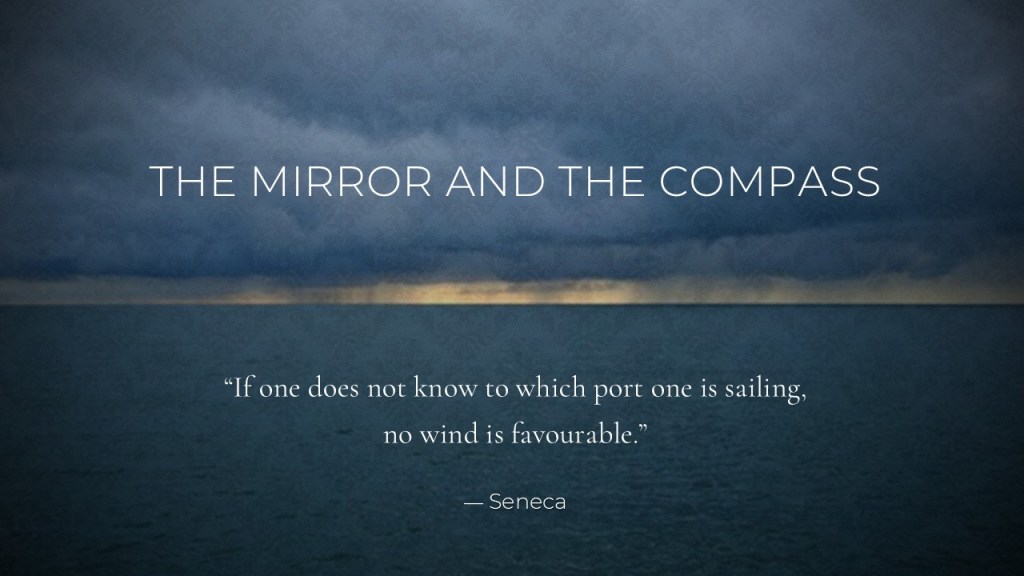
A continent that wishes to remain free cannot indefinitely borrow its direction from others. Without a new compass, even the strongest vessel will drift. And in a world of gathering storms, drift itself becomes a choice.
Afterword
Davos and Munich differ in tone, language, and setting. One speaks of dialogue, responsibility, innovation, and global management. The other speaks more openly of security, deterrence, rearmament, and force. Yet both belong to the same Western world, and both, in their own way, reflect its present condition.
What troubles me is not that power and national interest remain facts of international life. That has always been so, and no serious observer of history can pretend otherwise. More troubling is the growing ease with which force is once again spoken of — sometimes as necessity, sometimes as credibility, and sometimes almost as a privilege of those strong enough to exercise it.
In Munich, this appears in the explicit language of strategy. In Davos, it is softened by the idiom of governance and leadership. Yet the underlying question may be the same.
A civilisation does not lose itself only when it uses power unwisely. It also loses itself when it begins to forget the language of measure, restraint, and proportion. Simone Weil, writing in dark times, understood that force deforms not only those who suffer it, but also those who come to rely upon it. The older Greeks gave a name to the reckoning that follows such excess: Nemesis.
Whether our own civilisation still possesses the capacity for self-correction is therefore no abstract question. It is the question that lies beneath the speeches in Munich and the polished assurances in Davos. For when power begins to present itself as its own justification, what is lost is not only restraint, but perhaps also the wisdom to know where strength should end.
“Force is as pitiless to the man who possesses it, or thinks he does, as it is to its victims.”
—Simone Weil
June, 2026
📌Excerpt
From Davos to Munich, the Western world still speaks the language of power, responsibility, and order — but with less clarity than before. As the Atlantic relationship grows less reliable and the wider world adjusts to shifting balances, Europe faces a deeper question: whether it can still borrow its direction from others, or whether it must finally learn to act for itself. The Mirror and the Compass is a reflection on strategic drift, political incompleteness, and the need for measure in a less certain age.
 In what kind of world do we wish to live