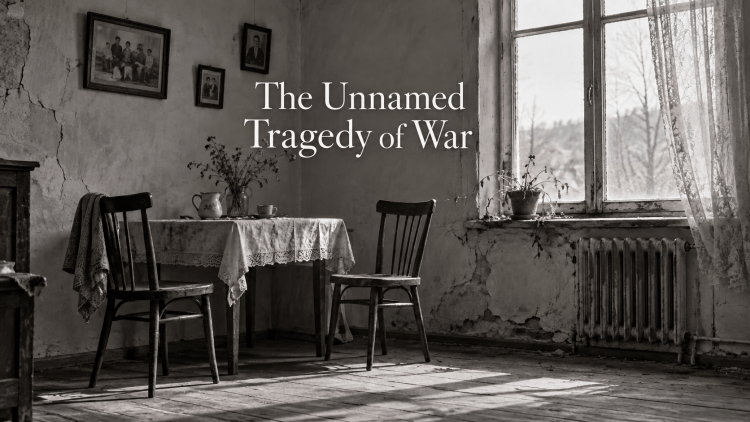
The Unnamed Tragedy of War
Ukraine, Russia, and the Human Cost of Simplified Identities
✍️ Author’s Note
This essay is not written to blur responsibility. Russia’s invasion of Ukraine remains the decisive act that unleashed the present catastrophe. But responsibility for aggression does not remove the need to look at war in its full human dimension.
Behind the language of sovereignty, security, alliances, deterrence, and national survival stand ordinary people: the displaced, the poor, the elderly, the conscripted, the mixed families, and those whose language, memory, or place of birth suddenly becomes a political burden. They do not design grand strategy. They do not draw the maps. Yet they are the first to pay the price.
The tragedy explored here is the simplification of human lives by war. Ukraine and Russia are not abstractions; they are also families, memories, churches, languages, loyalties, and histories that do not always fit neatly into political categories. Once the dogs of war are unleashed, complexity is among the first casualties.
This reflection therefore tries to hold two truths together: moral responsibility must remain clear, but the suffering of ordinary citizens must not disappear beneath the slogans raised in their name.
—WJJH
Force is that which makes a thing of whoever submit to it.”
—Simone Weil, The Iliad, or the Poem of Force
1. The unnamed tragedy
There is a tragedy in this war that neither side is eager to name, because neither side has much interest in ambiguity.
For many Ukrainians and Russians, the conflict is not merely an abstract confrontation between Kyiv and Moscow, democracy and autocracy, Europe and Russia, or the rules-based order and imperial ambition. It is also a war inside families, languages, churches, memories, and loyalties that were never cleanly one thing or another.
There are people with Russian roots and Ukrainian loyalty. Russian-speaking Ukrainians who want no part in Moscow’s imperial claims. Families divided less by ideology than by geography, by the accident of which side of a line they found themselves on when the shelling began.
War does not tolerate such complexity. It demands declarations. It turns language into evidence, memory into suspicion, and mixed identity into a political problem. In doing so, it abolishes a way of living that, for many people, was simply normal life.
2. The borderland inheritance
This, too, is not new in European history. Europe has always been a continent of shifting borders, broken empires, annexed territories, and overlapping identities. Its maps have often changed faster than the lives of the people who inhabited them. Borders were redrawn, but memories, languages, family ties, and local loyalties rarely obeyed the neat lines imposed upon them.
Nowhere was this more evident than in the lands once touched by the Polish-Lithuanian Commonwealth — that vast, plural, and ultimately fragile space where languages, confessions, and loyalties coexisted without resolving themselves into the clean national categories later demanded by the nineteenth and twentieth centuries. The Commonwealth’s collapse did not end that complexity. It merely left it exposed to forces that preferred simplicity: empire, nationalism, occupation, and the modern state’s hunger for clear allegiance.
Ukraine lies within that long and troubled history. Its tragedy is not only that it became a battlefield between states, but that the war has forced millions of people to choose between layers of identity that history had allowed, however imperfectly, to coexist.
The Commonwealth was not a modern liberal democracy. It was aristocratic, unequal, and often unjust. Yet it represented a form of historical coexistence that later national projects found difficult to tolerate. Polish, Lithuanian, Ruthenian, Jewish, German, Armenian, and Tatar communities lived within a shared, if fragile, political world. Their lives were not free from hierarchy or conflict, but they were also not yet forced into the harder categories that modern nationalism would later impose.
Its destruction by Russia, Prussia, and Austria left more than a geopolitical wound. It left a lesson. For the peoples who emerged from that borderland — Poles, Lithuanians, Ukrainians, Belarusians, Jews, and others — complexity could come to look like weakness. Ambiguity could look like danger. If you did not define yourself clearly, others would define you, and the definition might arrive with soldiers, officials, schools, police, and new borders.
That lesson did not disappear. It passed through partitions, Russification, German occupation, Soviet rule, population transfers, and the brutal simplifications of the twentieth century. Again and again, the region was taught that survival required legibility: one language, one loyalty, one historical memory, one flag.
This helps explain why Eastern Europe often sees the war in Ukraine differently from Western Europe. For Poland, the Baltic states, and others shaped by the memory of partition, empire, and occupation, Ukrainian ambiguity was not merely a richness to be preserved. It could also appear as a vulnerability to be corrected. Their support for Ukraine has been genuine and substantial. But it has also carried an implicit message: become unified, become clear, become a nation-state strong enough to resist absorption.
Western Europe, shaped by different experiences — the Reformation, the Enlightenment, post-1945 reconstruction, the long peace, and the European Union’s language of law and values — often saw Ukraine chiefly as a democracy to be defended and eventually integrated. That was not wrong. But it was incomplete. It did not always grasp that Ukraine was not only defending itself against an invader; it was also undergoing the painful, uneven, and sometimes harsh process of making itself into a more coherent nation-state.
Here the deeper tension begins.
3. The modern state under pressure
A modern state, especially one born from imperial collapse, cannot live indefinitely with unresolved questions of loyalty, language, memory, and institutional inheritance. It may tolerate ambiguity in peaceful times, but when it feels threatened, ambiguity begins to look like danger.
Ukraine faced this dilemma from the moment of independence in 1991. It inherited not only territory and institutions from the Soviet Union, but also languages, loyalties, memories, security structures, economic dependencies, and regional differences that did not easily fit into one national story. To build a functioning state out of such inheritance was never going to be simple.
The Russian threat sharpened this problem. As Ukraine increasingly came to be seen in Moscow as a potential Western bridgehead, Russian hostility hardened further, and Ukraine’s need for internal coherence became more urgent. Language policy, de-communization, lustration, cultural legislation, church questions, and the elevation of one historical memory over another all became part of the same process: the attempt to make the state more unified, more legible, and more resistant to outside pressure.
This was not merely intolerance. Nor was it simply nationalism in its crudest form. Much of it followed the logic of a vulnerable country seeking survival. A state that fears absorption by a larger neighbour will try to reduce the neighbour’s influence within its own institutions, symbols, schools, churches, and public space. It will ask: what binds us together, and what leaves us exposed?
Yet this logic carries its own danger. Measures created for protection can become instruments of exclusion. Policies intended to strengthen democratic independence can be used for political revenge. The effort to cleanse institutions of old power structures can expand into a broader suspicion of people, languages, memories, and cultural inheritance. What begins as state consolidation can become a narrowing of human possibility.
This is why lustration is among the most controversial tools of transitional justice. In limited form, aimed at the highest offices of state, it may be understandable in a country emerging from authoritarian rule or imperial domination. But when applied too broadly — to civil servants, judges, officials, teachers, or political opponents — it risks weakening the very rule of law it claims to defend. The past is not easily purified. It must be judged carefully, or the act of purification becomes another form of injustice.
This dilemma was not unique to Ukraine. Across much of post-communist Central and Eastern Europe, lustration became one of the most contested instruments of democratic transition. Its purpose was understandable: to prevent compromised officials, informers, or servants of the old regime from quietly carrying their influence into the new democratic order. But the same instrument could also be stretched too far. It could punish association rather than conduct, biography rather than guilt, and inconvenient political identity rather than proven abuse of power.
In societies emerging from dictatorship or foreign domination, the temptation to purify the public sphere is strong. But history rarely divides people neatly into heroes and collaborators. Many lived under systems in which silence, conformity, fear, professional survival, and ordinary compromise were woven into daily life. To judge such lives decades later by the certainties of a different age requires caution. Without that caution, lustration risks becoming less a defence of democracy than a ritual of retrospective judgment — and sometimes a useful instrument for those who inherit power.
Ukraine’s case was harsher because the threat was not only historical. It had developed over time, but after 2014 it became immediate. The old imperial centre had not disappeared. It stood across the border, armed, resentful, and increasingly willing to use force. Under such conditions, the pressure to define the nation more sharply became almost irresistible.
But the human cost remained. Russian-speaking Ukrainians with no loyalty to Moscow’s imperial claims could still feel the ground shift beneath them. Mixed families, bilingual habits, Soviet-formed memories, Orthodox affiliations, local loyalties, Russian literature, Ukrainian patriotism, European hopes — all could once coexist in imperfect but ordinary ways. Under the pressure of war, they became harder to hold together.
A vulnerable state seeks unity because it fears destruction. The individual carries plurality because life rarely obeys the demands of the state. Between these two realities lies the tragedy of the modern state under pressure: the law may speak in categories, but human beings live in layers.
4. The people in the middle
War has always had a cruel hierarchy. Those who decide, explain, justify, and remember it rarely suffer first. The first burden falls on the weak and defenceless: the elderly, the poor, the displaced, the mixed families, the people without influence, and those whose identities do not serve the certainty of either side.
The people most exposed to this tragedy are not always those with the loudest political voices. They are often those who lived between categories: Russian-speaking Ukrainians with no loyalty to Moscow’s imperial claims; families with relatives on both sides of the border; people whose memories were Soviet, Ukrainian, regional, European, religious, local, and familial all at once.
One hears, at times, a hardening of language toward Russian-speaking Ukrainians from the Donbas and other eastern regions. They are too easily treated not as people formed by a complicated borderland history, but as a problem to be explained, corrected, or distrusted. War makes such reactions understandable; it does not make them innocent, or right. The moment a language, accent, or region becomes moral evidence, the individual begins to disappear.
That is one of the quieter brutalities of war. It does not merely divide people by borders. It teaches them to mistrust the human complexity of their neighbours. A mother tongue becomes a political file. A family history becomes a possible accusation. A church affiliation, a childhood memory, a book on a shelf, a name, an accent, or a place of birth can suddenly carry meanings it never chose.
And this burden does not fall only on Ukrainians. Russia bears responsibility for the aggression, but Russian families also pay for the decisions of their rulers. Young men sent to die, mothers receiving silence or official lies, families broken by conscription, fear, propaganda, exile, imprisonment, or grief — they too belong to the human cost of this insanity.
To say this is not to create moral equivalence between aggressor and victim. It is simply to remember that states make war, but human beings bury the dead. The tragedy of Ukraine is first and foremost the tragedy of a country invaded. But it is also part of a wider human catastrophe in which ordinary Russians, especially those without power or protection, are consumed by the same machinery of violence.
There is no moral equivalence between aggressor and victim. Russia launched the full-scale invasion and bears responsibility for that crime. But responsibility for an act does not erase the longer history that made the act imaginable. For thirty years and more, warnings were given, opportunities missed, fears cultivated, ambitions enlarged, and compromise treated as weakness. Whether another path could truly have prevented the catastrophe, no one can know with certainty. What we do know is that ordinary people now pay for the failure of those who thought history could be managed without consequence.
Once the dogs of war are unleashed, the chain of decisions becomes harder to control. What begins as pressure, deterrence, correction, punishment, or limited intervention enters a world of its own. Fear answers fear. Escalation produces counter-escalation. Leaders still speak as if they are directing events, but increasingly they are also being carried by them. War creates its own momentum, its own vocabulary, its own justifications, and its own appetite for continuation. Those who opened the door may still claim purpose; those beneath the falling roof experience only chaos and destruction.
The weak and defenceless are always victimized in war. They are not the authors of the grand strategy. They do not sit at the tables where borders, alliances, sanctions, offensives, and peace terms are discussed. Yet they are the ones whose homes burn, whose sons disappear, whose daughters leave, whose language becomes dangerous, whose memories are rearranged by powers larger than themselves.
They are the unnamed casualties of a war everyone claims to be fighting for human values.
5. The final moral point
I write this from a distance, and distance has its privileges. It allows one to see patterns more calmly, to notice the long movements of history, and to observe the escalation ladder without being consumed by the intoxication of immediate passion. It may even make one see more clearly how avoidable elements entered the catastrophe. But distance also has its dangers. It can make suffering appear too orderly, too explainable, too available for interpretation. Those who live under shelling, occupation, conscription, displacement, exile, or fear do not experience history as an argument. They experience it as loss.
That is why the human cost must remain at the centre. States speak of sovereignty, security, alliances, deterrence, territorial integrity, democracy, liberation, historical justice, and survival. These things matter; without some of them no political community can endure. But the bitter irony is that every side invokes human values, while the human being too often disappears beneath the slogans raised in his name.
When the settlement is eventually announced — and it may well be announced from a city that is not Kyiv — the maps will be adjusted, the statements will be made, and the world will move on to the next crisis, as in many ways it already has. That is how such wars end, or appear to end. Europe will be living with the cost of this conflict for decades to come.
What will not be announced is the settlement of the human complexity this war has destroyed: the interrupted education, the damaged access to medical care, the families that cannot reassemble across new lines, the language spoken at home that now carries a political weight it never asked to carry. Nor will there be an official settlement for those who were both things, and are now required to be one, or neither, or something they do not recognise as themselves.
History is not sentimental about such losses. It does not record them cleanly. They surface later: in the next generation’s grievances, in the cultural wounds that outlast the military ones, in the quiet persistence of identities that refused to be abolished even when the state required it.
The Polish-Lithuanian Commonwealth was erased from the map in 1795. Its ghost has never left the region. The complexity it represented — imperfect, feudal, hierarchical, and ultimately indefensible against modern power — was suppressed repeatedly and returned repeatedly, in forms that those doing the suppressing did not anticipate and could not control.
This war will end, as most wars eventually end, through negotiation, exhaustion, or some arrangement imposed by necessity. The identities it has tried to simplify will not.
A realist looking at this from a distance sees something closer to recognition than consolation. History has never obeyed moral expectation. It obeys power, geography, demography, fear, exhaustion, and the stubborn consequences of decisions made by those who believed events could be directed without remainder.
The people caught inside the net — Ukrainians first of all, but also ordinary Russians consumed by the machinery of their own state — deserved better. They will not be fully compensated. The dead will not return. The wounded will carry their wounds. The displaced will carry their displacement. The mixed identities, the divided families, and the humiliated memories will not be restored by any communiqué.
And so the question Nikitenko asked in 1855, during the Crimean War — what is the sense of it all? — remains where he left it, watching another war consume lives over the same geography, for the same mixture of imperial ambition, political illusion, and human folly.
It had no answer then. It has no answer now. Perhaps it has never had one.
Unanswered.
And still the right question to ask.
“When the rich wage war, it is the poor who die.”
— Jean-Paul Sartre
June, 2026
📌Blog Excerpt
War demands clarity where human life is layered. It turns language into evidence, memory into suspicion, and mixed identity into a political problem. The tragedy is not only that states go to war, but that ordinary people — especially the poor, the weak, and the displaced — are made to pay for decisions taken far above them.
This essay reflects on the human cost of the war in Ukraine: not to blur responsibility, but to remember the ordinary people whose identities, homes, languages, and memories are crushed beneath the machinery of war.

