Every one is a Minority of One
The ‘other’ is closer than we think
✍️ Author’s Note
This essay began with a deceptively simple question: how do we deal with those who think differently? At first glance, the answer seems obvious: with tolerance, dialogue, and respect. Yet the question becomes more difficult when we realise how quickly “those who think differently” can be reduced to “the other” — the migrant, the refugee, the Muslim, the foreigner, or the political opponent.
My intention is not to deny real differences, nor to suggest that every opinion deserves equal moral weight. Humanism cannot be indifferent to racism, dehumanisation, authoritarianism, or contempt for the rule of law. But it should also resist the laziness of labels. Each person is shaped by culture, history, fear, loyalty, and experience — yet each person remains more than the category into which others place him.
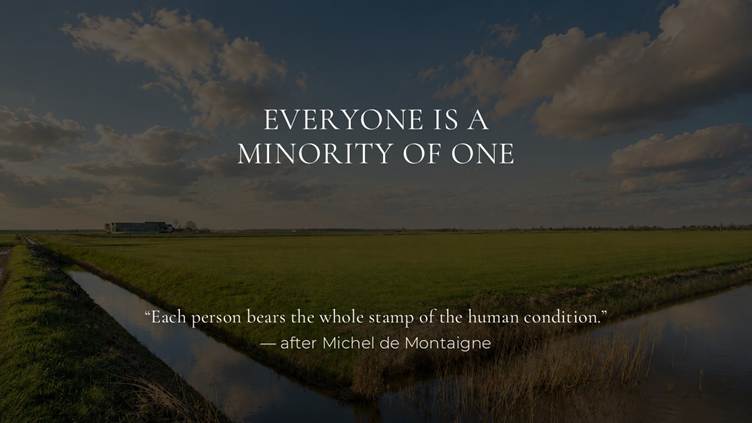
In that sense, everyone is a minority of one. The smallest minority is not a group, but the individual human being: vulnerable, contradictory, dignified, and never fully captured by a label.
— WJJH
I. The Trap Hidden in the Title
At first glance, the theme “How do we deal with those who think differently?” sounds generous, even humane. It suggests openness, dialogue, tolerance, and curiosity. Yet in the present political climate, the title also conceals a danger.
When we speak of “those who think differently,” many people do not immediately think of neighbours, friends, political opponents, believers, non-believers, conservatives, progressives, or difficult relatives around the dinner table. Too often, the phrase is instinctively translated into something narrower: refugees, migrants, Muslims, foreigners, or people with different passports and customs.
In this way, a broad humanist theme may unintentionally become a debate about “the other”: someone outside the dominant Dutch or Western self-image. That is precisely where simplistic labelling begins. And it is precisely the pitfall that any serious discussion on this subject should avoid.
The concept of “those who think differently” is much broader than “those from another culture.” It includes people with different political convictions, religious beliefs, moral instincts, levels of education, generational experiences, and ideas about freedom, authority, duty, identity, and truth. The urban progressive, the provincial conservative, the secular humanist, the Calvinist, the orthodox believer, the highly educated cosmopolitan, and the angry voter who feels ignored may all carry the same passport, but they do not necessarily inhabit the same mental world.
II. We Are All Andersdenkenden
Before asking how we should deal with those who think differently, we should first ask who exactly “we” are. The moment we take ourselves as the natural point of reference and view others as deviations, we have already created distance. We have placed ourselves outside the question.
A more humanist approach begins with the recognition that none of us sees the world from exactly the same window. Each of us is shaped by memory, temperament, upbringing, education, fear, hope, disappointment, loyalty, and experience. In that sense, every human being is a minority of one.
My own views are not easily captured by one label. I consider myself liberal, but not naïve; pro-European, but critical of Brussels; realistic, but not cynical; humanist, but not sentimental; tolerant, but with clear boundaries. In short, I too am an andersdenkende.
This kind of dissent — the refusal to fit neatly into simplified categories — is not a weakness of democracy. It is one of its conditions. A living democracy needs citizens who are not merely members of camps, tribes, or slogans, but persons capable of independent judgment.
In this regard, Geert Hofstede’s book Allemaal Andersdenkenden remains illuminating. His central insight is that people are not isolated thinkers. They are shaped by cultural patterns: attitudes toward hierarchy, uncertainty, individualism, collectivism, and long-term orientation. Such patterns help explain why people may react differently without immediately being unreasonable, hostile, or wrong.
But there is also a danger in cultural explanation. It can easily become cultural labelling. Then we no longer meet a person, but a category: “the Moroccan,” “the Muslim,” “the conservative,” “the migrant,” “the Westerner,” “the Dutchman.” Culture influences how people think and react, but it does not imprison them. Humanism should help us see both: the background that shaped a person, and the individual who may think beyond that background.
III. Three Kinds of Difference
Not all differences are the same. Anyone wishing to approach those with different views in a serious humanist spirit would do well to distinguish between at least three levels.
First, there are different opinions. These deserve patience, curiosity, and dialogue. Disagreements about political policy, climate change, taxation, education, migration, or the role of government are not threats to democracy. They are part of what democracy presupposes and needs.
Second, there are different values. These are more difficult, because they touch identity, morality, religion, loyalty, fear, and belonging. Here understanding is necessary. Hofstede’s framework may help, because it reminds us that people often reason from different cultural and emotional assumptions. But understanding is not the same as agreement. One can understand a person’s background without accepting their conclusions.
Third, there are hostile or anti-democratic viewpoints. These require firmness. Humanism cannot be neutral in the face of dehumanisation, racism, intimidation, conspiracy thinking, or authoritarianism. The boundary lies here: not every viewpoint deserves an equal moral place at the table. Polite inclusivity must not become a vehicle for normalising ideas that undermine human dignity itself.
IV. The Present Climate as a Mirror
The context in which this debate takes place is not neutral. Europe and the Netherlands are discussing migration and asylum in an increasingly hardened political language. Refugees and migrants are too often presented first as pressure, risk, burden, or problem — and only later, if at all, as human beings.
The new European Migration and Asylum Pact reflects this tension. It is presented as a necessary attempt to restore order, accelerate procedures, strengthen borders, and create a more workable European system. Yet the question remains: what values are being protected, and at what cost? Are these still the values of the Refugee Convention, human dignity, and the rule of law? Or are they increasingly the values of deterrence, administrative efficiency, and political containment?
The same hardening can be seen in Dutch politics. When mainstream parties adopt the rhetoric of the far right in the hope of taking the wind out of its sails, they often achieve the opposite. They confirm that the far right has identified the “real problem.” The policy may become somewhat more moderate than the extremist version, but the moral framework has already shifted.
History teaches us that compromise with the far right rarely neutralises it. More often, it normalises its language.
A humanist discussion should therefore be careful not to adopt the vocabulary of fear. Cultural differences deserve understanding, but people must not be reduced to cultural labels. A refugee is not first a case, a number, a burden, or a category. He or she is first a human being.
V. Civilised Without Being Naïve
The real challenge of this theme is not how we deal with like-minded people. That is easy. The challenge is how we remain humane, rational, and steadfast when confronted with people whose views we consider mistaken, disturbing, or even dangerous.
Tolerance has limits. Respectfully listening to a different opinion does not mean that every opinion deserves equal moral or factual weight. There is a difference between disagreement and bad faith, between another worldview and deliberate distortion, between criticism and dehumanisation.
For a humanist organisation, this is particularly relevant. Humanism is not only about freedom of thought. It is also about the self-discipline required to respect the thoughts of others without surrendering one’s own judgment. That is not an easy position. It is a balancing act — but perhaps the only honest one.
VI. The Mirror and the Compass
If we look in the mirror, we may see that the question is not simply how “we” deal with “them.” The other is closer than we think. The dissenter is not only outside the room. He is also inside each of us.
At the same time, the compass remains necessary. Openness without judgment becomes weakness. Judgment without openness becomes hardness. A humane society needs both: the mirror that reminds us of our own partial vision, and the compass that prevents us from losing moral direction.
This theme therefore raises four questions that cannot easily be avoided:
When does understanding turn into condoning?
When does tolerance turn into indifference?
When does cultural explanation become labelling?
When does political compromise become moral capitulation?
Perhaps this is the true humanist question: how can we remain open to people shaped by different worlds without abandoning our own moral and democratic principles?
That question is more difficult than the title first suggests. But for precisely that reason, it is worth asking.
For in the end, everyone is a minority of one. And once we understand that, the “other” is no longer merely outside us. The other is also our neighbour, our opponent, our fellow citizen — and sometimes, uncomfortably, ourselves.
📌Blog Excerpt
How do we deal with those who think differently? The question sounds generous, but in the present political climate it conceals a danger. Too often, “those who think differently” becomes a polite way of speaking about “the other”: the migrant, the refugee, the Muslim, the foreigner, or the political opponent. This essay argues that a serious humanist answer must begin elsewhere: with the recognition that every person is shaped by culture and experience, yet remains more than any label. Everyone is, in the end, a minority of one.

