Who Watches the Night
✍️Author’s Note
I have never found it difficult to say under which political roof I would rather live.
Liberal democracy, for all its imperfections, offers freedoms, institutions and protections I would not willingly exchange. But there is a difference between believing in liberalism and believing that liberalism must become a universal political religion.
Civilisations do not travel through history along the same route or at the same speed. Their histories, cultures, memories and interests differ. We may hope that human dignity, liberty and law acquire greater protection everywhere. But hope does not confer a right to redesign another society by force.
Perhaps an international order therefore has to begin more modestly: not with rules one group of states believes everybody else ought to accept, but with rules sufficiently different societies can actually agree to observe.
That may sound less ambitious. It may also prove more durable.
—WJJH
The strong do what they can and the weak suffer what they must.”
— Thucydides, the Melian Dialogue
After the Second World War, the United States stood at the centre of an international order, but it did not watch the whole world. The Cold War divided power, influence and allegiance between rival camps.
The Soviet collapse changed the scale of American ambition. For a time, Washington had the power to imagine that the rules of an international order could become the rules of the world. Under George W. Bush, that ambition acquired an especially confident language of freedom and democracy.
That order produced considerable public goods. It also reflected the unequal distribution of power from which it emerged. The United States benefited significantly from the economic, financial and strategic position it occupied within it.
Today that distribution is changing. The question is no longer whether the United States can remain the global Night Watchman it once aspired to be. It is whether order can survive when no one owns the night.
The Bellman and the Leviathan
In 1608 Thomas Dekker published The Bellman of London. The bellman walked the streets at night while others slept, calling the hours and warning of danger.

The image survived because the function survived: every community needs somebody to watch the gate.
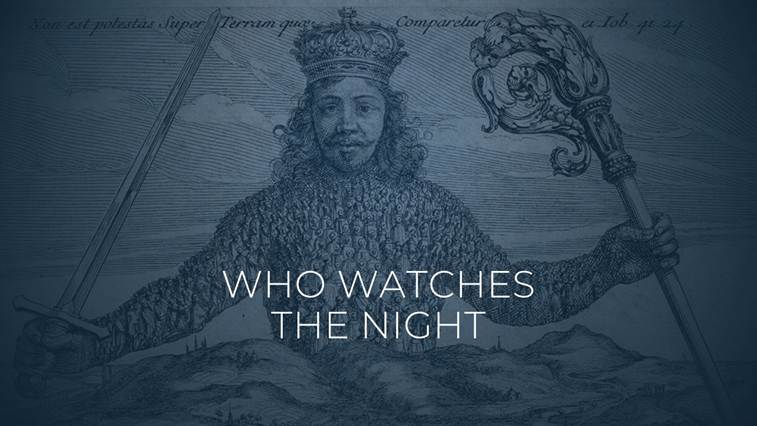
Thomas Hobbes approached the problem from another direction.
Writing Leviathan in 1651 after the upheaval of the English Civil War, Hobbes imagined human existence without a common authority capable of imposing order. His famous description of life as “nasty, brutish, and short” has survived rather better than the argument beneath it.
Hobbes’s point was not merely that human beings behave badly. Insecurity changes behaviour.
If nobody possesses sufficient authority to guarantee my safety, I must provide for it myself. I cannot know another person’s intentions, so precaution becomes rational. But what looks like precaution to me may look like preparation for aggression to somebody else.
Fear creates preparation.
Preparation creates fear.
Within the state, the Leviathan interrupts that cycle. Authority is hierarchical. Laws can be made, interpreted and ultimately enforced.
Between states, no comparable sovereign stands above them.
International politics is therefore anarchic—not in the sense that it is necessarily chaotic, but because there is no final political authority above sovereign states.
That distinction lies at the centre of the problem.
But Anarchy Is Not Chaos
Hobbes gives us the difficulty.
Hedley Bull offers a possible answer.
In The Anarchical Society, Bull distinguished between an international system, in which states must take one another into account, and an international society, in which states recognise certain common interests, accept common rules and participate in common institutions.
There can therefore be order without world government.
States do not have to trust one another completely. They do not have to share political systems or moral philosophies. They need sufficient common interest in predictability to accept restraints upon their own behaviour.
Agreements should be kept and diplomats protected. Borders cannot simply be altered whenever a stronger neighbour wishes; force should carry costs.
None of these rules abolishes power. They make it somewhat more predictable, and perhaps that is the most an international order can realistically achieve.
Who Watches the Night?
The international institutions created after 1945 were formally based upon sovereign states, but they were never entirely egalitarian in practice.
The United Nations Security Council gave five powers permanent membership and vetoes.
The IMF distributed voting influence according to quotas; today the United States retains roughly 16.5 per cent of IMF voting power, well ahead of any other individual member.
The Bretton Woods monetary arrangements placed the dollar at the centre of the post-war financial system.
The result was neither simply empire nor equality. The system was horizontal in legal form, but significantly hierarchical in power.
The United States benefited greatly from that arrangement. It also supplied something the institutions themselves did not fully possess: military capability, financial capacity, markets, political support and enforcement.
The institutions borrowed some of their effectiveness from the states willing to stand behind them—and disproportionately from the United States.
That helps explain why institutional authority and political power should never be confused. When sufficiently powerful states support institutions, their rulings matter. When that support is withdrawn, their limitations become much more visible.
The WTO’s Appellate Body provides a modern illustration. Its inability to hear appeals after vacancies were left unfilled demonstrates how an institution may retain rules and procedures while losing part of the political support necessary to make them function as intended.
Institutions can acquire legitimacy of their own.
They cannot entirely escape the world that created them.
From Westphalia to Intervention
Sovereignty gradually became one of the organising principles of relations among states.
It was never applied consistently. European states frequently violated it and were particularly selective in recognising the sovereignty of peoples outside Europe.
Nevertheless, the principle imposed an important restraint: difference alone did not create a right to intervene.
By the end of the twentieth century that restraint was increasingly challenged.
Tony Blair’s 1999 Chicago speech proposed what he called a “doctrine of international community.” In an increasingly interdependent world, he argued, governments could no longer simply turn away from conflict or serious violations of human rights inside other states. He called for new rules governing international intervention.
The moral attraction is obvious. Should sovereignty protect governments whatever they do?
But another question follows immediately: who decides when sovereignty no longer protects them, and under whose rules?
If there is no universally accepted authority capable of answering those questions, the power to define the exception begins to migrate towards those possessing the means to enforce it.
The Iraq War need not be retried here. Nor Libya, Afghanistan, sanctions or regime change. The larger problem is sufficient: the watchman had gradually become not merely an enforcer of agreed rules, but one of their principal interpreters.
A formally horizontal order had acquired elements of hierarchy.
Liberalism Without Missionary Liberalism
This brings me to a distinction I increasingly find important.
I can prefer liberalism without believing that every society must resemble mine.
I can defend individual freedom, institutions and the rule of law without assuming that history has prescribed one political destination for every civilisation.
That is not moral indifference.
It is recognition of agency.
States, like individuals, inherit circumstances they did not choose. They possess histories they cannot erase and interests they may define differently from ours.
We are remarkably generous in explaining our own compromises and remarkably severe when judging somebody else’s.
An international order capable of surviving profound political difference may therefore have to begin with a simpler question: on which rules can we agree?
Not which rules would I prefer everybody else to adopt, but which rules are we prepared to observe even when observing them is inconvenient?
The International Criminal Court offers a test.
It is easy to support international justice when it concerns adversaries.
It is harder when the same institution claims jurisdiction over our own soldiers, leaders or allies.
The legal questions differ from case to case.
The political test does not.
Are the rules meant to restrain everyone, including those powerful enough to resist them?
International law exists to prevent the strong from doing whatever they can while the weak suffer whatever they must. Its credibility depends less on whether it can restrain the weak than on whether the strong accept restraint as well.
A rule that binds only the weak is not much of a rule.
The Watchman Changes His Language
American foreign policy has always mixed principles and interests. Washington accepted substantial costs because successive administrations generally believed that alliances, open markets, international institutions and a favourable global balance ultimately served American interests. The bargain was often long-term.
America First uses a different vocabulary.
The present administration states American national interest, reciprocity, sovereignty and regional priority more explicitly. Its 2025 National Security Strategy calls for restoring American “pre-eminence” in the Western Hemisphere and describes a “Trump Corollary” to the Monroe Doctrine; the White House has repeated that language publicly.
The change is partly from long-term investment in an international system toward a more immediate and openly transactional conception of national advantage. There is something clarifying about that.
The Night Watchman no longer necessarily says that he patrols every street because everybody shares the same principles.
He says more plainly that some streets matter because they lead to his own house.
But that immediately creates another difficulty.
If the United States claims exceptional security interests in its hemisphere, what principle prevents Russia or China from making analogous claims closer to home?
The answer cannot simply be that we trust one power and distrust another.
A security interest may be real without conferring a right of domination. That applies to Washington, Moscow and Beijing alike. Their neighbours have interests and choices of their own.
Otherwise the people living on the street disappear from the argument entirely.
China and the Gathering Storm
Nowhere is the problem more consequential than between the United States and China.
Graham Allison popularised the expression Thucydides’s Trap to describe the danger when a rising power approaches an established one. The phrase should not be mistaken for prophecy: history does not dictate that China and the United States must fight.
It does warn us about fear. One side strengthens itself because it feels insecure; the other becomes more insecure because the first side has strengthened itself. Hobbes would recognise the mechanism immediately.
China, however, is not a minor challenger at the edge of an established system. It has become deeply integrated into world trade, global supply chains and the economic life of the United States itself.
A war intended to preserve an international system could destroy much of the system both parties depend upon.
The important question is whether rivalry can be contained by rules that both sides consider preferable to the consequences of abandoning them. That returns us to Bull: predictability can itself become an interest.
But the test has to apply on both sides of the Pacific.
If America’s security interests do not entitle it to dominate its hemisphere, China’s do not entitle it to dominate Asia.
China has real interests.
Its coast is exposed. Its trade runs through waters it does not control. Its memory includes a century of foreign humiliation.
Those interests deserve to be understood.
They do not deserve to be obeyed.
Vietnam, the Philippines, Japan and the smaller states around the South China Sea have interests of their own.
They live on the street.
Taiwan is where these principles meet their hardest test.
Beijing claims sovereignty over the island. Taiwan’s people have built a political life of their own and must have a voice in their future. To recognise China’s security concerns is not to grant it the right to settle that future by force.
Washington has long managed this difficulty by acknowledging Beijing’s position while leaving its own response to a crisis uncertain. That ambiguity has helped preserve time and space. It cannot tell us how the disagreement will ultimately be resolved.
The rule worth defending is narrower and more demanding: neither a claim of sovereignty nor a claim of security gives a great power permission to extinguish the agency of the people most directly concerned.
For a smaller society, the question is never whether a great power has interests. It always does. The question is whether those interests leave room for others to remain themselves.
That is the question Singapore had to ask.
The Small Island
This is where Lee Kuan Yew becomes particularly useful.
Lee did not observe great-power politics from the safety of abstraction.
He governed a small and vulnerable state surrounded by much larger neighbours and exposed to decisions taken far beyond Singapore’s control.
When Singapore became independent in 1965, its position was precarious. Contemporary American records described a state concerned about economic survival, regional instability and the withdrawal of British power. By 1967 Lee regarded access to American markets and capital as important to Singapore’s future and also saw continuing American strategic engagement in Southeast Asia as significant for regional stability.
Yet Lee remained determined that Singapore should retain its independence of judgement. American officials themselves described him as independent and non-aligned even while recognising his support for a continuing American regional role.
That combination matters.
Lee understood that sovereignty did not eliminate dependence.
Singapore needed markets, capital, secure sea lanes and a regional balance of power.
It therefore had an interest in American engagement.
But engagement was not the same as ownership.
Great powers could help create the space within which smaller states survived and prospered. The smaller state still had to preserve enough room to remain itself.
Lee’s realism was therefore not fatalism.
It was the realism of vulnerability:
recognise power;
use it when interests coincide;
avoid unnecessary dependence;
strengthen yourself;
and preserve agency.
He also refused to assume that China’s development would eventually produce a Western China.
Asked whether China would become a liberal democracy, he rejected the premise. Asked whether the United States could prevent China’s rise, he argued that it would instead have to learn to live with a larger China. And asked whether war between the two was inevitable, he said no: China, in his view, was pursuing Chinese national interests rather than recreating the Soviet ideological challenge.
China had no intention of becoming an honorary member of somebody else’s civilisation.
It intended to remain China.
What Would Lee Kuan Yew Say?
What would Lee say now?
I suspect he would begin with relatively simple questions.
What is possible?
What is sustainable?
Who has the power to do it?
Who pays?
What happens afterwards?
And perhaps, before all of them:
Why?
Why does China require what it says it requires?
Why does America fear what it says it fears?
Which interests are vital?
Which are negotiable?
Which rules make coexistence possible?
And which supposedly universal rules are actually the preferences of a particular power?
These are not romantic questions, and neither are they cynical.
They are questions about power stripped of illusion.
Hobbes reminds us that there is no final Leviathan above states. Bull reminds us that this does not condemn us to perpetual disorder. Lee reminds us that accepting power as a fact does not require surrendering agency to it.
Perhaps an international order requires neither one Night Watchman nor several competing Night Watchmen guarding overlapping streets.
Rules matter most to the weak. But the strong have reason to value them too. Hobbes knew that even the weakest could threaten the strongest, by cunning or by combining with others. Power offers no permanent exemption from insecurity. And sometimes the pitchforks come out.
Order requires states powerful enough to break the rules to decide that they have an interest in keeping some of them. Institutions, law, habit, interdependence and balance of power can help. But none eliminates the central question:
Why should the powerful accept restraint when they believe they can do better without it?
The Night Watchman cannot answer that question for us.
And somewhere in sixteenth-century England, Thomas Cromwell would probably have recognised it at once.
November, 2026
📌Blog excerpt
For a time, the United States aspired to watch the whole night. As power shifts, can states agree on rules they will observe even when those rules restrain them? Hobbes, Hedley Bull and Lee Kuan Yew help frame the question.

