NRC, Olivier B. Bommel and Me
✍️ Author’s Note
An offer to deliver the Saturday newspaper brought back an older household: my father behind his paper, his pipe, our Newfoundland on the floor, and the bear I looked for in its pages. This is a small remembrance of Olivier B. Bommel, whose world became more recognisable as I grew older.
—WJJH
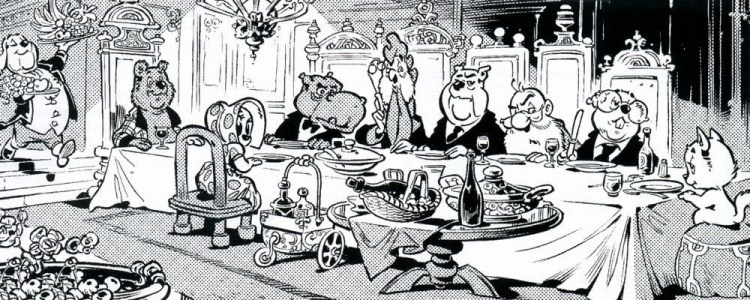
The phrase “a simple but nourishing meal” stayed with me.
In an age of social media and electronic news, NRC has offered to add a Saturday newspaper to my digital subscription, delivered before nine in the morning—for a modest additional fee, naturally. To borrow from Don Vito Corleone, it was an offer I could not refuse.
I prefer a book to an e-book, and a real newspaper to its digital edition. On a screen, I tend to glance through the headlines and select one or two articles. A paper in my hands comes alive and makes me read the paper. I turn the pages and encounter things I had not thought to look for.
NRC and I go back a long way—to my childhood in the years after the Second World War. There were no smartphones or laptops; the black-and-white television came later. There was, however, a piano, a radio, and there were books. Lots of them.
I can still picture my father reading when coffee was served after dinner, with Benno, our Newfoundland, stretched out beside him like an immovable piece of furniture. My father read the newspaper from beginning to end, smoking one of his pipes filled with Clan tobacco. My mother would smile and tell me to behave: he was “spelling out the paper.”
These are my scenes from childhood, Kinderszenen, with apologies to Robert Schumann.
My father had his newspaper, the Nieuwe Rotterdamsche Courant. I had my bear.
The bear was Olivier B. Bommel, the ever-misunderstood, life-tormented “gentleman of standing” from Marten Toonder’s universe. Neither the financial pages nor foreign affairs interested me then. Bommel and his young friend Tom Poes were quite sufficient.
In time, I would come to appreciate more of what lay between those pages. But Bommel was there first.
He lived at Bommelstein, near Rommeldam, a town whose picturesque houses always reminded me of Anton Pieck. Its inhabitants were animals, but their behaviour was thoroughly human. As I grew older, some became disconcertingly familiar.
Bommel—or heer Ollie, as Tom Poes calls him—was a gentleman of standing, at least by his own estimation. His standing occasionally required some maintenance. As NRC’s Folkert Jensma recounts, he hastily acquires ancestral porcelain before a visit from his aristocratic neighbour. An understandable precaution: ancestry is easier to establish when it is already on the table.
His mixture of vanity, generosity and noble confusion made him irresistible. He wanted to do great things, preferably without sacrificing too much comfort. Overconfidence carried him into trouble; self-pity accompanied him once he arrived.
Fortunately, Tom Poes kept a clear head. While Bommel explained the gravity of his predicament, his small companion generally found a way out of it.
The surrounding characters offered their own lessons in human affairs. Mayor Dickerdack looked after Rommeldam’s citizens while keeping a watchful eye on his own interests. Responsibility was something he preferred to delegate.
The Marquis de Canteclaer van Barneveldt guarded the distinctions of class and breeding, especially when Bommel threatened to blur them. A gentleman could apparently have money, a castle and a butler, yet still fail the entrance examination.
The butler was Joost, who kept the household running and usually restored order with a simple but nourishing meal.
And then there were the expressions that stayed with us:
“Money is of no consequence.”
“If you know what I mean.”
“As my dear father always said…”
His dear father seems to have left him advice for almost every occasion. Whether it helped was another matter.
For decades I collected the stories. Later, their long rerun in NRC brought Bommel and Tom Poes back into my evenings. They became familiar companions whose habits I knew and whose next misfortune I still wanted to discover.
Bommel was seldom wise and not always noble. Beneath the vanity, however, lay a warm heart. He could be generous, easily moved and genuinely concerned for others—even when his efforts made their situation considerably worse.
I understood his attachment to the good life: a comfortable chair, a crackling fire, freedom to arrange one’s own affairs, and Joost bringing dinner. My liberal sympathies could accommodate much of that, although the arrangement depended rather heavily on Joost.
Toonder allowed us to enjoy this comfortable world while exposing its pretensions. Officials evaded responsibility, businessmen pursued advantage, and clubs guarded their doors. Bommel protested when excluded and was delighted when admitted. He represented himself, and that kept him sufficiently occupied.
The final story, in 1986, brought him peace and marriage to his neighbour Annemarie Doddel. After so much confusion, it seemed a kindly place to leave him.
Now the Saturday paper will arrive before nine. I shall make coffee and unfold it before going into town for my shopping. Bommel and Tom Poes left its pages years ago. I still miss them.
Perhaps that is why a newspaper can be more than the news it carries. Unfolding it brings back my father, my mother, who played the piano and the violin beautifully; his pipe and the unmistakable smell of Clan tobacco, Benno on the floor, and a bear who became an old friend.
As children we laughed at Bommel’s world; with age, we began to recognise its inhabitants. Mayor Dickerdack became rather less fictional. De Canteclaer could occasionally be found at dinner. And Bommel himself might even appear in the mirror—if you know what I mean.
October, 2026
📌Blog Excerpt
A Saturday newspaper brings back my father, his pipe, and Olivier B. Bommel—a childhood companion whose world grew more familiar with age.
Source note
Character background and the porcelain anecdote: Folkert Jensma, “Met uw welnemen”, NRC: https://retro.nrc.nl/W2/Lab/Profiel/Bommel/welnemen.html
The final story and marriage: Literatuurmuseum, “Relatie met de maatschappij”: https://literatuurmuseum.nl/nl/ontdek-online/literatuurlab/online-exposities/toonder/relatie-met-de-maatschappij

