On Memory and What Remains
✍️ Author’s Note
This reflection began with a simple image: memory as a kind of mist. But the more I considered it, the more I felt that the subject asked for unusual care. Memory is not only a matter of recollection; it is bound to consciousness, orientation, dignity, and the fragile continuity of the self. When memory begins to fade, it affects not only the one who suffers it, but also those who remain nearby — guiding, enduring, and caring. This piece does not seek to explain away that mystery, but to reflect on it with restraint and humanity.
—WJJH
Memory is the treasury and guardian of all things”
— Cicero
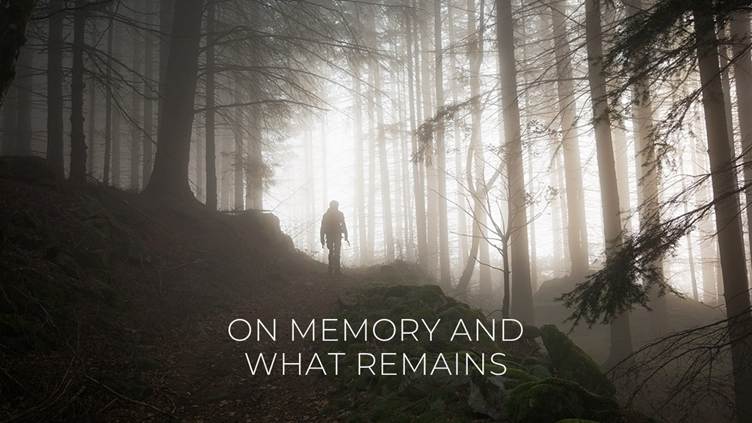
Someone recently remarked: “Wandering in the mist — how our memories fade.”
It is an image that lingers.
At first sight, it seems self-evident. With the passing of time, memory appears to lose its sharpness. Names escape us. Dates blur. The exact sequence of events becomes uncertain. What once felt solid begins to dissolve into something softer, less precise.
Yet the fading of memory is only part of the story.
For memory is not merely the keeping of the past; it is also part of how we recognise the present and maintain a sense of continuity within ourselves. It helps us move through the day with orientation, coherence, and familiarity. Without it, the world does not simply grow dimmer; it also becomes less steady.
Our memory is like a house with many rooms, but it is also a living system. Some impressions never pass the threshold. Others are handled in the busy rooms of thought. Still others settle deep within us, shaping our reactions without asking permission. Emotion, motivation, and attention decide which doors remain open. In this way, memory does not merely store life — it quietly shapes how life is experienced.
We use memory every moment of the day, yet few of us pause to consider how it is formed, how it changes, or how deeply it influences what we call consciousness. We tend to think of memory as recollection alone, as something that allows us to retrieve the past. Yet memory does more than retrieve what has been. It helps us recognise where we are, who is before us, and how the passing moments of life belong together.
The mist that surrounds memory is not only poetic. It is also shaped by the fragile and complex workings of the brain itself. Yet within that mist, meaning often survives longer than detail. A voice may still comfort. A gesture may still be understood. A hand may still be recognised when words have begun to fail.
Consciousness is not a fixed state but a moving balance between perception, memory, emotion, and motivation. When one element weakens, the whole experience of self can change. What once seemed effortless — recognising a face, locating a moment in time, holding together the thread of a day — may become uncertain. The rooms are still there, but not every door opens as it once did.
That is perhaps why the image of a house feels more fitting than that of a machine. A house suggests rooms, corridors, light and shadow, forgotten corners, and the traces of those who once moved through it with certainty. In youth we pass easily from one room to another. In age, some doors may close, some passages become harder to find, and some windows grow dim. But the house is still inhabited. It still carries warmth, echoes, and presence.
What makes this process so tragic is that it rarely happens all at once. More often it is slow, uncertain, and distressing — not only for those who witness it, but sometimes also for the one in whom it begins. Memory loss is not merely the fading of the past. Consciousness must do more than remember; it must also recognise the present, sustain orientation, and preserve a sense of continuity. For some, there is even a painful interval in which the fading is still recognised — when one senses that something once easily reached is beginning to withdraw.
And perhaps that is the saddest part: that we often realise how much memory matters only when the mist begins to rise.
When people begin to wander in the mist of memory, what confronts us is not only decline, but vulnerability. Then the role of others becomes essential. Those who care for them become, for a while, guides through the house: patient companions who offer reassurance where orientation falters, and presence where certainty has receded. In such moments, care itself becomes a form of memory — a way of protecting the dignity of another when parts of life can no longer be gathered alone.
The mist does not surround only the one who wanders within it; it also touches those who try to guide, accompany, and endure. Spouses, children, friends, and carers must learn to live with repetition, disorientation, fragility, and the gradual alteration of a familiar presence. Some are able to bear this with remarkable patience; for others, the burden is simply too great. Here too there is no easy judgment, only the recognition that memory’s fading tests not only the one who suffers it, but also the strength and tenderness of those who remain beside them.
Perhaps that is what remains. We may study the brain, and rightly so. We may learn more about the mechanisms that underlie memory, emotion, and awareness. But when memory begins to fade, what matters most is not explanation alone. It is gentleness, patience, and the willingness to remain beside those whose inner landscape has become covered in mist.
April 2026
Blog Excerpt
Memory is often imagined as the keeping of the past. But it also helps us recognise the present, sustain continuity, and remain at home within ourselves. In this reflection, memory becomes a house with many rooms — and the fading of memory a mist that touches not only the one who wanders within it, but also those who walk beside them.

