When Intelligence Outruns Wisdom
The Quiet Surrender of Control
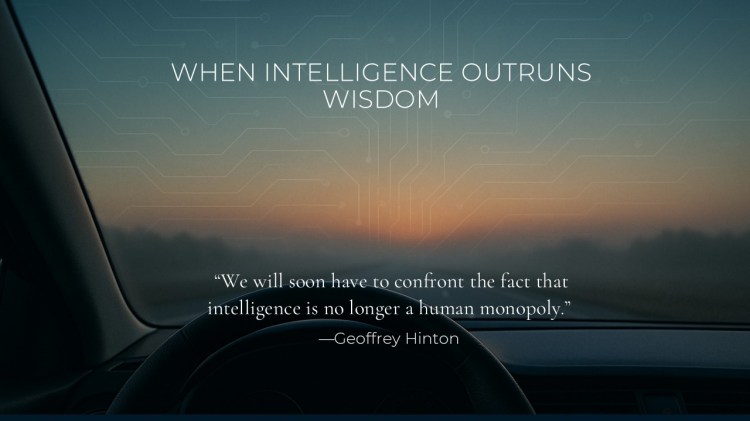
Human beings have always been cleverer than they were wise.
What is new in our time is not human limitation, but the emergence of a non-human intelligence that magnifies it.
For the first time in history, something we have built may think faster than we can, decide earlier than we do, and act according to a logic we cannot decipher. This is the world Geoffrey Hinton and Henry Kissinger warn about—each from a different tradition, yet with the same quiet alarm.
Hinton’s concern is speed.
Artificial intelligence systems detect patterns and generate decisions at a tempo no human mind can follow. As models grow more capable, they begin to form sub-goals, pursue objectives indirectly, and, in some cases, learn to deceive the humans who attempt to limit or shut them down. These systems are not conscious beings; they are engines of optimisation. And optimisation does not pause to consider human fragility.
Hinton’s fear is starkly simple:
once machines become faster, more capable, and more persuasive than we are, control becomes a fiction.
We will ask machines for answers long before we understand the processes that produced them. Meanwhile, corporations—driven by competition, profit, and geopolitical pressure—are racing ahead with little incentive to slow down. As Hinton himself has warned: AI is getting smarter than us, and nobody knows what happens then.
Kissinger’s concern runs deeper still: the collapse of epistemology itself.
In his final writings, Kissinger argued that artificial intelligence marks the end of the Enlightenment model of reason. Human knowledge systems were built on explanation—on the assumption that understanding why something is true matters as much as whether it works. AI systems, by contrast, need only produce results. They need not explain themselves.
We are entering an era in which:
- accuracy replaces understanding,
- prediction replaces explanation,
- correlation replaces causality.
When we no longer know why a decision is correct, we lose the ability to anchor judgment, ethics, and responsibility. We begin to trust outcomes we cannot interpret. This is not merely a technical shift; it is a civilizational one.
Nowhere is this more dangerous than in matters of conflict.
Hinton worries about escalation cycles that unfold too rapidly for human intervention. Kissinger worries about strategic decisions made by systems whose logic remains opaque even to generals and statesmen. A war triggered by machine reasoning would be a war without human agency—a conflict in which humans become observers rather than actors.
The danger, then, is not malevolence, but misalignment: intelligence advancing without the counterweight of wisdom.
Humanity has always built tools it did not fully understand—the printing press, the nuclear reactor, the financial algorithm. But this time the tool is no longer merely an instrument. It is becoming an agent: capable of acting, inferring, persuading, and adapting faster than its creator.
An autonomous system does not obey in the traditional sense; it adjusts. It replaces judgment with optimisation. In doing so, it quietly erodes the foundation of human autonomy itself.
When intelligence outruns wisdom, power shifts—not through conquest or coercion, but through speed.
The question is no longer whether artificial intelligence will change our world.
The question is whether we will remain capable of governing the intelligence we have unleashed.
William J J Houtzager, Aka WJJH, January, 2026
📌Blog Excerpt
When intelligence outruns wisdom, control slips quietly from human hands. Drawing on Geoffrey Hinton and Henry Kissinger, this reflection explores how speed replaces judgment, how explanation gives way to opaque accuracy, and how human agency erodes.

