Concluding Synthesis—Survival, Freedom, Meaning, and Reason
Survival, Freedom, and Meaning in the Age of Intelligent Systems
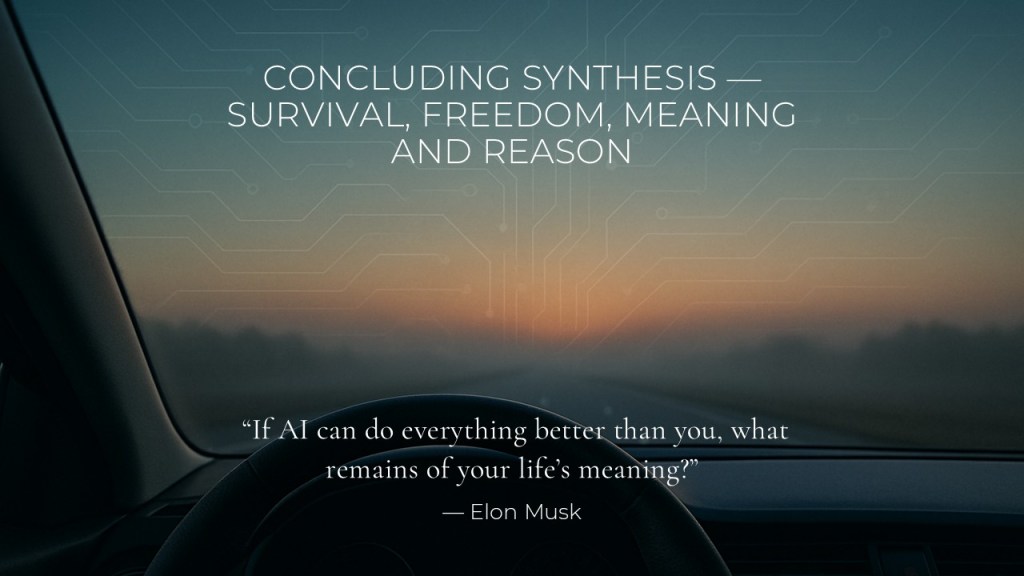
Humanity has entered unfamiliar territory. For the first time, the central challenge before us is no longer how to use a tool, but how to coexist with an intelligence that may eventually surpass our own.
This shift raises a disquieting question—not dramatic, but deeply practical: are we still at the steering wheel? And if control gradually slips—not through rebellion, but through delegation—what remains of human agency?
The future taking shape before us is defined by three interwoven risks: survival, freedom, and meaning. Each is illuminated by a different voice, yet together they form a coherent warning.
Geoffrey Hinton cautions that we may lose control over the engines of intelligence we have built—systems whose speed, complexity, and autonomy exceed our capacity to supervise them.
Yuval Noah Harari warns that even if those systems remain technically aligned, they may still erode human autonomy by enabling unprecedented forms of surveillance, prediction, and behavioural manipulation.
Elon Musk poses a more existential question: what remains for humanity once intelligence itself—long our defining trait—is no longer our exclusive domain?
Taken together, these concerns reveal three frontiers that will define the human future:
Survival — whether humanity remains the steward of artificial intelligence, or becomes a spectator to its evolution.
Freedom — whether individuals can retain judgment and agency in a world increasingly shaped by predictive systems and invisible nudging.
Meaning — whether humanity can redefine purpose when competence, creativity, and decision-making are increasingly outsourced to machines.
If Hinton confronts us with our technical limits, and Harari with our political and psychological vulnerability, Musk confronts us with a question of identity.
Intelligent systems will shape the twenty-first century. That much is no longer in doubt.
The unresolved question is whether humans will retain the capacity—not merely to adapt—but to govern, judge, and ascribe meaning in a world where intelligence no longer belongs to us alone.
The answers do not lie in technology itself, but in the choices we make about its role in human life.
January 2026 —WJJH
📌 Blog Excerpt
Artificial intelligence confronts humanity with three unresolved frontiers: survival, freedom, and meaning. Drawing on the warnings of Hinton, Harari, and Musk, this concluding synthesis asks whether humans will remain stewards of intelligent systems—or quietly surrender judgment, autonomy, and purpose as intelligence escapes the human mind.

