Unexpected Encounters
✍️Author’s Note
Now and then, a simple prompt opens a door one had not expected to revisit. This short reflection recalls an encounter in New York many years ago that stayed with me, not because of its drama, but because of its quiet correction. We are often tempted to read lives from appearances. Life, however, is rarely so transparent.
-WJJH
Describe a random encounter with a stranger that stuck out positively to you.
LETTERS TO THE PROMPT
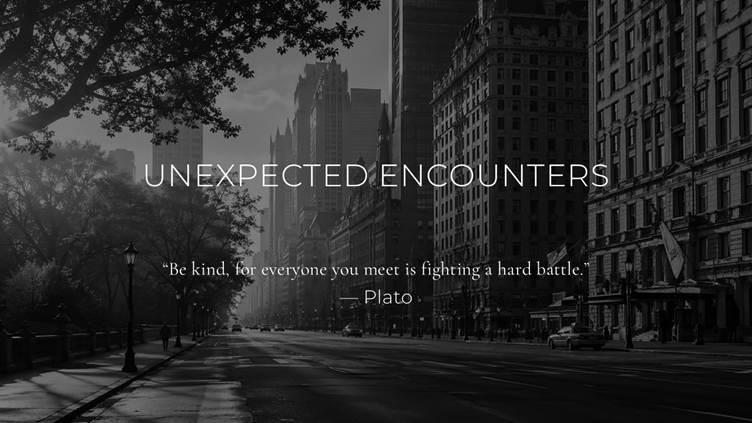
There is no question that some prompts ask rather intrusive questions. They send one wandering down the long corridors of memory, searching for a room one had not intended to open, until at last the safe of long-term recollection gives way.
The year was 1995, and the city was Rudy Giuliani’s New York. At the time, he still enjoyed the reputation of a hard-driving reformer: the former U.S. Attorney, the mayor determined to restore order to a city that, in the public imagination, had become too dirty, too unruly, and too visibly marked by its social failures. New York had always been a city of spectacle, money, ambition, and expensive illusion, but it also displayed what polite society preferred not to see: homelessness, disorder, and those who had somehow slipped through the grand narrative of success.
Such people easily became the subject of comfortable dinner-table wisdom. Why don’t they get a job? Why don’t they help themselves? The usual questions asked by those who have never had to test how fragile comfort can be. In that climate, the answer was not to examine causes too closely, but to remove the inconvenient symptoms from sight. The city was to be reclaimed. Disorder was to be moved along from one corner to the next. The discomfort of shoppers and diners seemed to count for more than the lives of those who caused it.
It is easy, in our arrogance, to look down on others as though their circumstances reveal their character. But life is rarely so simple. We seldom know the full story behind a life, and it is wiser not to be too presumptuous in our judgments. Life is a succession of events, some good, some better forgotten. The main thing is to find a certain balance among its many colours and, when a mirror happens to be nearby, to take a look at our own reflection.
It was on a hot Friday afternoon in June, in precisely that atmosphere, that I walked out of the Plaza Hotel onto Fifth Avenue after a rather generous lunch. I was on my way back to Europe and due to leave shortly for JFK. Before crossing over to the Pierre, my favourite hotel in New York, I looked for a bench where I could enjoy my cigar in the open air, restaurants by then already taking a dim view of cigar smokers, as though we were a threat to civilisation itself.
So I sat down, Montecristo in hand, beside someone who, at first glance, seemed utterly out of place in that setting and perhaps, to others, in society itself. He had clearly fallen on hard times and was homeless, precisely the kind of person who offended Giuliani’s image of the city and whose presence, like dirt in the street, was to be swept from view.
One is not supposed to learn lessons about dignity while leaving the Plaza Hotel with a cigar in hand. Such lessons are usually presented more ceremoniously, as I know from my own experience, rather in the way my father used to do in his study: hand on my shoulder, stern look, and a few pointed words about youthful indiscretions. Yet life, as always, had other ideas.
We struck up a conversation. I bought him a bottle of water, which I suspect would not have met with Mayor Giuliani’s approval. As it turned out, he was in his forties, a graduate of MIT, and the former owner of a company that had failed. We spoke about America and Europe, about bankruptcy and shame, and about the curious difference between cultures that glorify collapse as bravado and those that regard it as social disgrace. Donald Trump came up, even then a convenient symbol of the American talent for dressing failure in gold leaf and calling it success.
After a while I got up, gave him some money, and returned to the hotel to wait for the car that would take me to the airport. I thought no more about it.
The surprise came later.
Some time afterwards, when I had long forgotten the stranger on the bench, I received an envelope postmarked Boston. Inside was a short thank-you note and a crisp one-hundred-dollar bill.
The money itself meant very little. The correction to my assumptions meant rather more.
It is easy, from the comfort of a good hotel, a well-furnished apartment, or a departing flight, to think one understands who has succeeded and who has failed. Life is rarely so neatly arranged, and dark clouds seldom announce their arrival.
I had imagined I was offering a small kindness. In the end, it was my own assumptions that were sent back to me, neatly folded in an envelope from Boston. The hundred-dollar bill was framed and became part of the Amsterdam office I occupied overlooking the canal, a quiet reminder that appearances explain very little.
August, 2026
📌Blog Excerpt
A chance meeting on a bench outside the Plaza Hotel in New York became, in time, a small lesson in humility. What first appeared to be a simple act of kindness returned later as something else: a reminder that appearances explain very little, and that human lives are seldom as neatly arranged as we imagine.

