Zen Time in the Twilight Zone – When the Surreal Becomes Routine
✍️Author’s Note
Every August, for four weeks, I step back. No politics, no newspaper rituals, no endless stream of declarations, outrages, reversals, and spectacles dressed up as history. In earlier years I called this Zen Time in the Twilight Zone, half in irony and half in self-defence. But over time the phrase has become less playful. What once felt bizarre now often appears methodical. The Twilight Zone is no longer merely an episode of excess; it has become part of the atmosphere.
This yearly absence is therefore not an escape from reality, but an effort to preserve some independence from it. Distance is sometimes the only way to keep one’s footing.
—WJJH
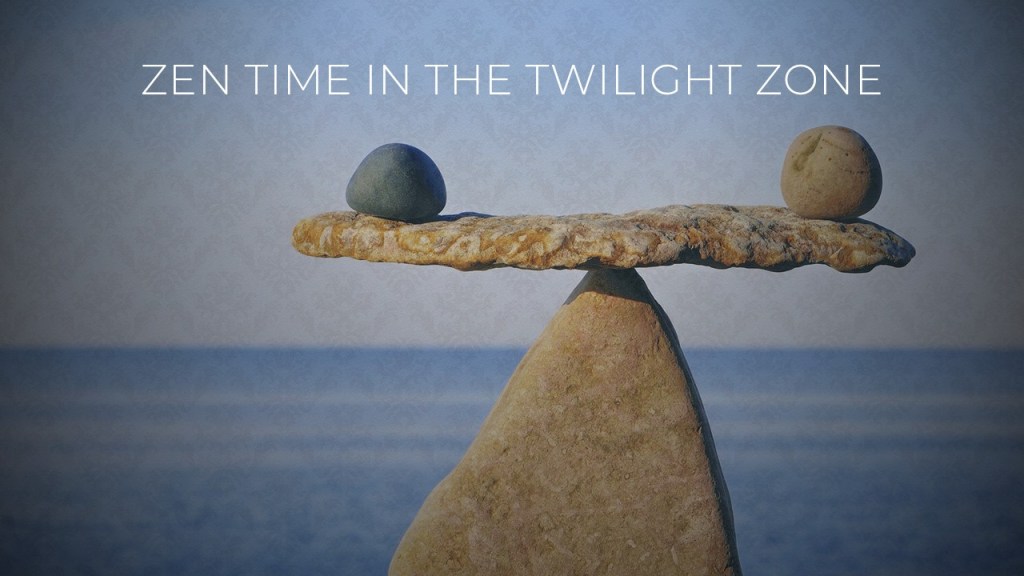
“To deny madness the right to occupy one’s mind without remainder is not cowardice. It is a modest act of self-government.”
—WJJH
This August reflection continues my yearly Zen Time in the Twilight Zone theme. It is not the same Twilight Zone I knew as a boy in the early 1960s: that remarkable television series of science fiction, mystery, and moral unease which, in those years, was reason enough to stay home. Family life was different then, and watching together still had the character of a small shared ritual. Today’s Twilight Zone is of another order: a stream of declarations, outrages, reversals, and spectacles dressed up as history.
What began as an ironic description of political absurdity now feels more serious. The surreal has become routine, and public life increasingly demands not only our opinions, but also our attention and inner balance. This piece is not an argument for indifference, but for distance as a way of preserving judgment, proportion, and a measure of inner freedom.
Every age, of course, has its gains and its losses. The world of the early 1960s was simpler in some respects and more immediate in others, but our own time too has its marvels. Each period has its burdens, but also its peculiar attractions. The difficulty is not that one age is wholly superior to another, but that each asks something different of us.
There was a time when the political world felt like an interruption of ordinary life: a passing fever, a season of agitation, a spectacle that would eventually exhaust itself. One could still assume that beneath the noise the institutions remained intact, that proportion would return, and that public life, however flawed, still obeyed some recognisable grammar.
That confidence has become harder to sustain.
We have entered a period in which the surreal is no longer incidental. It is no longer the occasional absurdity that breaks through an otherwise stable order. It has become routine. The language of public life has coarsened, vengeance is presented as strength, improvisation as leadership, and permanent agitation as proof of vitality. The exceptional has become ordinary. The grotesque no longer surprises; it settles in.
That, perhaps, is the most disturbing change. Not simply that public life has become more shrill, but that we have begun to adapt ourselves to shrillness. We absorb the spectacle, adjust our expectations downward, and begin to mistake distortion for normality. Once that happens, the danger is not only political. It is inward. We risk being shaped inwardly by what we outwardly condemn.
It is for that reason that I take my annual leave in August.
I do not do so because the world no longer matters, nor because I have withdrawn into indifference. One reaches an age at which illusions are lighter to carry, but reality remains what it is. No, I step back because there are times when one must refuse to let the world occupy every room of the mind. When disorder becomes incessant, distance becomes a form of hygiene.
For me, this August withdrawal is not entirely new. I have long had the habit of taking my holidays in August, often for four to six weeks: time for diversion, travel, sailing, good food, and the welcome gift of new impressions. In much the same spirit, I have also tried to keep a quieter rhythm during the festive period at the end of the year. Over time, this has come to feel less like indulgence than like necessity.
The mind, like a house with many rooms, gathers clutter. Too much noise enters, too much agitation remains, and if one is not careful, the whole place becomes congested. One must open the windows from time to time, let in fresh air, and clear away what has accumulated: the pollution of endless distraction, the residue of outrage, the mental rubbish that modern life deposits in us almost without permission. Only then can one begin again to distinguish what is essential from what is not.
That, in part, is what these periods of retreat have always meant to me. Not an escape from life, but a return to its proper rhythm. Nature still understands something that modern society has largely forgotten: that all life depends on intervals, pauses, seasons of recovery. We are not made for permanent acceleration.
In that sense, two real periods of withdrawal each year have never seemed to me a luxury, but part of a civilised life. It is good for the individual and, one might add, not bad for the institutions and companies that rely on people who are no longer mentally exhausted. Quality of life is not a sentimental matter. It is part of what makes endurance possible.
And in our own time this need has only grown. The speed of life, the tyranny of the smartphone, the coarsening of the public sphere, the endless demands of the herd for attention, and the steady theatre of absurdity we have witnessed since the turn of the millennium have made distance more necessary than ever. What once may have seemed a pleasant custom now feels closer to a discipline of preservation.
The old temptation is to imagine retreat as surrender. But not every withdrawal is a defeat. There are moments when stepping back is precisely what allows one to return without bitterness, without exhaustion, and without losing one’s measure. To deny madness the right to occupy one’s mind without remainder is not cowardice. It is a modest act of self-government.
In that sense, Zen Time is not a holiday from thought. It is a recovery of proportion.
I have no grand theory of Zen, nor do I pretend to possess any special wisdom. My version is humbler. It means reading without haste. It means walking without destination. It means mornings without headlines, afternoons without argument, evenings with music, a book, or the quiet company of one’s own thoughts. It means the temporary suspension of the compulsion to react. The world is full of demands on our attention; not all of them deserve obedience.
There is a curious violence in the modern public sphere, even when no weapon is visible. It is the violence of intrusion, of incessant claim, of the insistence that one must always respond, always declare, always remain available to the latest outrage. Politics now often seeks not only our opinions, but our nervous systems. It colonises attention, shortens patience, and rewards indignation over reflection.
Against that, one needs forms of inner resistance.
For me, these are simple things. Walking. Writing. Reading history rather than merely consuming events. Music that restores scale. The sight of water. Silence. Even chess, with its small discipline of patience and consequence, has more to teach than many public debates. Such activities are not escapes from the world. They are reminders that life still contains order, rhythm, and form, even when public discourse does not.
Perhaps that is what age teaches more clearly than youth. Not detachment in the cold sense, but selectivity. One no longer feels compelled to rush into every arena or answer every provocation. One learns, slowly and not always gracefully, that attention is finite and ought not to be squandered on every passing performance of power. To guard one’s attention is not selfishness. It is stewardship.
And yet I do not wish to romanticise withdrawal. The world does not improve because one man reads a book by the sea or declines to watch the evening spectacle. Injustice does not pause for summer. Noise does not take a holiday. The machinery continues. But human beings are not machinery, and one of the few freedoms still available to us is the freedom to decide what shall enter us, and on what terms.
That matters more than it may seem.
For if public life becomes a theatre of cruelty, vulgarity, and manipulation, then the preservation of inward decency is no small thing. We cannot always repair the age, but we can resist becoming fully made in its image. We can refuse to let the language of contempt become our language. We can decline the invitation to live permanently in reaction. We can step back long enough to remember that the world is larger than its noisiest actors.
That is the deeper meaning of my August absence.
It is not peace in any perfect sense. The world remains what it is, and I remain, by temperament, too much of a realist to believe in cleansing rituals. August does not purify. It merely interrupts. It offers a brief season in which one may lay aside the burden of immediate commentary and listen for a quieter register of life. That, in itself, is already something.
The sea still moves according to older laws. Morning light still arrives without asking our permission. Books still speak in calmer voices than politicians. Music still reminds us that order and beauty have not entirely disappeared. And a walk, however slow, still restores more balance than an hour spent with professional agitators on a screen.
So I shall disappear for four weeks, as I do every year.
Not because the Twilight Zone has vanished, but because it has deepened. Not because the world deserves less attention, but because it now demands too much of the wrong kind. And not because I have ceased to care, but because one sometimes cares best by refusing to be devoured.
In September, the world will still be there. The noise will not have ended. The grotesque will not have retired. But perhaps one returns a little steadier, a little less colonised by urgency, and a little more capable of seeing things in their true proportions.
That is enough.
For the world may continue to speak in the language of spectacle, revenge, and permanent agitation. But August still permits another language: that of distance, rhythm, silence, and the quiet defence of one’s own mind.
August, 2026
📌Excerpt
There are times when stepping back is not surrender, but a modest act of self-governance. In an age of spectacle, vengeance, and permanent agitation, distance can become a way of preserving one’s footing. August then offers not escape, but a brief recovery of rhythm, silence, and proportion.
What began as an ironic description of political absurdity now feels more serious. The surreal has become routine, and public life increasingly demands not only our opinions, but also our attention and inner balance.

