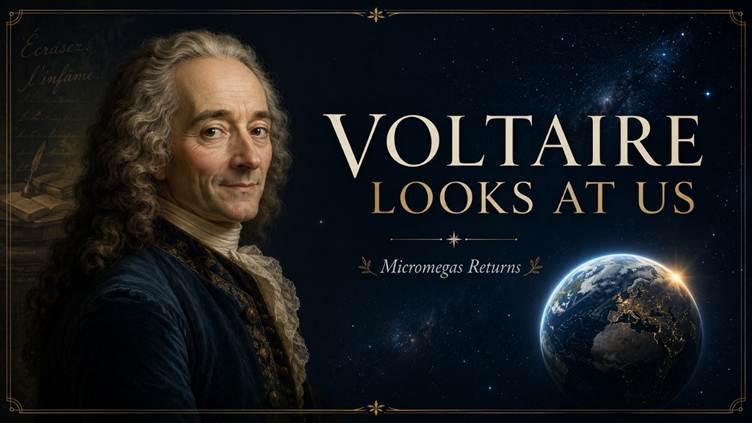
Voltaire Looks at Us: Micromegas Returns
✍️ Author’s Note
Voltaire’s Micromegas remains one of the most delightful works of philosophical satire. Two giant travellers—from Sirius and Saturn—descend to Earth and discover a species almost too small to see, yet entirely convinced of its own importance.
The travellers do not despise humanity. They simply see us in proportion.
This reflection imagines Voltaire looking at our own age through the eyes of Micromegas: at our quarrels and certainties, our nationalism and technology, our capacity for destruction, and our equally remarkable capacity for imagination and kindness.
Sometimes satire teaches us more than solemn philosophy. By allowing us to see ourselves from a distance, it may bring us a little closer to the truth.
—WJJH
“My soul is the mirror of the universe, and my body is its frame.”
— Voltaire, Micromegas
Voltaire’s Micromegas has always delighted me: a cosmic fable in which beings from Sirius and Saturn, miles tall, descend to Earth and observe humanity with curiosity, amusement, and pity.
To them, our quarrels, our dogmas, and our sense of grandeur appear as little more than ants disputing ownership of a mound of dust.
It is satire, of course, but also a profound mirror. Voltaire reminds us how small and comic we appear when stripped of our self-importance and viewed from a higher perspective. What seems to us history-shaping and world-shaking might look, from Sirius, like a brief disturbance on an almost invisible planet.
Imagine Micromegas returning today.
He would find us still arguing over borders, still accumulating weapons capable of destroying us, and still damaging the soil, seas, and atmosphere upon which our lives depend.
He might be puzzled by our idea of progress. We have created machines that can calculate, communicate, and imitate intelligence across enormous distances, yet we remain vulnerable to ancient fears, tribal loyalties, and the seductions of power.
He would hear nations proclaiming their exceptional virtue while behaving much like all the others. He would watch leaders speak of peace while preparing for war. He would see human beings connected as never before, yet increasingly divided by the very instruments intended to bring them together.
Our technology would astonish him. Our wisdom might not.
Much of what we call modern would probably seem familiar to Voltaire: old folly dressed in new clothes, old dogmas transmitted at greater speed, and old ambitions armed with more powerful instruments.
And yet Micromegas might not despair.
For within these nearly invisible beings, he would also discover imagination, art, tenderness, curiosity, and the search for meaning. He would hear music, read poetry, observe acts of courage and kindness, and see people caring for one another without hope of reward.
If ants can quarrel, they can also build.
If human beings can destroy, they can also create.
Seen from Sirius, our cruelty and our grace would appear as inseparable parts of the same fragile whole. Our insignificance in the universe would not make our conduct meaningless. It would make our responsibilities more urgent.
The lesson of Micromegas is not that humanity should be belittled, but that it should be humbled.
In the vastness of the universe, the only grandeur we can reasonably claim lies not in dominance, possession, or conquest, but in the way we treat one another and care for the small planet entrusted to us.
The giants laugh at us not because we are small, but because we pretend to be so large.
What, then, might Micromegas say before leaving us once more?
Perhaps only this:
You are not as important as you imagine, but you are more capable of goodness than you believe. Choose wisely. Your little planet is all you have.
📝 A Glass with Voltaire
Rereading Micromegas with a glass of wine in hand, I was reminded of the promise made by the Sirian to the tiny philosophers he encountered on Earth.
He would prepare for them a beautiful work of philosophy, written in very small print, in which they would finally discover the meaning of everything.
The book was delivered to the Academy of Sciences in Paris. The secretary opened it and found that every page was blank.
“Ah!” he said. “I suspected as much.”
There lies Voltaire’s final joke—and perhaps his deepest wisdom.
The universe does not hand us a completed book of answers. Each generation receives the pages largely empty and must decide what to write upon them.
Our age offers instant explanations, abbreviated opinions, and machines capable of producing answers before we have properly considered the questions. But wisdom has never resided in speed or certainty. It grows through reading, doubt, reflection, and the willingness to live with contradiction.
The blank book is therefore not empty of meaning. It is a responsibility.
What matters is whether we fill its pages with cruelty or dignity, vanity or humility, folly or wisdom. Our greatness lies not in our size, our power, or our certainty, but in how we care for this tiny planet—the only stage upon which our brief theatre of life can be performed.
“Doubt is not a pleasant condition, but certainty is an absurd one.”
— Voltaire, letter to Frederick William, Prince of Prussia, 28 November 1770
September, 2026
📌 Blog Excerpt
Through the eyes of Voltaire’s cosmic traveller, humanity appears small, quarrelsome, ingenious, and unexpectedly capable of grace. Micromegas reminds us that the giants laugh not because we are small, but because we pretend to be so large.


One thought