Cold Mountain
The Bowl That Holds Us
✍️ Writer’s Note
This reflection grew out of my usual four-week Zen period in August, a time when I deliberately step back from some of the noise and movement of the world.
During those quieter weeks, I returned to the poetry of Han-shan, the elusive Tang-dynasty poet and recluse whose name means Cold Mountain. Many years ago, I encountered his image of human beings as insects trapped in a bowl, endlessly moving while time passes almost unnoticed.
It stayed with me.
Read again many years later, the poem seemed to ask a slightly different question. Perhaps the important thing is not whether we can escape the bowl, but whether we ever stop long enough to recognise that it is there.
That seemed an appropriate thought with which to leave Zen and return to the world.
—WJJH
“Man, living in the dust, is like a bug trapped in a bowl.”
— Han-shan, translated by Burton Watson
During my usual four-week Zen period in August, when I step back from some of the noise of the world, I was reminded of the poetry of Han-shan—the Buddhist poet and recluse whose name means Cold Mountain.
The name refers both to the poet and to the remote place with which he identified himself. His life is usually placed during the Tang Dynasty, although little about him can be known with certainty. Like many figures who withdraw from the world, he seems to belong partly to history and partly to legend.
Many years ago, I first encountered these lines, in Burton Watson’s translation:
Man, living in the dust,
is like a bug trapped in a bowl.
All day he scrabbles round and round,
but never escapes from the bowl that holds him.
The immortals are beyond his reach,
his cravings have no end,
while months and years flow by like a river
until, in an instant, he has grown old.
In very few words, they gave me a remarkably clear picture of what life is about for many people.
There was wisdom in the poem, but also a touch of cynicism: man as a bug trapped in a bowl, endlessly scrabbling around, mistaking movement for escape while the years flow past.
Read now from the perspective of an octogenarian, the poem has acquired a second meaning. Earlier in life, one notices the bug and the bowl. Later, one recognises that months and years do indeed flow like a river, and that age seems to arrive almost in an instant.
Perhaps growing old also allows us, briefly, to stop scrabbling and look at the shape of the bowl.
Yet the poem is not merely about ageing. It is about the way much of human life is spent: pursuing one thing after another, seldom pausing to ask whether any of it leads beyond the vessel that contains us.
We work, accumulate, compete, quarrel and seek recognition. We call much of this progress. Yet the bowl still holds us, while time passes almost unnoticed.
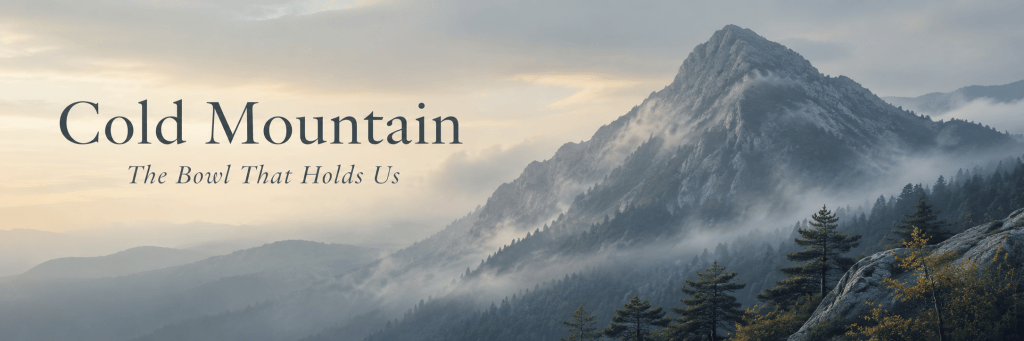
Cold Mountain stands in contrast: a place of distance, stillness and clearer sight.
The wisdom of the poem lies in its recognition of human limitation. Its cynicism lies in the suggestion that our incessant activity may amount to little more than movement in circles.
We imagine that the bowl has grown larger because we move faster within it. We communicate across continents, measure the universe and build machines that appear to think. Yet we continue to circle around many of the same appetites, fears, ambitions and quarrels.
Our powers have expanded.
The bowl may not have.
Charlie Chaplin caught a version of the same truth in Modern Times: the human being absorbed into machinery, hurried along by forces he barely understands, tightening bolts because the belt keeps moving.
Han-shan gives us the bowl. Chaplin gives us the assembly line.
Neither the bug nor the worker is idle. Quite the opposite. Their trouble is not a lack of activity, but a lack of exit.
And perhaps this is where the deeper question lies: how free are we, really, in the midst of all that motion?
We speak easily of freedom. We claim it, celebrate it, fight wars over it and place it above almost everything else we value. Yet much of what passes for freedom consists of choosing among possibilities already shaped by upbringing, habit, fear, desire and the circumstances into which we were born.
We call the choice liberty, while seldom asking about the shape of the bowl in which that choice is made.
Perhaps no one designed the bowl. Some of it is made by society, some by circumstance, some by our own desires, and some simply by the limits of being human.
The rarer freedom, if it exists, may therefore not lie in escaping the bowl, but in noticing its rim.
That may be the remarkable thing about Han-shan’s poem. A Tang-dynasty recluse, living on a mountain more than a thousand years ago, described a human condition that remains immediately recognisable.
The bowl of the twenty-first century has not changed its shape very much.
Only the speed of the scrabbling has increased.
Perhaps Cold Mountain is not a place beyond the bowl.
Perhaps it is the moment in which we stop scrabbling long enough to see the bowl for what it is.
September, 2026
Blog excerpt
A Tang-dynasty recluse once compared human beings to insects trapped in a bowl, endlessly moving while time flows past. Read again many years later, Han-shan’s image raises a simple question: have we enlarged the bowl—or merely increased the speed at which we move within it?

