The Longest Book I Ever Read
“There are many rivers of civilization, and each deserves respect.”
✍️ Author’s Note
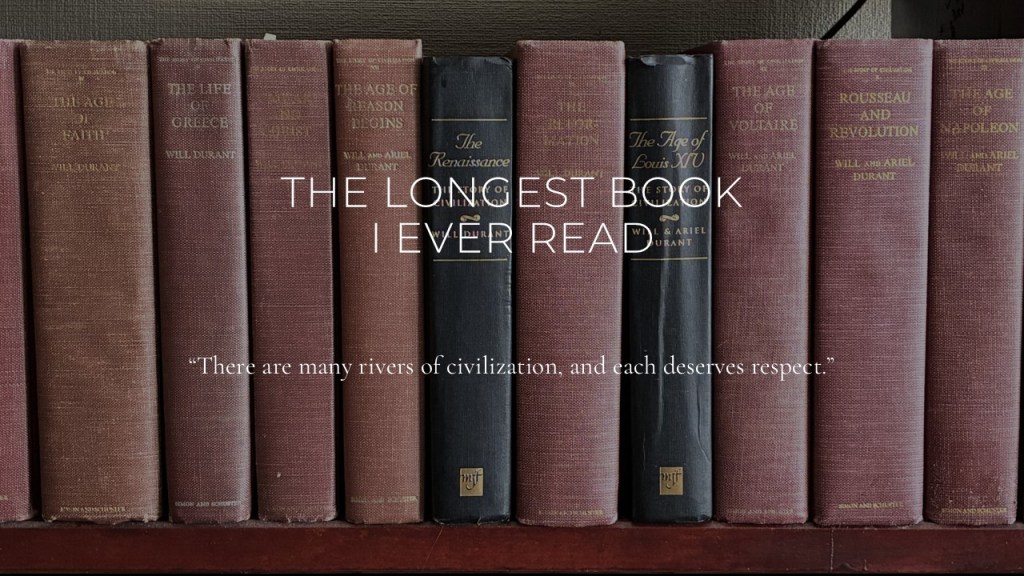
A passing prompt asked me for the longest book I had ever read. That seemed a rather mechanical way of measuring a book, but it led me back to Will and Ariel Durant’s The Story of Civilization.
I remember those eleven volumes not for their length, but for the perspective they offered: civilizations meeting, borrowing, struggling, declining and leaving something behind. They taught me something more useful than the number of pages I had read.
Perhaps the real measure of a book is how much larger the world seems after we close it.
—WJJH
What’s the longest book you’ve ever read?
A passing prompt asks:
“What’s the longest book you’ve ever read?”
The wisdom of the question — or perhaps the lack of it — is itself worth reflecting on.
I have never thought of books primarily in terms of length. Pages can be counted, but their effect cannot. The more interesting question is which books leave their mark, quietly shape our thinking, and make us open them again after they have supposedly been finished. Which books send us back to a chapter because we are searching, years later, for another horizon?
That question brings me to Will Durant.
Together with his wife Ariel, Durant produced The Story of Civilization, eleven volumes tracing the long movement of human societies, ideas, religions, wars, discoveries and cultures from the ancient world to the age of Napoleon.
It is certainly long enough to satisfy the prompt.
But that is not why I remember it.
Durant had the rare ability to make history feel spacious without making it remote. His prose belongs to another literary age: elegant, unhurried, and written with a confidence in the reader’s attention that seems increasingly uncommon.
Reading him sometimes feels like entering a time when ideas were allowed to arrive in paragraphs rather than soundbites, and when a carefully constructed sentence was not yet regarded as an obstacle to communication. It was also an age when letters were written rather than tapped out between two traffic lights.
Progress, admittedly, has many definitions.
What stayed with me most, however, was something larger.
There are many rivers of civilization, and each deserves respect.
In the opening volume, Our Oriental Heritage, Durant reminds us that what we call Western civilization inherited far more than it created by itself. Ideas, mathematics, religions, systems of government, scientific observations and forms of art travelled across peoples and centuries long before anyone thought of history as belonging neatly to East or West.
Reading Durant was therefore less like moving through a line of dates than standing for a moment on a high hill and looking across the long road travelled by humanity.
From that height, one begins to notice continuity.
Civilizations rise and decline. Empires become footnotes. Borders move. Religions divide and reconcile. Political systems appear with great confidence and eventually discover their limitations.
Yet the questions remain remarkably familiar.
How should people live together?
How should power be exercised?
How much order is necessary, and how much freedom can survive it?
How does a society preserve what is worth preserving while still allowing itself to change?
Durant was not blind to human folly. His history contains more than enough war, cruelty, ambition and collapse. But he was not a cynic either. Running through his work is the sense that civilization is also an accumulation — of memory, knowledge, beauty and experience — passed imperfectly from one generation to another.
That may be what I took most from those eleven volumes.
Not answers, exactly, but proportion.
From Our Oriental Heritage to The Age of Napoleon, they offered a reminder that an age of uncertainty is not something invented by our own time. Humanity has been uncertain before. It has lost confidence before. It has mistaken temporary arrangements for permanent ones before.
And yet something has usually been carried forward.
So, what is the longest book I have ever read?
The numerical answer is probably The Story of Civilization.
Eleven volumes should keep even the most statistically minded prompt satisfied.
But after closing the final volume, I discovered that length was the least interesting thing about it.
Some books occupy a shelf.
Others quietly enlarge the room in which we think.
September, 2026
📌Blog Excerpt
A prompt asks for the longest book I have ever read. The answer leads to Will and Ariel Durant’s eleven-volume Story of Civilization — and to a more interesting question: not how many pages a book contains, but how much larger the world becomes after we close it.

