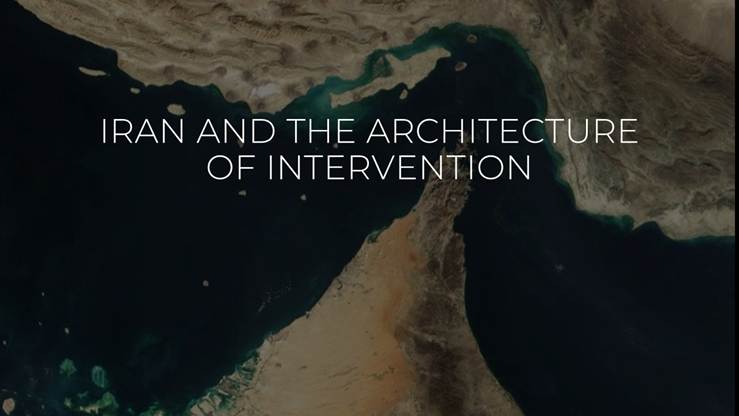
Iran and the Architecture of Intervention
✍️ Author’s Note
This essay is the third part of a sequence on Iran. It follows the introductory reflection, Iran: Before the Strategic Map, and the civilisational essay, Persia: Before Ideology.
It is not written to excuse the Islamic Republic. Its repression, ideological control, regional conduct, and narrowing of civil society are real and cannot be romanticised. But Iran cannot be understood if it is reduced to the regime that governs it, the nuclear file, sanctions, oil, or regional threat.
The purpose of this essay is to examine the longer architecture of intervention: geography, empire, oil, the coup of 1953, the Shah’s modernisation, the revolution of 1979, sanctions, containment, regime-change temptations, and the grammar of permanent crisis around Iran.
Great powers act according to interests; no serious view of history can pretend otherwise. But strategic knowledge is not the same as understanding. Iran has been studied, mapped, sanctioned, inspected, and assessed for more than a century. Yet the society beneath the strategic map has repeatedly been misread.
This essay asks what happens when a civilisation is seen mainly as a problem to be managed — and what such a gaze costs both those who are acted upon and those who act.
—WJJH
“Every empire, however, tells itself and the world that it is unlike all other empires, that its mission is not to plunder and control but to educate and liberate.”
—Edward W. Said
- From Civilization to Strategic Object
Once modern power politics enters the scene, Iran begins to disappear, in the eyes of others, as a civilization, and to reappear as a problem to be managed.
This is the second of two essays about Iran and its transformation: how one of the oldest continuous civilizations on earth came to be seen less as a historical society than as a strategic question, and what that persistent misreading has cost everyone involved — including those who believed they were merely managing the problem.
Iran is not a young nation that stumbled into modernity. It is one of the world’s oldest continuous civilizations: Persia, whose cultural, literary, and political reach shaped the ancient world in ways that still reverberate. The Persian language carried poetry, memory, and philosophy across Central Asia. The administrative traditions of the Achaemenid Empire influenced ideas of governance long after the empire itself had dissolved.
This matters because the injury at the beginning of the modern Iranian story is not only material. It is also epistemological. At some point in the nineteenth century, in the chancelleries of London and Saint Petersburg, and later in Washington, Iran stopped being read as a civilization with its own depth, dignity, and trajectory, and began to be managed as a space: a buffer, a route, a resource, a problem. The country did not change. The quality of attention directed at it did.
The problem, then, is not intervention as a single act. It is intervention as architecture: a recurring structure of pressure, encirclement, suspicion, and strategic calculation that has shaped modern Iran as deeply as any internal force. To understand Iran today, we must understand that structure. And to understand that structure, we have to go back in time.
II. Geography, Empire, and Oil
Iran did not choose its geography, but its geography has done much to shape its historical memory and strategic imagination.
Situated between Central Asia, the Caucasus, Mesopotamia, the Persian Gulf, and the Indian Ocean world, Iran has long stood at the crossroads of routes, empires, languages, and ambitions. The mountains, plateaus, deserts, and corridors of the Iranian landscape helped protect the country from easy conquest, but they also placed it in the path of others. Geography gave Iran depth. It also gave outside powers reasons to interfere.
For centuries, this position helped sustain a strong civilizational identity. Persia was not merely a territory on a map. It was a cultural world, a language, an administrative tradition, and a memory of empire. But in the nineteenth century, as Britain and Russia expanded their influence, this same geography began to acquire another meaning. Iran became less a civilization to be understood than a space to be measured: a buffer against Russian movement southward, a concern for Britain’s protection of India, a route, a frontier, a zone of influence.
The logic was simple and brutal. Whoever influenced Iran influenced access routes, buffer zones, and the balance of power between empires. The Great Game, usually remembered as the rivalry between Britain and Russia across Central and South Asia, did not leave Iran untouched. Iranian sovereignty was repeatedly treated as something negotiable: through concessions, pressure, spheres of influence, and diplomatic arrangements made over its head.
The Qajar state, weakened by internal rivalries, fiscal dependence, and limited administrative capacity, was not without responsibility for Iran’s vulnerability. It did not merely suffer concessions; it granted them. It sold privileges, played foreign powers against one another, and too often mistook short-term manoeuvring for durable statecraft. Britain and Russia exploited Iranian weakness, but they did not invent it. The tragedy of the period lies in this convergence: imperial appetite from outside and political fragility from within.
In the twentieth century, oil transformed the strategic calculus. What had once been a question of routes and buffers became a question of industrial civilization itself. Oil was not simply another resource. It powered navies, factories, armies, economies, and the modern state. With the discovery and exploitation of Iranian oil, the country’s position moved from significant to indispensable.
The decisive shift came when oil ceased to be merely a commercial resource and became the fuel of modern power. The transition from coal to oil was not an eccentric choice; it belonged to the logic of industrial civilisation itself. Navies, armies, factories, aircraft, transport systems, and modern economies required mobility, speed, and energy on a scale coal alone could no longer provide. Britain’s move toward oil, especially in naval strategy, therefore made Middle Eastern oil a matter not only of commerce, but of state security. What had once been a question of concession and profit now became a question of empire, mobility, and survival. Iranian oil entered a different category. It was no longer simply something to be bought, sold, or taxed. It was something great powers believed they could not afford to lose control over.
Oil was Iran’s blessing and its curse. It promised wealth, modernization, independence, and regional weight. But it also attracted the permanent attention of powers that saw energy not as a national possession but as a strategic necessity.
Iran did not merely sit on oil. It sat on part of the energy logic of the twentieth century.
That is why it could never simply be left alone. Geography made Iran important; empire made Iran vulnerable; oil made Iran indispensable.
III. The Modern Wound — 1953
What is happening today did not come from a vacuum.
The story of 1953 is familiar to many observers of Iran and the wider Middle East, but it has never occupied the same place in Western public memory that it occupies in Iran itself. In Iran, the coup against Mohammad Mossadegh was not merely another Cold War episode. It became a political memory of betrayal, transmitted across generations: a lesson in what outside powers were prepared to do when Iranian sovereignty collided with oil, empire, and strategic convenience.
Mossadegh was not a revolutionary in the usual sense. At a time when Iranian politics was shaped by monarchy, clerical influence, military power, and foreign pressure, he represented a different possibility: constitutionalism, the rule of law, parliamentary authority, and national self-determination. His demand that Iranian oil should belong to Iran was not only an economic claim. It was a political and moral claim about sovereignty.
That is why the nationalisation of the Anglo-Iranian Oil Company in 1951 carried such force. To many Iranians, it expressed dignity, legality, and independence. To Britain it threatened imperial habit, corporate interest, and the wider structure of Western influence in the Middle East. Once the dispute was translated into the language of the Cold War, oil could be presented as anti-communism. The public language was containment. The private grammar was oil, money, and control.
The coup of August 1953 therefore became a turning point in modern Iran. It crushed a democratic experiment, removed a constitutional nationalist, restored the Shah to full authority, and reasserted Western influence over Iranian oil under new arrangements. Writers such as James Barr and Robert Fisk place this moment within the broader history of Anglo-American manoeuvring in the Middle East: Britain fearing the loss of imperial influence, the United States fearing communist expansion, and both powers seeing Iran less as a sovereign society than as a strategic problem to be managed.
The coup of 1953 did not remain an episode in the archive. It entered Iranian political memory as a living wound: proof, for many, that Western support for legality, democracy, and self-determination had limits — especially when these principles collided with oil and strategic interest. Mossadegh was defeated politically, but he survived symbolically. His image would remain a reference point for nationalists, secular democrats, reformers, students, and others seeking an alternative both to autocracy and to clerical rule.
Nor did the memory remain confined to Iran. Across the wider Middle East, 1953 became part of a broader regional grammar of suspicion. It seemed to confirm what many nationalists, reformers, and anti-imperial voices already feared: that Western support for democracy and self-determination was conditional, and that those conditions were set by oil, empire, military access, and the balance of power. In that sense, the coup did not merely wound Iranian political memory. It entered the memory of the region as one more proof that sovereignty could be tolerated only so long as it did not disturb the architecture of Western interest.
The coup did not simply return the Shah to power. It changed the meaning of his power. After 1953, the monarchy could no longer present itself simply as the guardian of national continuity. In the minds of many Iranians, it had become tied to foreign protection, oil interests, and the defeat of constitutional nationalism.
This did not prevent modernization. On the contrary, it helped produce one of the most ambitious modernization projects in the region. The Shah would build roads, schools, industries, universities, and armies. He would speak the language of progress, secular development, and national greatness. Yet the foundation beneath him had been compromised. Modernization could proceed, but legitimacy had been wounded.
That was the double sword.
IV. The Shah, Modernization, and the Double Sword
After 1953, Mohammad Reza Shah resumed, in his own way, the modernizing project his father had been forced to abandon in 1941. But the monarch who emerged from the coup was not the same ruler who had struggled for authority before it. He understood more clearly where his power rested. In the years that followed, he expanded the three pillars of his state: the military, the bureaucracy, and the court patronage system.
He also became one of Washington’s most important strategic partners in the Middle East. That partnership strengthened him internationally, but it carried a domestic cost. To many Iranians, the monarchy now appeared inseparable from Western support, oil interests, and the defeat of constitutional nationalism. The Shah had ambitions of his own and was not merely an instrument of American policy. Yet the association with Washington deepened the suspicion that Iran’s sovereignty remained compromised.
In international politics, friendship usually means alignment of interests. The Shah was indeed a good friend of the United States, as Nixon understood very well. But in Iran, that friendship carried another meaning: it suggested that the monarchy’s survival depended less on consent at home than on strategic usefulness abroad.
What followed was one of the great paradoxes of twentieth-century modernization. Iran under the Shah was not an autocracy standing still. It was an autocracy in motion: modernizing, centralizing, secularizing, educating, industrializing, and arming itself at remarkable speed. Oil revenue funded ambitions that were both practical and grandiose. The Shah wanted Iran to become a major regional power, and by certain measures he was succeeding. Yet progress and coercion were not separate chapters of his rule. They belonged to the same political structure.
This is what makes the Pahlavi period difficult to judge in simple terms. It brought real social and economic change. Infrastructure expanded. Universities grew. Women entered public and professional life in greater numbers. The urban middle class widened. The state became more capable, more visible, and more ambitious.
But Iran was not a small or simple society to transform by decree. It was large, layered, and socially complex: rural and urban, religious and secularizing, Persian and non-Persian, tribal in some regions and bureaucratic in others, deeply traditional in many habits yet increasingly exposed to modern education, media, and global currents. Its regions, classes, bazaars, religious institutions, villages, tribes, and expanding cities did not all move at the same speed.
Modernization from above could build roads, schools, factories, universities, and armies. It could expand literacy, create technocrats, professionalize parts of the state, and bring many Iranians into the modern economy. But it could not easily harmonize the different rhythms of society. Some groups experienced the Shah’s reforms as opportunity. Others experienced them as disruption, humiliation, or intrusion. In such a country, progress was never a single movement. It was uneven, contested, and deeply unsettling.
That was the double sword. The Shah modernized Iran, but his modernization rested more on control than consent. The political architecture did not modernize with society. Participation remained limited, opposition was silenced, and the machinery of coercion grew alongside the machinery of development.
SAVAK, the secret police, became the darker companion of modernization. It guarded the state against opposition, but in doing so ensured that the social transformation produced by the Shah’s own policies had no legitimate political outlet. The educated urban classes his programs helped create — students, lawyers, civil servants, intellectuals, professionals — found themselves in a society changing beneath them but closing above them. Dissent was not debated. It was detained.
Western governments, especially Washington, looked at the Shah’s Iran and saw stability: anti-communism, oil security, regional order, and a reliable ally. Friendship in international politics is rarely innocent. To Washington, the Shah represented a pillar of Western strategy. To many Iranians, the same friendship became evidence of dependence.
This was the double sword in its sharpest form. The stronger the Shah appeared abroad, the more exposed he became at home. The more modern Iran became socially and economically, the less tolerable its political closure appeared to those who had been educated, urbanized, and mobilized by that very modernization.
The Shah was not wrong to want a modern Iran. The failure lay in believing that society could be transformed without allowing politics to breathe. In a large and complex country, modernization required flexibility, patience, trust, and institutions capable of absorbing conflict. His system provided control instead.
When the revolution came, many American policymakers were genuinely shocked. They should not have been. The information existed. The will to read it did not.
V. 1979 — Revolution as Rupture and Memory
The revolution of 1979 did not come from nowhere. It was the natural consequence of a society that had been modernized without being politically trusted, educated without being allowed to participate, and opened to the world while being denied a legitimate voice in its own future.
The Shah had modernized much of Iran, but not the political structure through which Iran was governed. Society was changing; authority was not. Education expanded, cities grew, women entered public life, expectations rose, and a new middle class emerged. But the state continued to demand obedience rather than participation. It modernized the country while preserving the old grammar of command.
That is why the revolution is still too often misunderstood in the West when it is described primarily as an Islamic revolution: a backward turn, a rejection of modernity, a civilization recoiling from the twentieth century. This interpretation contains an element of truth, because the religious forces became decisive. But it is incomplete. It reduces a vast historical upheaval to the identity of its eventual victor and misses the deeper structure of what had been building beneath the surface.
The Shah’s Iran was not a static society. It was modernizing, urbanizing, educating, and expanding. But it was doing so under a political system that increasingly denied participation, silenced opposition, and concentrated authority in the monarchy and its instruments of control. The White Revolution had transformed landownership, weakened the old landed class, disrupted rural structures, and raised expectations the state could not fully satisfy. At the same time, the creation of the one-party Resurgence Party narrowed the remaining space for political expression and deepened the impression that loyalty to the state had become compulsory.
Modernization, when it is not accompanied by political legitimacy, can become a double-edged sword. It creates new classes, new students, new professionals, new ambitions, and new grievances. It opens windows, but does not necessarily open doors. Iran in the 1970s was therefore not a country rejecting modernity, but a country in which modernization had outpaced political trust.
There was also the question of foreign dependency. The Shah’s close alignment with the United States, and his positions on sensitive issues such as Palestine and Vietnam, intensified old resentments and created new ones. For many Iranians, the monarchy had come to symbolize not national independence, but subordination to foreign power. Whether this perception was always fair is less important than the fact that it became politically decisive. Revolutions are not made only by facts; they are also made by memories, humiliations, and the accumulated feeling that a country no longer belongs to itself.
In this sense, 1979 was above all a revolt against humiliation. Against dependency. Against the experience of living in a country whose government seemed to answer more readily to foreign capitals than to its own people. The coalition that made the revolution was vast and ideologically incoherent: Marxists, nationalists, constitutionalists, clerics, bazaari merchants, students, and ordinary citizens who wanted very different futures. What united them was not a shared vision of what Iran should become. It was a shared rejection of what Iran had become.
That is why the revolution must be distinguished from the regime that followed it. The Islamic Republic was the outcome, but it was not the whole meaning of the revolution. Khomeini prevailed because he possessed what the others lacked: a clear religious language, an existing social network, organizational discipline, and the willingness to speak in uncompromising moral absolutes. In a confused revolutionary landscape, clarity can be more powerful than moderation.
The tragedy was that the overthrow of one authoritarian system did not lead to freedom, dignity, and constitutional renewal. It opened the way to another form of domination. The monarchy had suppressed political pluralism in the name of order and development. The Islamic Republic would suppress it in the name of religion and revolution. In this way, the moment of liberation became another chapter in Iran’s long struggle between state power and society.
The West, watching through the anxieties of the Cold War, again misread the Iranian equation. Iran was treated less as a civilization with its own historical memory than as a strategic problem to be managed. The fear of communism, the loss of influence, and the search for the “less dangerous” alternative helped produce yet another miscalculation. The revolutionary forces were not understood in their full complexity, and the religious movement was underestimated until it had already taken command of the stage.
The Islamic Republic that followed systematically dismantled its revolutionary partners. Those who had marched together against the Shah soon discovered that they had not been marching toward the same destination. Liberals, leftists, nationalists, constitutionalists, women, minorities, and independent voices were pushed aside, silenced, imprisoned, exiled, or absorbed into the new order.
Yet the revolution itself was larger than its outcome. To reduce it to its victor is to misunderstand the energy that produced it. Beneath the Islamic Republic remained the older Iranian struggle: the desire for dignity, independence, justice, and a political order that answers to society rather than standing above it. That energy did not disappear after 1979. It went underground, into memory, family, language, literature, exile, private resistance, and the quiet refusal to forget.
In that sense, 1979 was not only a rupture. It was also a memory — unresolved, wounded, and still alive.
VI. The Architecture After 1979
If the revolution was meant to end the architecture of intervention, it did not. It changed its forms.
The age of the Shah and overt dependency had ended, but after 1979 another structure of pressure emerged: sanctions, containment, regional proxy conflict, nuclear suspicion, security-state logic, and the recurring temptation of regime change. These were not isolated events or temporary reactions. Over time, they became a built environment in which Iran, the United States, Europe, Israel, the Gulf states, and Iran’s neighbours all learned to operate.
None of this means that states act without reason or that great powers can simply ignore their interests. They cannot. Access, alliances, energy, deterrence, and regional balance are part of the hard grammar of international relations. The problem begins when these interests are treated as the whole of reality, and when the society affected by them is seen only as an obstacle, instrument, or threat.
This chapter does not attempt to tell the full domestic history of the Islamic Republic. That history is vast in itself: war, repression, reformist hopes, student protests, the Green Movement, women’s resistance, economic hardship, and generational change. The focus here is narrower: how, after 1979, Iran became enclosed within a regional and international architecture of fear, pressure, retaliation, and mistrust.
Domestic developments mattered, of course. The war with Iraq hardened the new regime. The Revolutionary Guards became not only a military institution, but also a political and economic actor. Reformist hopes rose and were contained. Iranian society became more educated, urban, and self-aware, while the state became more suspicious and security-driven. But these developments are considered here mainly insofar as they shaped the larger architecture around Iran.
Each element reinforced the others. Sanctions intended to weaken the regime often strengthened the Revolutionary Guards economically, as they moved into spaces that legitimate commerce and foreign investment had vacated. Containment designed to isolate Iran encouraged the development of asymmetric regional influence — through Hezbollah, Iraqi Shia militias, Syria, and the long conflict in Yemen. Nuclear suspicion justified further pressure; further pressure reinforced Iran’s conviction that deterrence and strategic depth were necessary for survival.
In this way, the architecture of pressure repeatedly produced outcomes that contradicted its own stated purposes. Measures meant to moderate Iran often empowered its most suspicious and security-driven institutions. Policies meant to isolate Iran helped push it toward regional networks that made isolation impossible. Threats of regime change did not produce liberal democracy; they confirmed the regime’s oldest argument that foreign powers still sought to decide Iran’s future from outside.
None of this absolves the Islamic Republic of its own choices. Iran was not only acted upon; it also acted — often ruthlessly, opportunistically, and with little regard for the societies in which it extended its influence. Its regional policies deepened conflicts, armed non-state actors, and strengthened precisely the fears that its opponents used to justify pressure. But those choices developed inside an architecture that rewarded suspicion more than moderation.
The security-state logic operated on all sides. The Islamic Republic used external threat — sometimes real, sometimes amplified — to justify internal repression, economic mismanagement, and the subordination of society to ideological control. Outside powers, in turn, used Iranian behaviour — also real, and also amplified — to justify a posture of permanent confrontation that served several domestic and strategic purposes at once.
The crisis thus became functional for those administering it, even as it remained catastrophic for the Iranian people living inside it. For the regime, confrontation helped discipline society and silence dissent. For outside actors, Iran became a convenient explanation for regional militarisation, sanctions policy, alliance management, intelligence cooperation, and the repeated postponement of diplomacy. What was presented as a temporary crisis gradually hardened into a permanent system.
Regime change belongs inside this architecture. In Iran, it has not been attempted after 1979 in the full military sense seen elsewhere in the region, but it has never been fully abandoned either. It remained a recurring temptation: sometimes spoken openly, sometimes implied through sanctions, covert pressure, military threats, or the language of maximum pressure. For Tehran, this ambiguity was enough to confirm the regime’s central narrative — that foreign powers still wished to decide Iran’s future from outside.
Sanctions became the non-military face of that temptation. They were often described as tools of moderation, but in their cumulative form they became something larger: an attempt to force political transformation without openly calling it regime change. They did not invade Iran, but they sought to alter the behaviour of the state by making economic and social life increasingly difficult. When the demands became maximal — nuclear policy, regional policy, missile policy, internal conduct, ideological orientation — sanctions began to resemble regime change by pressure rather than by arms.
The problem is that such pressure rarely falls only on rulers. It hardens the security state, impoverishes society, empowers black markets and militarised economic actors, and gives the regime a ready explanation for its failures. Sanctions became, at times, regime change in slow motion: not always openly declared as such, but often moving in that direction through cumulative pressure.
This does not mean the Islamic Republic should be preserved, excused, or romanticised. The moral distinction is essential. Opposition to the Islamic Republic belongs first of all to Iranian society. Externally imposed regime change belongs to the old architecture of intervention. One expresses the desire of a people to reclaim their own future; the other risks turning that future once again into the object of outside design.
To impose regime change on Iran would not liberate an empty political space waiting to be reordered. It would unsettle a large, old, complex society whose internal tensions no outside power could easily master. Iraq, Libya, and Afghanistan should have ended the illusion that states can be broken and then rebuilt according to foreign expectation. In Iran, the consequences would almost certainly be wider, deeper, and less controllable.
This was always the dangerous illusion: that pressure could produce a predictable political outcome. States are not machines whose defective parts can simply be removed and replaced. Iran is not a vacuum waiting for a preferred design. It is an old civilisation and a wounded modern state, with memories of intervention, monarchy, revolution, war, repression, sanctions, and betrayal. To imagine that such a society can be remade from outside is to repeat the oldest error in the architecture itself.
What followed 1979, then, was not simply hostility between Iran and the West. It was the construction of a system in which every action confirmed the fear that had produced the previous one. Sanctions strengthened the security state. The security state justified foreign suspicion. Foreign suspicion reinforced regime paranoia. Regime paranoia fed proxy strategy. Proxy strategy invited containment. Containment confirmed the original sense of encirclement.
The architecture did not merely contain conflict. It organised it.
To understand why this architecture endured, however, one must also examine the relationship between Israel, the United States, and the politics of permanent crisis.
VII. Israel, the United States, and the Grammar of Permanent Crisis
A grammar is not a single sentence. It is the structure that determines how sentences can be formed, which words fit together, and which meanings become natural before they are even questioned. International politics has grammars of its own. Around Iran, one of these grammars is the grammar of permanent crisis.
Like so many conflicts, the confrontation with Iran was not inevitable in its present form. It became so through accumulated injury, strategic habit, mutual suspicion, and the refusal to take seriously how actions are remembered on the other side. A lack of respect became a lack of understanding; a lack of understanding became policy; and policy, repeated over time, became architecture.
To understand this grammar, we have to look not only at events, but at the interests served by the way those events are interpreted. The language of permanent crisis does not merely describe Iran. It organizes the field around Iran. It determines which forms of diplomacy appear naïve, which forms of pressure appear responsible, and which forms of escalation are presented as unavoidable.
This does not mean that the Iranian threat is imaginary. It is not. Iranian rhetoric, regional conduct, support for armed movements, hostility toward Israel, and the opacity of its security ambitions have all contributed to the fears surrounding it. A serious argument cannot pretend otherwise. But the existence of a threat does not mean that every use of that threat is innocent.
For the United States, Iran has served since 1979 as both adversary and justification. Hostility toward Iran helps explain continued American presence in the Gulf, arms sales, security guarantees, sanctions architecture, and a wider regional posture that might otherwise require more difficult explanation. The relationship is not only hostile. It is structurally useful.
For Israel, the framing of Iran as an existential threat has an even sharper meaning. It has a real basis in Iranian rhetoric and in Iran’s regional networks, but it also serves strategic purposes. It helps organize regional alignments, secure American guarantees, preserve military freedom of action, and maintain Israel’s centrality in Washington’s Middle Eastern imagination. Again, this does not make the threat unreal. It means that the framing of the threat also performs political work.
Permanent crisis changes societies from within. It can harden language, narrow sympathy, and make contempt sound like realism. That does not strengthen Israel; it corrodes the moral confidence on which durable security must ultimately depend.
That is the grammar of permanent crisis. It turns suspicion into policy, danger into structure, and confrontation into habit. Evidence is read through the grammar. Ambiguity is resolved through the grammar. Diplomacy becomes suspect before it begins, because the grammar has already decided what Iran is: not a state with interests, fears, factions, and historical memory, but a problem whose normal condition is crisis.
The Joint Comprehensive Plan of Action briefly interrupted this grammar. Whatever its limits, it represented an attempt to move the Iranian nuclear question from permanent emergency into verifiable constraint. It did not require trust in Iran. That was precisely the point. It substituted inspection, verification, and negotiated limits for assumption, suspicion, and escalation.
Yet the agreement also revealed how difficult it is to escape the grammar. Even when diplomacy produced a concrete result, opposition to it remained intense. The question was not only whether the agreement was perfect. No agreement of that kind ever is. The deeper question was whether normalization, even partial and conditional normalization, was allowed to become thinkable.
There is a double standard at work here, and the grammar of permanent crisis makes certain questions almost unaskable. Why is one state’s security anxiety treated as self-evident, while another’s is treated as illegitimate? Why is deterrence normal for some and intolerable for others? Why are international norms invoked with great intensity in one direction and treated more flexibly in another?
That is what grammars do. They do not merely shape answers. They decide in advance which questions may be asked.
VIII. The Society Beneath the Strategic Map
Iran is not its government, and the Islamic Republic should not be mistaken for Iranian society.
The state has imposed its codes, its morality police, its rituals of conformity, and its ideological language. But beneath the official surface, another Iran has continued to exist: in private homes, family gatherings, universities, cafés, conversations, music, satire, memory, and ordinary acts of self-preservation. Scarves came off behind closed doors. Music returned. Laughter resumed. Life found ways to reclaim space from doctrine.
This private Iran is not simple or uniform. It is educated and traditional, religious and secular, urban and rural, Persian and non-Persian, conservative and rebellious, wounded and ironic. But it is real. It has never disappeared. It has learned, under pressure, to live between public conformity and private complexity.
The architecture of intervention consistently obscures this. It treats the state as the only relevant actor because the strategic map is built to see governments, armies, oil fields, nuclear facilities, sanctions, militias, sea lanes, and alignments. These are real. No serious analysis can ignore them. But when they become the whole picture, society disappears.
Beneath the strategic map is a society of extraordinary complexity and vitality: young, educated, connected, historically conscious, and carrying a relationship to Iran’s identity that fits neither the Islamic Republic’s founding ideology nor the West’s strategic categories. This society cannot be reduced to the regime that governs it, nor to the illusion that outside force can liberate it into a shape of someone else’s choosing.
This marks a profound difference from 1979. Iran today is far more literate, urban, educated, and socially aware than the country that entered the revolution. The confrontation between society and the ruling establishment therefore takes place on different ground. This is not a society awakening to politics for the first time. It is a society that has accumulated education, memory, disappointment, and experience.
The generation that led the 2022 uprising — young women removing their headscarves in the street, at serious personal risk and often in front of cameras they knew were watched — was not simply protesting a dress code. It was challenging the state’s claim to possess the inner life of society. It was saying that the revolution, the war with Iraq, the martyrdom narrative, and the rituals of ideological obedience no longer organize its imagination in the same way.
Those memories still matter. They remain powerful for parts of the state and for sections of society. But for many younger Iranians, they belong to another historical room: the world of parents and grandparents, not the world in which they must imagine their own future.
That society has been consistently underread in strategic thinking. It does not fit the threat frame. It does not fit the regime-change illusion either, because it is quite capable of wanting change on its own terms without wanting to be liberated by outside force. It may reject clerical rule without welcoming foreign intervention. It may desire openness without desiring dependency. It may want a different Iran without wanting Iran to be turned once again into the object of someone else’s design.
The recent language of “unconditional surrender” belongs to this same illusion. It imagines Iran as a regime to be broken rather than a society to be understood — a political surface on which outside power can write its preferred design.
This is precisely what the architecture of intervention has never been willing to see. Iran is not only a state, a regime, a nuclear file, a sanctions problem, or a regional adversary. It is also a society — layered, restless, wounded, proud, and alive beneath the strategic map.
IX. Conclusion — Intervention Without Understanding
Great powers often intervene in countries they have studied strategically but never fully understood. They know the maps, the resources, the factions, the military balances, the pressure points, and the alliances. What they understand less well is the civilisational depth of the societies into which they enter: their memories, injuries, rhythms, pride, humiliations, and internal contradictions.
This is the quiet accusation at the heart of everything written above.
Yet this is also the world we live in. Great powers act according to what they understand as their national interests. They shape orders, define norms, defend access, cultivate allies, punish adversaries, and use military, economic, and diplomatic leverage to protect what they consider vital. That is the nature of international relations. No serious view of history can pretend otherwise.
But strategic knowledge is not the same as understanding. Strategic knowledge is useful for intervention. It identifies pressure points, calculates costs and benefits, maps leverage and vulnerability, and produces the language of risk, stability, and deterrence. Modern foreign-policy institutions are very good at producing this kind of knowledge.
What they produce less well is an understanding of what a society believes itself to be: what injuries it carries, what memories it protects, what futures it is trying to build, and what it will not absorb before it changes in ways no strategic model predicted.
Iran has been studied strategically for more than a century. Its oil fields have been mapped, its political factions analysed, its military capabilities assessed, its nuclear programme inspected, its economy sanctioned with considerable technical precision. And yet the major turning points in modern Iranian history — the revolution of 1979, the durability of the Islamic Republic, the repeated failure of predictions of collapse, the Woman, Life, Freedom uprising and its aftermath — have repeatedly surprised outside powers most invested in understanding it.
The present situation only confirms the pattern. Once again, Iran is discussed primarily through the language of nuclear capability, sanctions, shipping lanes, armed networks, regional escalation, and strategic guarantees. These are real issues and cannot be dismissed. Iran’s nuclear programme, ballistic missiles, regional alliances, repression at home, and hostility toward Israel are not inventions of Western imagination. But neither can they be understood outside the longer architecture that helped produce the present impasse.
Beneath that map, Iranian society continues to move. The repression of the Woman, Life, Freedom movement, the pressure on civil society and labour activism, and renewed protests over economic hardship show that Iran’s internal question has not disappeared beneath the nuclear file. Yet the society beneath the strategic map remains too often secondary to the state above it.
That failure of attention is not accidental. It is the cost of a particular gaze: one that looks at a civilisation and sees mainly a problem to be managed.
The problem was never Iran alone. It was also the quality of attention directed at it — the plank before our own eyes, the map mistaken for the country, the strategic file mistaken for the living society.
Countries are rivers with different banks. What appears as strategy from one side may be remembered as humiliation from the other. What appears as containment from one bank may be experienced as encirclement from the opposite shore. To stand on one bank is not to see the whole river.
To understand Iran does not mean to excuse its rulers, deny its dangers, or romanticise its society. It means recognising that no durable policy can be built on misreading. For more than a century, Iran has been treated too often as geography, oil, ideology, threat, or file. But Iran is also memory, civilisation, society, injury, pride, and continuity.
Intervention without understanding does not merely fail to solve the problem. It often helps create the next one.
To see Iran only as a regime, a threat, or a nuclear file is therefore to repeat the old error in a new language. The architecture of intervention does not merely act upon Iran from outside; it also narrows the imagination of those who act. It trains them to see pressure where patience may be needed, leverage where listening may matter, and crisis where history is still speaking.
That is why the story of Iran cannot end with the Islamic Republic, the nuclear question, or the latest confrontation. These are real, and they matter. But they are not the whole country, nor are they the whole history. Beneath the strategic map lies the older river: memory, civilisation, grievance, pride, society, and the continuing struggle over what Iran is allowed to become.
September, 2026
Selected background reading
- Ervand Abrahamian, A History of Modern Iran
- Michael Axworthy, A History of Iran: Empire of the Mind
- Will Durant, Our Oriental Heritage, Vol. I of The Story of Civilization
- Fereydoun Hoveyda, The Shah and the Ayatollah: Iranian Mythology and Islamic Revolution
- Paul Kriwaczek, Babylon: Mesopotamia and the Birth of Civilization
📌Blog Excerpt
Iran has been studied strategically for more than a century: its oil fields mapped, its factions analysed, its nuclear programme inspected, and its economy sanctioned. Yet strategic knowledge is not the same as understanding. Beneath the map lies an older river: memory, civilisation, grievance, pride, society, and the continuing struggle over what Iran is allowed to become.
Strategic knowledge is not the same as understanding. This essay examines how Iran became enclosed within an architecture of intervention — and why a civilisation cannot be reduced to a regime, a threat, or a nuclear file.

