Clarity and Respect
Reflections on the Sea in Painting and Life
✍️ Author’s Note
This reflection grew gradually — from memories of sailing and witnessing the winter sea to encounters with Dutch marine painting and national history. It is not an attempt to explain the sea, but to understand how generations have lived beside it. From the voyages to Nova Zembla to the tragedy of 1953, from the muted dignity of Mesdag’s coastlines to personal moments of clarity before dark water, this essay explores the quiet lesson the sea continues to offer: humility, proportion, and respect.
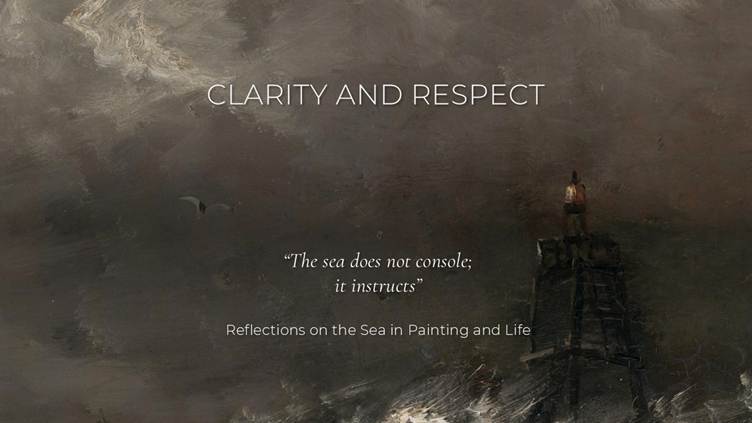
There is something endlessly fascinating about the sea. For a maritime people like the Dutch, it has never been merely a landscape. It is memory, livelihood, danger, and horizon at once. Across the centuries painters have tried to capture this shifting presence — from the proud fleets of the Golden Age to the sombre fishing beaches of the nineteenth century. Yet the sea resists explanation. It must be encountered rather than described.
In the Dutch Golden Age, when the Republic lived by trade and navigation, marine painting flourished as a natural expression of national life. Artists such as Hendrik Vroom, Adam Willaerts, and Cornelis Claesz van Wieringen depicted ships returning from distant waters, naval encounters, and the daily labour of fishermen. Their works portrayed movement and ambition, but also uncertainty. While Rembrandt and Vermeer explored interior worlds, maritime painters like Ludolf Bakhuizen, Willem van de Velde the Younger, and Jan van de Cappelle turned toward the open horizon, where prosperity and risk were inseparable.
The maritime imagination of the Netherlands was also shaped by episodes of extreme exploration. The expeditions to Novaya Zemlya, led at the end of the sixteenth century by Willem Barentsz, became enduring symbols of endurance and ingenuity. Overwintering in Arctic ice represented more than discovery; it was a confrontation with nature at its most unforgiving. This memory continued to shape how the sea was perceived — not merely as a route to wealth, but as a force that demanded humility.
By the nineteenth century, marine painting underwent a subtle transformation. Painters of the Hague School such as Hendrik Willem Mesdag and Jozef Israëls drew inspiration increasingly from fishing villages along the North Sea coast. In Scheveningen and Katwijk the sea appeared less as a symbol of national power and more as a condition of existence — at once provider and threat. Boats lay on the sand, men faced uncertain weather, and families waited on the shore. Heavy skies and muted tones conveyed endurance rather than triumph.
In the final decades of the nineteenth century new artistic influences emerged. The naturalism of the French Barbizon School encouraged broader attention to landscape and atmosphere. Painters such as Louis Apol, fascinated by winter light and northern stillness, extended this tradition into images of snow and ice. In these works water appeared not as restless sea but as frozen silence — another reminder of scale and vulnerability.
Much has been said about the sea in history and painting, yet its fascination remains inexhaustible. The sea, both beautiful and powerful, both generous and destructive, resembles a painting we never fully understand. One can hold a daily conversation with the Panorama Mesdag and still discover something new. Changing light alters perception; the illusion of depth shifts; the horizon deceives. It captures the reality of living beside the sea — not conquest, but coexistence.
For centuries there has been a tendency to believe that we control the sea, just as earlier generations believed they stood at the centre of the universe. Yet the sea teaches humility. It follows its own rhythms of ebb and flow, cycles so fundamental that entire ecosystems have formed within them. History has repeatedly shown that we cannot negotiate with such forces.
For my generation the sea was rarely romantic. The night of North Sea flood of 1953 ended any lingering illusion of mastery. Water crossed the fragile boundary between land and sea and left destruction in its wake. Since then the North Sea has never appeared merely as horizon or livelihood, but also as warning — a reminder that coexistence with nature is never final, only managed.
This duality lies at the heart of Mesdag’s vision. His work is never sentimental. The North Sea appears brutal, forceful, indifferent. It gives livelihood, yet it can take it back without reservation. In De Vuurtoren the lighthouse stands as a fragile human assertion against wind and water.
My own understanding of water began long before I reflected on it in art. As a boy sailing a Flying Dutchman, I learned that wind and balance leave little room for illusion. Skill may guide a course; respect determines survival.
Many years later, living in Kilchberg near Zürich, I experienced another lesson. From the comfort of an apartment overlooking the lake, the water often appeared calm and ordered. Yet there were evenings when the sky darkened within minutes and the lake turned almost black, revealing how quickly tranquillity can yield to elemental force.
These memories returned whenever I stood before the winter North Sea. There, kindness is rarely offered. The horizon becomes iron-grey, the wind insistent, the waves indifferent. Yet in this austerity clarity emerges. The sea does not console; it instructs. It places human ambition within a wider frame.
In the end the sea remains beyond possession — in history, in painting, and in memory. It reminds us how small our certainties can be. What remains, after wind and wave have passed, is clarity — and with it, respect.
William J J Houtzager, Aka, WJJH, APRIL 2026
📜 Excerpt
For centuries the Dutch have painted the sea as horizon, livelihood, and warning. Yet the sea resists mastery. Standing before a winter shore, one understands that clarity often arrives not through comfort, but through confrontation with forces larger than ourselves.

