Four Books That Shaped My Thinking
✍️ Author’s Note
This reflection grew from a simple question: which books truly leave a mark? Not the many volumes we pass through in a lifetime, but the few that remain—quietly shaping our thinking long after their pages have closed.
Choosing only four is, of course, an injustice to the many books that have offered companionship, wisdom, or consolation along the way. Yet a handful always stand apart. They cease to be objects on a shelf and become part of one’s inner furniture.
For me, these four books represent different kinds of guidance: conscience, dignity, perspective, and humility. Together, they form a quiet compass—one shaped not by certainty, but by memory and reflection.
Introduction
There are books one reads and forgets, and there are books that quietly remain. And then there are books that seem to grow legs—borrowed by good friends and never returned.
Yet books rarely impose themselves. They return later in life, sometimes unexpectedly, as a sentence, an image, or a question that refuses to fade. They appear in conversation, in memory, or in a quiet moment, and one realizes that they have been present all along, shaping thought in ways not immediately noticed.
Looking back, four such books stand out in my life. They differ in tone and origin, yet together they shaped how I think about society, responsibility, time, and civilization.
Choosing only four is, of course, a small injustice. A lifetime of reading leaves many companions behind. Some books comforted, others provoked, and a few simply entertained. But there are always a handful that settle more deeply. They stop being objects on a shelf and become part of one’s inner furniture.
These four belong to that quiet company.
Max Havelaar — Multatuli
My first encounter with Max Havelaar was not intellectual, but domestic.
My mother owned a first edition. It stood on her writing desk among a few volumes of poetry. Memory is a curious thing: it does not always preserve events, but it preserves atmospheres.
For my mother, Max Havelaar was not primarily a literary achievement, but a moral one. She cared less for its style than for its message. The book exposed the exploitation that accompanied Dutch colonial rule, particularly in Indonesia.
We read parts of it at school, though often without the full context. It is easier to admire a national past than to confront the suffering that accompanied it. Only later, after visiting places like Fort Amsterdam in Ghana, did the realities of colonialism become more tangible to me. History, when seen up close, is rarely heroic. It is complex, and often uncomfortable.
Max Havelaar taught me that prosperity is not always innocent. It raised questions about responsibility—about what we owe to others, and about how nations remember, or choose not to remember, their past.
A nation’s maturity, one might say, is measured not by the glory it remembers, but by the honesty with which it faces its shadows.
Cicero — On Old Age
If Max Havelaar belongs to the awakening of conscience, Cicero belongs to the acceptance of time.
His short essay on old age is a gem of calm reflection—a book my brother was reading in his final days. It does not deny the losses that come with the years, but it shows that aging can also bring clarity, dignity, and freedom from certain illusions.
What struck me most was the tone. There is no bitterness, no complaint—only a gentle reminder that life moves in seasons, and that each season has its own gifts. Old age, in Cicero’s view, is not merely decline, but a time for reflection, memory, and conversation.
In today’s superficial world—obsessed with youth, speed, and soundbites—Cicero offers the opposite: slowness, reason, judgment, memory, and quiet continuity. It is a book that grows with you. When you are young, it feels distant. When you are older, it feels like a companion that settles the mind.
Will Durant — The Story of Civilization
If Multatuli awakened conscience and Cicero offered wisdom, Will Durant gave me perspective and proportion.
His great historical work—written in a prose rarely found today—opened a different horizon. It was not a single book, but a vast panorama of civilizations, ideas, and struggles across centuries. There are, in truth, many rivers of civilization, and each deserves respect.
In Our Oriental Heritage, Durant reminds us that Western civilization inherited far more than it created alone. Much of what we consider “Western” thought was shaped by earlier cultures in Asia, the Middle East, and beyond. Reading Durant felt like stepping onto a high hill and looking out over the long road of human history.
What struck me most was not the detail, but the continuity. Civilizations rise and fall, but certain questions remain constant: how to live together, how to govern, how to balance freedom and order, how to preserve culture in times of change.
Durant did not write as a cynic. He wrote as someone who believed that despite war, folly, and decline, humanity also carries forward wisdom, art, and memory. His work gave me a sense of proportion: our time is not the first to feel uncertain, and it will not be the last.
Voltaire — Micromégas
If Multatuli awakened conscience, Cicero offered wisdom, and Durant gave perspective, Voltaire taught humility.
In Micromégas, a playful yet sharp philosophical satire, giants from other worlds visit Earth and discover how small—both physically and intellectually—human beings really are.
Through humor, Voltaire exposes human vanity, dogmatism, and the absurd certainty with which we defend our opinions. It is a lesson in humility, and perhaps also in tolerance.
The story suggests that our quarrels and convictions may look very different when seen from a wider perspective. What we consider absolute truths may turn out to be local habits of thought.
A Quiet Compass
These four books differ greatly: a colonial indictment, a Roman meditation on old age, a vast history of civilizations, and a playful philosophical satire. Yet together they form a quiet compass that has guided my thinking.
Max Havelaar taught conscience.
Cicero taught dignity.
Durant taught the long view of civilization.
Voltaire taught humility.
Durant once suggested that there are many rivers of civilization. Each flows through its own landscape, shaped by its own traditions, beliefs, and struggles. Yet in the end, all rivers move toward the same sea. Human civilizations, for all their differences, are carried by similar questions: how to live, how to govern, how to remember, and how to endure.
Of course, it is a small injustice to choose only four books. I have loved many others. Some of Voltaire’s companions—Candide, Zadig, The Ingénu, The White Bull—belong to the same family of ironic wisdom. There are books like Kennedy’s Profiles in Courage, and others still, that have quietly taken up residence in the mind.
But it is true that some books settle in more deeply than others. They stop being objects on a shelf and become part of one’s inner furniture.
Last night, with a small glass of whiskey in hand, I found myself looking back to the writing desk of my childhood. Memory is a curious companion: it does not always come when summoned, but sometimes appears when one is not looking for it.
Next to Max Havelaar stood another book: Camera Obscura, the gentle collection of sketches by Hildebrand, the pseudonym of Nicolaas Beets. And on the other side of the desk lay two Bibles. My mother occasionally opened them, though her curiosity reached far beyond the church walls. She was interested in the cosmos, in science, and in the larger questions of existence.
One of the Bibles was leather-bound; the other had belonged to her older sister, who died far too young, at the age of thirty-two. Like my mother, she had been a gifted pianist and violist. The book remained, quietly, as memory often does—without words, but not without meaning.
Those Bibles belonged to the Dutch Reformed tradition, rooted in the long history of the Republic. My father, by contrast, was Catholic. As a boy he had sung in the choir, though in later life the faith seemed more a duty inherited from his parents than a conviction of his own.
I sometimes think that my mother’s faith was shaken by the loss of her sister, while my father’s simply faded with time. Perhaps that difference also shaped their characters: my mother more cautious, especially with money; my father more easy-going in that respect.
These are not things one thinks about when young. But memory, like a book, returns when it chooses.
None of the four books offered easy answers. Yet each, in its own way, reminded me that life is not about certainty or triumph, but about respect, understanding, restraint, and perspective.
In the end, the past does not ask for pride or shame alone.
It asks for memory—and the humility to learn from it.
Perhaps that is all one can ask of a book: not that it entertains us for a season, but that it stays with us for a lifetime—and, when the time comes, is handed over to a new caretaker who will offer it a warm home.
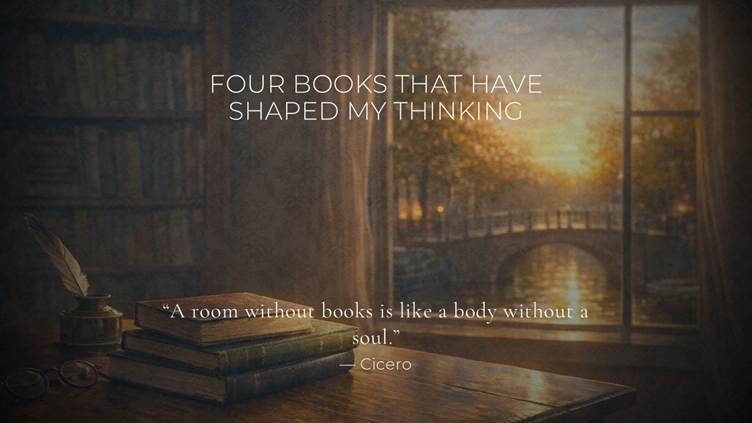
“A room without books is like a body without a soul.”
— Cicero
William J J Houtzaher, Aka WJJH, April, 2026
📌Blog Excerpt
There are books one reads and forgets, and there are books that quietly remain. And then there are books that seem to grow legs—borrowed by good friends and never returned.
Yet the most important books rarely impose themselves. They return later in life as a sentence, an image, or a question that refuses to fade. Looking back, four such books stand out in my life. They differ in tone and origin, yet together they shaped how I think about responsibility, time, civilization, and humility.

