Marco Rubio and the Rules of the Jungle
✍️ Author’s Note
The International Criminal Court is imperfect, dependent upon state cooperation and vulnerable to political pressure. Yet its existence affirms an essential principle: the gravest crimes must not become lawful merely because they are committed by the powerful.
This essay reflects on Marco Rubio’s declared campaign to dismantle the Court, the selective use of international justice, and the particular responsibility of the Netherlands as host country.
—WJJH
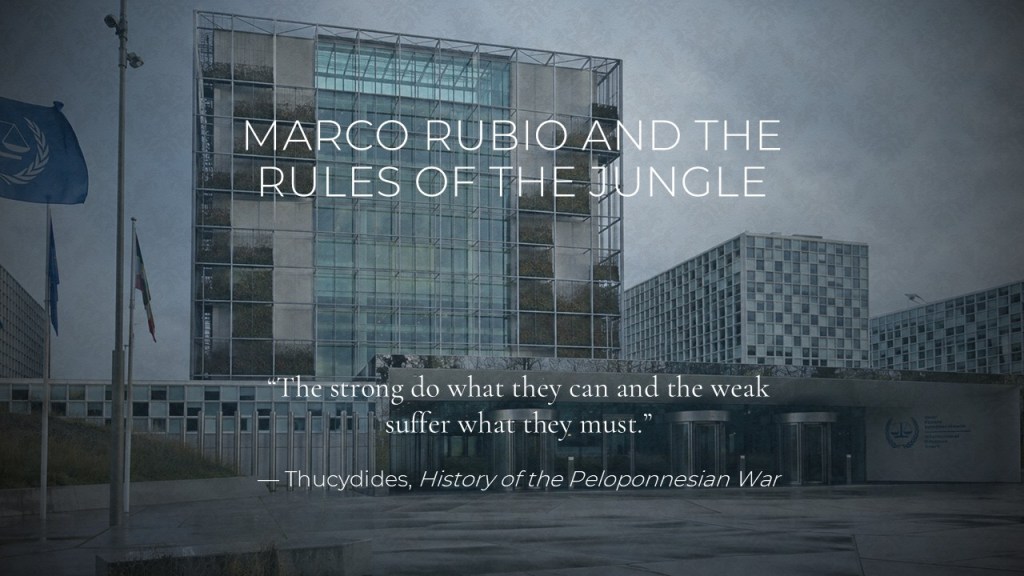
I have written before about the International Criminal Court in The Hague as humanity’s fragile conscience—imperfect, often ignored and frequently attacked, yet still essential. Justice must remain universal, or it eventually ceases to be justice at all.
The latest assault on the Court marks a further escalation. Donald Trump’s secretary of state, Marco Rubio, is no longer merely criticising individual decisions or sanctioning members of the Court. He is making the case for dismantling the institution itself.
Writing in The Wall Street Journal, Rubio accused the “ICC and its friends” of waging war against the United States—not with bullets or missiles, but with statutes, treaties and what he dismissively called “so-called international law.” His conclusion was explicit: the United States would, if necessary, dismantle the Hague-based Court “brick by brick.”
This forms part of the Trump administration’s wider campaign against multilateralism. The United States has withdrawn from international arrangements it dislikes, disrupted institutions it cannot control and placed pressure on other countries to adopt its preferences.
The campaign against the ICC goes further. It is not simply an attempt to withdraw cooperation from an institution. It is an effort to make an existing international court unable to function.
The Trump administration has already imposed sanctions on the Court’s chief prosecutor and several judges, including financial restrictions and travel bans. ICC employees affected by such measures have reportedly had credit cards blocked and encountered serious interference in their daily lives.
Washington is now seeking to pressure governments that continue to support the Court. Countries may face visa restrictions, economic penalties and consequences for the foreign assistance they receive if they refuse to distance themselves from the ICC.
The contradiction is striking. The United States claims to be defending its independence while threatening other states for honouring a treaty they freely ratified. What is presented as a defence of sovereignty is, in practice, an attempt to override the sovereign choices of others.
This is not merely a disagreement about jurisdiction. It is a coercive attempt to prevent the Court from functioning.
Sovereignty or Immunity?
Rubio’s argument draws upon a longstanding American nationalist suspicion of international institutions. From the Senate’s rejection of the League of Nations onward, treaties and international organisations have frequently been portrayed as threats to American constitutional independence.
Not every such concern has been without foundation. But the recurring conclusion is revealing: international institutions are acceptable when they advance American purposes, yet become illegitimate when they might restrain American power.
One is therefore left with the impression that the effort to dismantle the ICC is intended partly to insulate American political leaders and service members from possible accountability for crimes committed beyond the territory of the United States—in countries that have accepted the jurisdiction of the Court, but where Washington has used, or may seek to use, military force.
The ICC is a court of last resort. National authorities retain the primary responsibility to investigate and prosecute genocide, crimes against humanity and war crimes. The Court becomes involved when a state with jurisdiction is unwilling or unable genuinely to do so.
Its reach is not unlimited. It cannot abolish American sovereignty or prosecute conduct within the United States merely because it wishes to. But when alleged crimes are committed on the territory of a state that has accepted the Court’s jurisdiction, nationality alone does not necessarily provide immunity.
For a country with a global military presence and hundreds of installations abroad, that creates a vulnerability which rhetoric about sovereignty cannot entirely remove. American forces frequently operate in countries that have joined the Court.
The practical fear is therefore not the death of the United States as a sovereign and independent nation. It is the possibility that international law might limit the freedom of American leaders to conduct military operations without external legal scrutiny.
What Rubio is defending is not sovereignty in any consistent sense. He is asserting immunity: the idea that American officials and their allies must remain beyond the reach of international law, even when their actions take place in countries that have accepted the Court’s authority.
Sovereignty, in this argument, belongs fully to the United States but only conditionally to everybody else.
Justice at a Safe Distance
There is a longer and less honourable history behind this.
During the Court’s early years, when its defendants were overwhelmingly African—rebels, militia leaders and politicians from states with little power to retaliate—Washington could afford to speak approvingly of international justice and even assist particular prosecutions.
Some of those cases were referred by African governments themselves, and others by the United Nations Security Council. Even so, the political convenience was unmistakable. International justice appeared least threatening when it operated far from the centres of Western power.
Justice exercised against the weak demonstrated moral seriousness at little political cost.
Previous American administrations also supported international accountability when it was directed towards adversaries. The Biden administration assisted the pursuit of evidence concerning alleged Russian crimes in Ukraine while opposing the Court when it issued warrants concerning Israeli leaders.
The pattern is therefore older than Trump. What Rubio has added is greater candour and a more destructive ambition.
When the same legal principles move closer to the United States or its protected allies, international justice is recast as foreign interference, an attack on sovereignty and even an act of war.
The objection is not principally that the Court is politicised or that its jurisdiction is too broad. It is that rules applied to Africans, Russians and other adversaries might also be applied to Americans, Israelis or others protected by American power.
This is the old hierarchy of international law laid bare: accountability for the weak, discretion for the powerful and immunity for those powerful enough to enforce it.
The Dutch Dimension
There is also a distinctly Dutch dimension to this argument.
The Netherlands is not merely another country expressing concern. Article 90 of the Dutch Constitution instructs the government to promote the development of the international legal order. As host country of the ICC, it has a particular responsibility to ensure that the Court, its judges, prosecutors and staff can carry out their work safely and without obstruction.
Yet the official Dutch response has remained strikingly cautious.
After Rubio announced his intention to dismantle the Court “brick by brick,” the Ministry of Foreign Affairs expressed concern about the hardening of the American tone and added that the Netherlands, as host country and treaty party, supported the Court and its personnel.
That left the essential question unanswered: what will the Netherlands actually do?
The contrast with other European responses was notable. The European Commission described Rubio’s threats as unacceptable. Germany’s foreign minister spoke explicitly of the need to defend and protect the Court as an independent institution.
The Dutch response appeared pale by comparison.
This caution is no longer an abstract diplomatic matter. Employees of the Court have already experienced the practical consequences of American sanctions. Critics have argued that the Netherlands has a positive obligation to protect people who are intimidated or obstructed because of their work for an institution based on Dutch soil.
Former chief prosecutor Fatou Bensouda has also said that she saw no evidence that the Netherlands acted upon her complaint concerning intimidation by the Mossad while she was investigating alleged crimes in the occupied Palestinian territories.
The question is therefore no longer merely whether the Netherlands supports the Court in principle. It is what the government is prepared to do when its obligations as host state collide with economic, energy and strategic interests.
Recent reporting about the Dutch missions in Afghanistan adds an uncomfortable domestic context.
Dutch intelligence officers prepared 28 Special Reports containing information about possible violations of international humanitarian law by allied forces. As far as is known, the reports were not investigated or transmitted to the countries concerned at the time. The Ministry of Defence says it does not know what happened to them.
One of those reports was prepared in Uruzgan in 2010. It recorded an allegation from a source considered reliable that Australian special forces had tortured and killed an Afghan man whom Dutch forces had earlier detained, questioned and released.
The allegation has not been proved, and Defence now disputes that torture and execution took place. But the institutional question remains: why was a serious report not secured, examined and transmitted to the authorities capable of investigating it while the evidence was still fresh?
For years, the Ministry could not produce the report. After an extensive search had been abandoned, it was eventually recovered in 2024 from an incorrectly archived data carrier containing hundreds of Special Reports.
The soldiers reported. The institution forgot.
That is precisely why an independent international court remains necessary. National institutions may fail not because they lack legal authority, but because allegations concern allies, military operations or decisions protected by state power—and because justice becomes politically inconvenient.
The Dutch example should not distract from the central issue. It sharpens it.
The host country of the International Criminal Court should not whisper its unease in diplomatic corridors while the world’s most powerful state publicly promises to dismantle the Court stone by stone.
It should state clearly that intimidation of judges, prosecutors, staff and cooperating organisations is unacceptable; that attempts to coerce states into abandoning the Rome Statute will be resisted; and that the Netherlands will fulfil both its constitutional responsibility and its obligations as host country.
Power Recognising Power
The ICC is not beyond criticism. No institution should be. Its record is uneven, its reach limited and its dependence upon state cooperation an enduring weakness.
Those shortcomings are arguments for strengthening international justice, not for destroying the institution whenever its attention becomes politically inconvenient.
According to reporting by the Financial Times, Donald Trump proposed to Xi Jinping that the United States, China and Russia should cooperate against the International Criminal Court.
There is no public evidence that Beijing or Moscow accepted the proposal or that a formal three-power campaign exists. That distinction must be respected.
Yet the proposal itself is revealing.
It imagines three of the most powerful military states outside the Rome Statute finding common cause against the one permanent international court established to hold individuals accountable for the gravest international crimes.
Their political systems, strategic interests and public ideologies differ profoundly. But when external accountability approaches, those differences become less important.
This is power recognising power across every ideological line that supposedly separates it: an understanding that international law may be useful against adversaries but must never be allowed to restrain the great powers themselves.
That is more than poor diplomacy. It is a description of the international order being proposed—great powers reserving the right to judge others while recognising one another’s claim to remain beyond judgment.
Rubio’s campaign exposes the real issue. International law is welcome when it disciplines adversaries and weaker states. It becomes “so-called international law” when it threatens to restrain the powerful themselves.
At a moment when the United States is helping to dismantle the international legal order it once claimed to defend, expressions of concern are no longer enough.
We are moving away from the imperfect rule of law and back towards the oldest rule of all: that the powerful may do as they please, while the weak endure what they must.
That is not international order.
It is the rule of the jungle.
“Wherever law ends, tyranny begins.”
— John Locke, Two Treatises of Government
Netherlands, July 2026
📌Blog Excerpt
Marco Rubio’s campaign against the International Criminal Court exposes an old hierarchy: justice for adversaries, discretion for allies and immunity for the powerful. As Washington promises to dismantle the Court “brick by brick,” the Netherlands must decide what its responsibilities as host country mean in practice.


LikeLiked by 1 person
Met dank voor de reacties. Over Davos gesproken, het navolgende is mogelijk van interesse, https://wjjh.blog/2026/06/12/the-mirror-and-the-compass/
LikeLike