War, Sustainability, and the Limits of Solidarity
✍️Author’s Note
This short reflection considers war not only as a human and political catastrophe, but also as a test of our moral consistency. We speak often of sustainability, solidarity, and shared responsibility, yet conflict reveals how quickly such principles are subordinated to fear, power, and self-interest. The piece asks whether war exposes not only the fragility of sustainable ambitions, but also the narrowness of our concern for others.
—WJJH
“The death of human empathy is one of the earliest and most telling signs of a culture about to fall into barbarism.”
—Hannah Arendt
War exposes many things. It destroys lives, cities, and certainties. But it also reveals something less visible and perhaps more unsettling: how shallow our commitment to sustainability often is, and how limited our solidarity remains when suffering takes place elsewhere.
We speak readily of climate goals, sustainable development, shared responsibility, and care for future generations. Yet the moment war erupts, these principles are pushed aside with remarkable ease. Power, fear, revenge, security, and strategic interest return to the foreground, and what was presented as a universal concern quickly becomes secondary. Sustainability, it turns out, is often a luxury of peace.
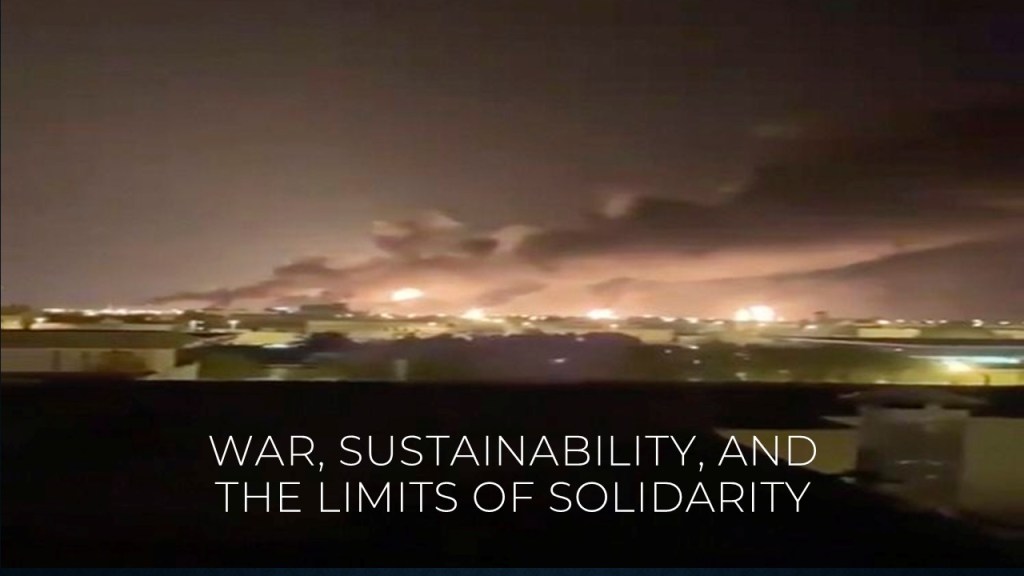
This is visible in Palestine, where war has meant not only death and displacement, but also the destruction of land, water systems, agriculture, housing, and basic infrastructure. The environmental consequences will outlast the bombardments themselves. In the wider confrontation involving Iran, the effects are different but no less real: rising energy prices, disrupted supply chains, inflation, renewed economic insecurity, and greater strain on societies already under pressure.
Yet even this does not reach the heart of the matter. The deeper issue is what war reveals about us. We tend to care most when the consequences reach our own doorstep: when fuel becomes more expensive, when food prices rise, when markets tremble, when migration increases, when comfort is disturbed. What affects others may be called tragic; what affects us becomes urgent. That is the hierarchy we prefer not to name.
Governments respond accordingly. They secure supplies, protect markets, recalculate alliances, and postpone longer-term ambitions. Businesses adapt. Citizens worry about costs and stability. In such moments, sustainability is not abandoned because it has been disproved, but because it was never as deeply rooted as we preferred to believe. It remains subordinate to immediate necessity, and often to immediate self-interest.
At most, war may force a reconsideration of dangerous dependencies. States may speak more seriously about energy diversification, resilience, or reducing reliance on unstable regions. But that is not sustainable progress in any noble sense. It is adaptation under pressure. The lesson, if it is learned at all, comes late and without innocence.
The conclusion is therefore not an optimistic one. War does not create sustainability. It reveals how little sustainability we had to begin with. More than that, it exposes how narrow our moral horizon often remains. We are moved most deeply when our own lives are touched. Until then, humanity speaks in general terms and carries on.
War does not create sustainability; it exposes how little sustainability — and how little solidarity — we possessed to begin with.
April 2026
📌Blog Excerpt
War is rarely discussed in terms of sustainability, yet its consequences are profoundly unsustainable. It destroys lives, land, water systems, infrastructure, and economic stability, while also exposing how limited our solidarity often remains when suffering happens elsewhere. What affects others may be called tragic; what affects us becomes urgent.


LikeLiked by 1 person