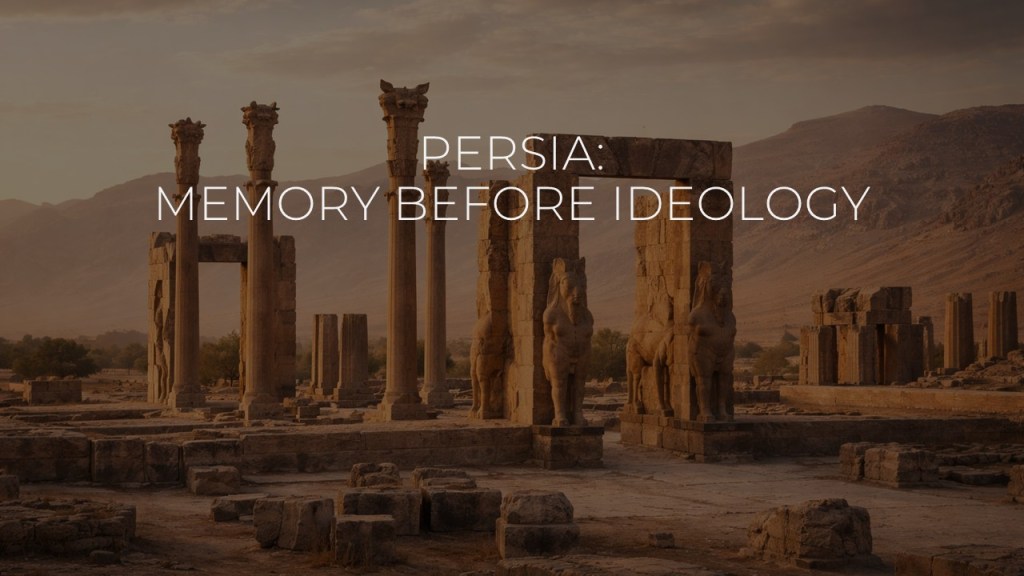
Persia: Memory Before Ideology
Empire, language, and the long memory of a civilization
✍️Writer’s Note
This essay is the first part of a two-part reflection on Persia and Iran. It does not begin with the crises of the present, but with a longer civilizational memory: empire, language, religion, and poetry. Too often Iran is viewed only through ideology, strategy, or fear. Yet beneath these modern lenses lies a far older continuity, one shaped across millennia and preserved not only through power, but through memory itself.
—WJJH
“History is the memory of time.”
—Emile Cioran
I. Seeing Iran through the fog of the present
Iran is often spoken of as though it began with the quarrels of our own time. In the Western imagination it appears chiefly as a regime, a nuclear file, a regional danger, a destabilizing force, or a problem to be contained. Yet long before it became an object of contemporary anxiety, it was already one of the world’s great civilizational landscapes: a land of empire, memory, language, and poetry, shaped across millennia. History teaches another lesson too: civilizations endure because they outlive the states that claim to embody them. Regimes rise, harden, and pass away; deeper continuities remain. Iran, in that sense, belongs to the long duration of history, not merely to the anxieties of the present. The Iranian lands preserve cultural continuities stretching from prehistory and ancient Iran into the Islamic and modern periods.
II. Persia and Iran: the problem of naming
Even the names reveal something of this divide in perception. For centuries the West spoke of Persia, a name inherited through the Greeks from Parsa, while the people of the land preserved older forms of self-identification that would, over time, find expression in the name Iran. The difference is more than linguistic. It reminds us that countries are not only what outsiders name them, fear in them, or project onto them. They are also what they remember themselves to be.
III. Cyrus and the first great memory of order
The early political grandeur of Iranian civilization emerged first through the Medes and then, more decisively, in the sixth century BC with the rise of the Achaemenid Empire under Cyrus the Great. When Cyrus entered Babylon in 539 BC, he was aided not only by force of arms but by the disaffection that Nabonidus had created among important elements of Babylonian society, including the priesthood of Marduk. For roughly two centuries, Persian rule combined expansion with a relative tolerance in imperial administration, and with the idea that power could govern diversity rather than merely crush it.
IV Conquest without disappearance
Yet the story of Iran did not end with the grandeur of the Achaemenids. Alexander shattered the old Persian imperial order and opened a Hellenistic age, but Iran was not dissolved into someone else’s civilization. The Seleucid layer proved temporary, and Iranian power re-emerged under the Parthians and, more fully, the Sasanians. Centuries later, the Mongol invasions brought devastation of a different order, destroying cities and overturning established structures of rule. Yet even this catastrophe did not erase Iran’s deeper continuity. Within generations, the Mongol rulers of Iran had themselves entered an Iranian world of administration, literature, and courtly culture. What endured through these upheavals was not political continuity, but civilizational continuity.
The same pattern appears in religion. Zoroastrianism stood near the centre of Iranian life in late antiquity, especially under the Sasanians, before the Arab conquest opened a long passage into the world of Islam. That transformation was profound, yet gradual. Iran became Islamic without becoming unrecognizable to itself. Over the centuries it gave Islam a distinctly Persian imprint, and under the Safavids that evolution took a decisive political form when Twelver Shiʿism became the state religion.
Thus Iranian history is best understood not as a series of replacements, but as a layered continuity in which conquest altered much, yet never erased the deeper civilization. The names of its faiths changed, the languages of power shifted, dynasties rose and fell, yet the deeper continuity remained: Iran was conquered, transformed, and reconstituted, but never wholly remade from outside.
V. Language as vessel of continuity
The Iranian languages, belonging to the Indo-Iranian branch of the Indo-European family, helped shape a world of shared memory across the peoples of the region. Persian above all became the enduring language of literature, reflection, and cultural continuity, surviving conquest, dynastic change, and religious transformation. Arabic and Turkic influences added further richness to this world, but it was Persian that remained the principal vessel of historical and literary self-understanding. The Shahnameh and the Golestan are still read, and poets such as Ferdowsi and Saadi continue to occupy an honoured place in the cultural memory of Iran. Persian is not only Iran’s heritage, but part of the wider legacy of the Persianate world, where it gave enduring form to literary imagination, moral reflection, and the language of feeling.
Iranian civilization endured not only because it survived conquest, but because it continued to create. In different periods it shaped literature, courtly culture, learning, and forms of political and ethical reflection far beyond its own borders. Persian was not only a language of memory, but also a language of civilizational expression.
VI. Ferdowsi, epic, and the memory of Iran
Few works in world literature rival the Shahnameh in scope, ambition, and enduring cultural force. Composed by Abū al-Qāsim Ferdowsi around the turn of the first millennium, it gathers into verse a vast semi-mythical, semi-historical account of Iran’s kings, heroes, and dynasties. But the poem stands at the end of a much older stream of memory. It drew on Sasanian-era chronicles, Middle Persian traditions, Zoroastrian cosmological material, and a rich inheritance of oral heroic lore. In shaping these materials into a national epic, Ferdowsi did not simply recount Iran’s past; he gave poetic permanence to a civilization’s memory of itself.
VII. Poetry as homeland
Persian literature is shaped by figures such as Ferdowsi, Hafez, Saadi, Rumi, and Attar, each of whom gave voice, in a distinctive register, to ethical reflection, mystical longing, and the full range of human experience. In Iranian culture, poetry is far more than a mirror of emotion. It is also a language of thought and a repository of collective memory. The verse of Hafez and Saadi explored the subtleties of feeling, moral insight, and worldly wisdom, while Rumi’s Masnavi opened an inward path toward the soul, imagination, and the unseen dimensions of human life. Persian literature remains one of the great literary traditions of the world.
VIII. Memory before ideology
Before the modern languages of nationalism, Islamism, or geopolitics, there was already Iran: a civilization sustained not only by power, but by memory, language, poetry, and faith. Its deepest continuity lies there, in what endured before ideology and will likely outlast it.
IX. Conclusion
To approach Iran only through ideology is to arrive too late. Before the slogans, before the strategic files, before the modern vocabulary of power, there was already a long civilizational memory carried by empire, religion, language, and verse. That memory did not prevent change, nor did it spare Iran from conquest or rupture. But it gave continuity to what might otherwise have been lost. In that sense, Iran endures not only as a state, but as one of history’s great acts of remembrance.
September, 2026
📌Blog Excerpt
Iran is often spoken of as though it began with the quarrels of our own time. Yet long before it became an object of contemporary anxiety, it was already one of the world’s great civilizational landscapes: a land of empire, memory, language, and poetry. To approach Iran only through ideology is to arrive too late.

